
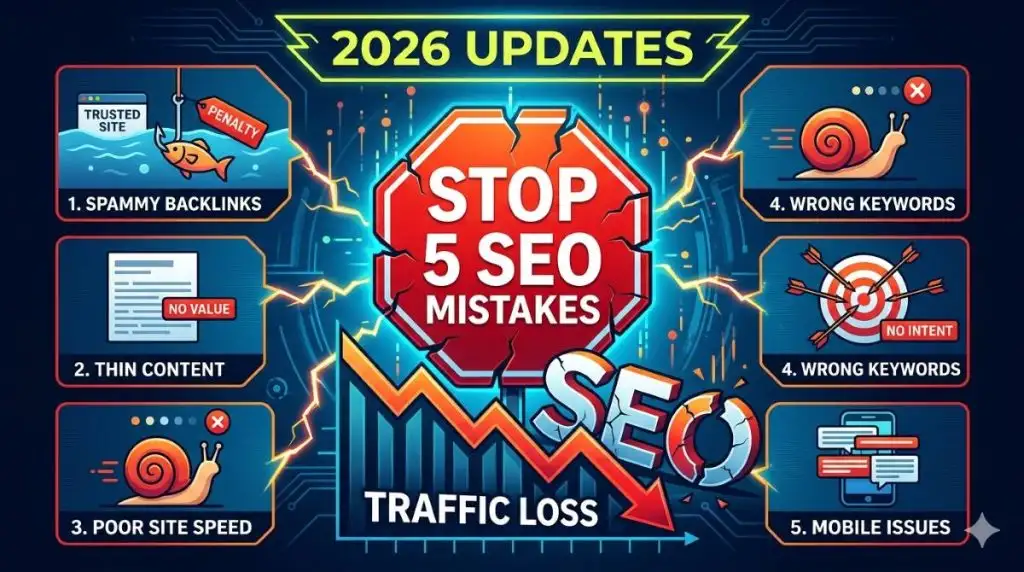
Don’t let 5 SEO mistakes kill your site traffic in 2026. Follow our updated guide to find, fix, and prevent errors that hold your rankings back. Click here!
Introduction: Stop 5 SEO Mistakes Before They Kill Traffic
In the rapidly shifting digital landscape of 2026, SEO has evolved far beyond the primitive era of “tricking” an algorithm or stuffing keywords into a webpage. Today, search engines have transitioned into highly sophisticated, AI-driven entities that prioritize a frictionless, high-authority user experience above all else. With the full implementation of Google’s “Human-Centric” updates, the margin for error has narrowed significantly. What were once considered minor technical oversights or lazy strategic habits can now lead to catastrophic, near-instantaneous traffic losses that are difficult to recover from.
As a website owner or digital marketer, staying ahead of the curve requires a proactive approach to site health and content integrity. The search landscape is no longer just about being found; it is about being trusted. If you want to protect your hard-earned rankings and ensure your domain maintains its competitive edge, you must identify and rectify the fundamental flaws currently sabotaging your growth. Addressing these 5 SEO Mistakes is no longer optional—it is a mechanical necessity for survival in a world where AI determines visibility. Failure to pivot now could lead to a permanent decline in your site’s authority, leaving your brand invisible in an increasingly crowded and automated digital marketplace.
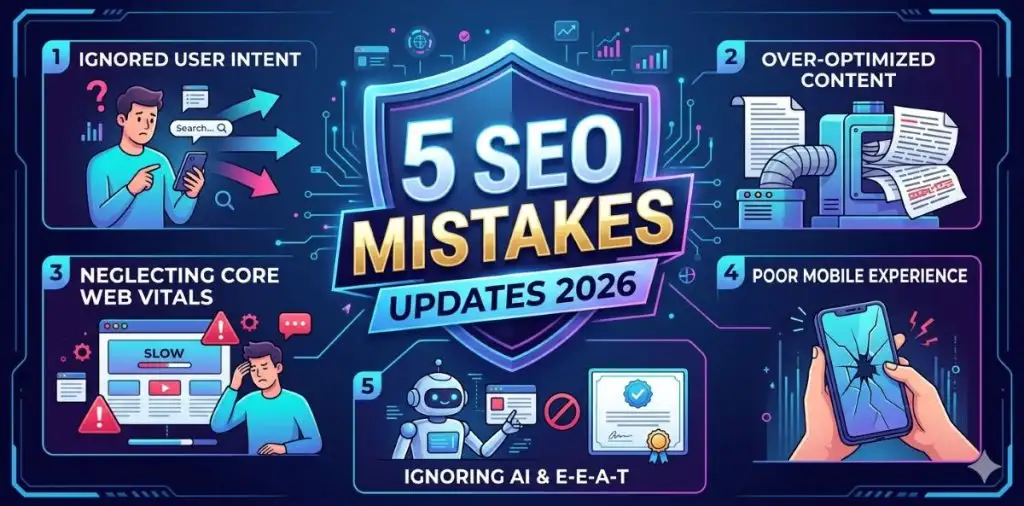
5 SEO Mistakes | Updates 2026
In the fast-evolving digital climate of 2026, the most critical 5 SEO Mistakes revolve around ignoring “Interaction to Next Paint” (INP) and relying on unedited AI content. Google’s latest “Human-Centric” updates have shifted the focus from simple keyword density to actual information gain. Websites that fail to optimize for mobile-first interactivity or those that neglect content decay find their rankings plummeting overnight. If you aren’t auditing your old posts for fresh data and ensuring your site responds to clicks in under 200 milliseconds, you are essentially invisible to modern search crawlers.
To safeguard your traffic, prioritize original authority over mass-produced text. The current algorithm is designed to reward “Experience” and “Expertise,” meaning your personal insights and unique data are now more valuable than any backlink strategy. Stop writing solely for search bots and start solving specific user problems with high-performance, responsive design. By addressing these core technical and strategic errors now, you don’t just protect your existing rankings—you build a resilient digital brand that thrives amidst the AI-driven shifts of 2026.
1. Relying Solely on “Thin” AI Content
In the sophisticated digital ecosystem of 2026, search engines have developed a near-perfect ability to distinguish between generic, mass-produced text and high-value, original insight. Google’s “Information Gain” and “Helpful Content” algorithms are now more aggressive than ever, specifically targeting and devaluing websites that contribute nothing new to the web’s knowledge base.
- The Critical Mistake: Many website owners fall into the trap of using AI tools to pump out hundreds of articles at scale. These “thin” posts typically offer nothing more than a rehashed summary of existing Top-10 search results. This lack of originality creates a redundant experience for users and signals to crawlers that your domain lacks true authority or unique value.
- The Catastrophic Result: The consequences of this strategy are severe. Initially, your pages may move to the “Crawled – currently not indexed” status, meaning they are invisible to users. Over time, your entire site can lose its “Helpful Content” status, causing a site-wide suppression of rankings that is extremely difficult to reverse.
- The Importance of Experience: Google now prioritizes the first “E” in E-E-A-T (Experience) above almost all other signals. If your content lacks the “human touch”—such as personal anecdotes, proprietary data, or unique visual evidence—it is flagged as low-quality. In 2026, being an expert isn’t enough; you must prove you have lived the experience you are writing about.
- The 2026 Fix: To safeguard your rankings, use AI exclusively for research, structuring, and outlining. The actual “meat” of the content must include Original Data and Personal Insights. For a travel blog, this means original photography; for a tech site, it means unique case studies. Always ask yourself: “What am I telling the reader that they can’t find anywhere else?”
2. Neglecting “Interaction to Next Paint” (INP)
In 2026, the technical standards for SEO have shifted from mere loading speeds to active responsiveness. While “Largest Contentful Paint” (LCP) was once the primary metric, Google’s Core Web Vitals have evolved to place a dominant weight on Interaction to Next Paint (INP). This metric measures the time it takes for a page to physically respond to a user’s action, such as clicking a link, tapping a button, or opening a navigation menu.
- The Mechanical Mistake: Many site owners focus exclusively on making a page “look” loaded quickly. However, the mistake lies in having a site that appears ready but feels “frozen” or laggy when a user interacts with it. This usually happens because the browser’s main thread is preoccupied with heavy background tasks or excessive JavaScript, preventing it from processing user inputs immediately.
- The Behavioral Result: From a user’s perspective, a delay in response feels like a broken website. This leads to “rage clicking” or an immediate bounce back to the search results. In the eyes of Google Search Console, a “Poor” INP rating acts as a major red flag. If your site fails this metric, Google will systematically demote your URLs, pushing you off the first page regardless of how good your content is.
- The 2026 Fix: Technical optimization is the only cure. You must audit your site’s JavaScript execution. This involves removing unused scripts, minifying code, and deferring non-essential functions so they don’t block the main thread. Your goal is to ensure that every interactive element on your site responds to a user’s touch or click in under 200 milliseconds.
- Performance as Design: In the current landscape, a responsive site isn’t just about a pretty layout; it is defined by mechanical performance. High-ranking sites in 2026 treat “snappiness” as a core feature. By prioritizing a lightweight code structure and optimizing third-party scripts (like ads or trackers), you create a seamless loop between user intent and site reaction that Google is eager to reward.
3. Ignoring “Branded Search” & Reputation
The 2026 search landscape has undergone what experts call “The Great Inversion.” As traditional, high-volume keywords become oversaturated with AI-generated summaries and massive corporate competitors, the path to sustainable traffic has shifted toward personal brand recognition.
- The Keyword Mistake: Many creators continue to pour all their resources into ranking for generic, high-volume terms like “best SEO tips.” While these are valuable, they are also the most volatile. Relying solely on these means you are fighting a constant, losing battle against AI-integrated search results that answer the user’s query before they even click your link.
- The Dependency Result: By ignoring your own brand name and reputation, you remain at the mercy of every minor algorithm update. If Google changes how it handles a specific topic, and you have no “brand loyalty,” your traffic can vanish overnight. Without a recognized name, you are just another anonymous source in a sea of data.
- The Brand Pond Strategy: The 2026 fix is to build what is known as a “Brand Pond.” This involves encouraging users to search for your site specifically—for example, searching for “Viral Bangladesh SEO tips” instead of just “SEO tips.” When Google sees a high volume of users looking for you by name, it interprets this as a massive signal of authority and trust, which boosts your rankings across all other topics.
- The Reputation Factor: In this era, off-page signals have evolved. Mentions on social media, active discussions in community forums, and reviews on third-party platforms are now weighted as heavily as traditional backlinks. Google’s algorithms are looking for “social proof” that real humans value your brand. If people are talking about you, Google will rank you.
Building a reputation is your ultimate insurance policy. While algorithms change, a loyal audience that seeks out your specific brand remains a constant source of high-converting traffic.
4. Lack of Mobile Content Parity
By 2026, Google has transitioned to a 100% mobile-first indexing environment. This means the desktop version of your website is virtually invisible to search crawlers for ranking purposes. If a piece of information, a link, or a keyword doesn’t exist on your mobile site, it effectively doesn’t exist to Google.
- The Ranking Result: The consequence of this disparity is a total loss of keyword relevance. If your primary keywords or supporting evidence are tucked away in a “desktop-only” sidebar, Google will not associate those terms with your page. This leads to a mysterious drop in rankings even if your desktop site remains perfectly optimized.
- The Design Mistake: To create a “cleaner” aesthetic on smaller screens, many website owners mistakenly hide substantial amounts of text, sidebars, or secondary content on their mobile versions. While this might look better to a casual user, it creates a massive “content gap” where the mobile version is a hollowed-out shadow of the desktop site.
- The 2026 Fix: The 2026 solution is to utilize smart UI elements like accordions, “read more” tabs, or expandable sections. These allow you to keep 100% of your content accessible to crawlers while maintaining a tidy user interface for humans. This ensures that every word of your SEO strategy is indexed without overwhelming the mobile viewer.
Maintaining mobile content parity is no longer a suggestion—it is a technical requirement. Your mobile site should be the definitive, complete version of your digital presence.
5. Failing to Update “Content Decay”
In the fast-paced digital landscape of 2026, the value of information has a shorter shelf life than ever before. For niches such as technology, travel, and news, “Freshness” has evolved from a minor bonus into a primary ranking factor. Google’s algorithms now prioritize real-time accuracy, meaning that even a masterpiece written a few years ago can quickly become a liability if it isn’t maintained.
- The Static Mistake: The most frequent error made by established publishers is treating a blog post like a finished product. Many creators publish a comprehensive guide in 2024 and never touch it again, assuming the “evergreen” nature of the topic will carry it forever. However, in 2026, search engines perceive static content as potentially obsolete or inaccurate, especially if links lead to 404 errors or the data points are outdated.
- The Competitive Result: The immediate consequence of content decay is being “leapfrogged” by newer, smaller competitors. Even if your domain authority is higher, a new site that publishes an “Update 2026” version of your topic with current statistics and working links will steal your position within weeks. Google views this newer content as more helpful to the user, causing your traffic to bleed away to more diligent rivals.
- The Content Audit Fix: The solution for 2026 is to implement a rigorous “Content Audit” every quarter. Instead of constantly chasing new keywords, spend significant time refreshing your top 20% of posts that drive the most traffic. This includes updating old statistics, replacing broken outbound links, and adding a short video summary to increase “dwell time.” A refreshed page signals to Google that the content is being actively managed and is still relevant.
- Signals of Freshness: To maximize the impact of your updates, ensure the changes are visible to both users and bots. Update the “Last Modified” date in your schema, and include the current year in your title tag and meta description. Google loves seeing these indicators of maintenance. By transforming your archive into a living library of information, you ensure that your rankings remain resilient against the passage of time and the influx of new competition.
By consistently fighting content decay, you protect your previous successes while building a foundation of trust with your audience. In 2026, the best way to grow is often to look back and improve what you have already built.
Comparison: Old SEO vs. 2026 SEO
| Feature | Old Way (2022-2024) | The 2026 Way |
| Keywords | Exact match repetition | Semantic clusters & Intent |
| Content | High word count | High “Information Gain” |
| Backlinks | Quantity over quality | Brand mentions & Trust |
| Speed | “Fast enough” | Instant Interaction (INP) |
Frequently Asked Questions: SEO Mistakes in 2026
Q: What is the most common SEO mistake in 2026? A: The biggest mistake is Information Redundancy. With the internet flooded by AI-generated text, Google now prioritizes “Information Gain.” If your content simply rehashes what is already on Page 1 without adding new data, personal experience, or a unique perspective, it likely won’t rank, even if it is technically “perfect.”
Q: How does “Interaction to Next Paint” (INP) affect my ranking? A: INP measures how quickly your site responds when a user clicks a button or interacts with a menu. In 2026, Google views a “frozen” or laggy interface as a failure in user experience. A high INP score can lead to a significant drop in rankings, as Google favors sites that feel “instant” to the touch.
Q: Can I still use AI to write my blog posts? A: Yes, but using unfiltered AI is a major mistake. To avoid penalties, you must use AI as a research assistant rather than a ghostwriter. Every post should be edited by a human to include “Experience” (the first ‘E’ in E-E-A-T), such as personal anecdotes, original photos from your travels, or specific case studies from your business.
Q: Why is my old content losing traffic even though I haven’t changed it? A: This is due to Content Decay. In 2026, freshness is a critical ranking signal for many niches. If your competitors are updating their articles with 2026 data while yours still references 2024, Google will view your content as obsolete. Aim to refresh your top-performing posts every 3 to 6 months.
Q: Does “Mobile-First” still matter if most of my users are on Desktop? A: Absolutely. Google uses the mobile version of your site for indexing and ranking, regardless of where your users come from. A common mistake is “hiding” content on mobile to save space. If it’s hidden on mobile, Google’s bots may ignore that content entirely, hurting your overall keyword profile.
Final Thoughts for Website Owners
The most dangerous of the 5 SEO Mistakes is undoubtedly complacency. In the hyper-competitive digital ecosystem of 2026, the search landscape is moving faster than ever before, leaving stagnant websites in the dust.Today, success is reserved for those who view SEO as a dynamic commitment to quality rather than a checklist of technical hacks. By shifting your primary focus toward User Intent, Technical Speed (specifically INP), and Original Authority, you don’t just survive the relentless cycle of algorithm updates—you thrive because of them. These updates are designed to filter out the noise, meaning every improvement you make to the human experience acts as a magnet for higher rankings.
Key Takeaway: Stop writing for the bots. In 2026, search engine crawlers have been meticulously trained to identify and reward exactly what human readers love: clarity, expertise, and genuine value. When you prioritize the human being behind the screen, you are essentially aligning your brand with Google’s own long-term objectives. Focus on providing real solutions, engaging narratives, and seamless technical performance. If you consistently put the human first, the bots will recognize that value, and the sustainable rankings you seek will naturally follow.