
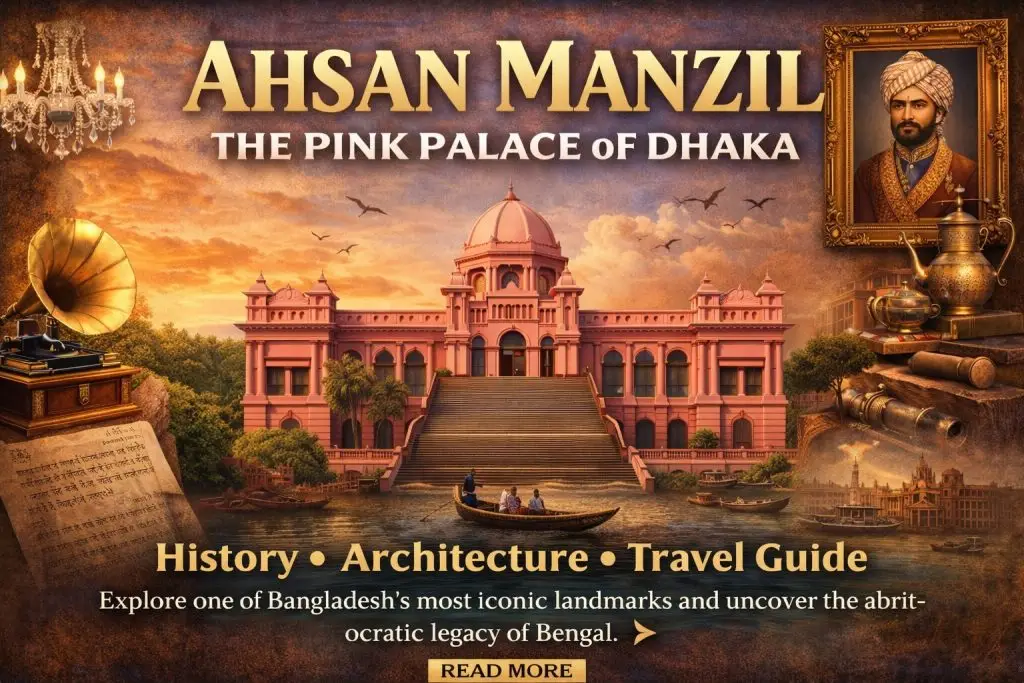
Explore Ahsan Manzil Dhaka Stunning History & Secrets (2026) full history, architecture, museum highlights, opening details, and travel tips. Discover Dhaka’s iconic Pink Palace today.
Few landmarks capture the spirit, heritage, and political history of Bangladesh as beautifully as Ahsan Manzil. Known as the Pink Palace of Dhaka, this architectural masterpiece stands as one of the most iconic historical attractions in the country. Whether you are a history lover, traveler, photographer, or student, Ahsan Manzil offers a fascinating glimpse into the aristocratic past of Bengal.
Located in the heart of Old Dhaka, Ahsan Manzil remains a symbol of cultural pride, colonial-era politics, and stunning Indo-European architecture.
This comprehensive guide explores its full history, architectural beauty, and practical travel tips to help you plan the perfect visit.
📍 Where Is Ahsan Manzil Located?
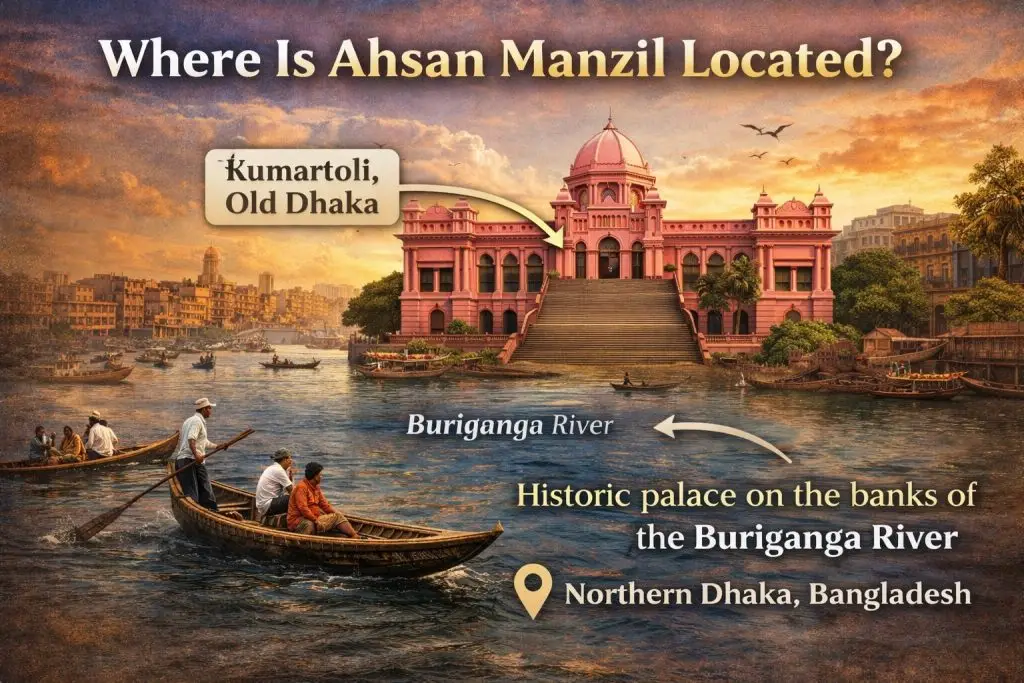
Ahsan Manzil is located in the historic Kumartoli area of Old Dhaka, Bangladesh. The palace stands proudly on the northern bank of the famous Buriganga River, which played a vital role in the city’s development. During the Mughal and British eras, the river served as a major trade and transportation route, connecting Dhaka with other important regions.
The riverside location of Ahsan Manzil was carefully chosen. At that time, riverfront properties were considered highly prestigious and symbolized power and wealth. Its strategic position allowed easy access for merchants, officials, and visitors arriving by boat, highlighting its political and economic significance.
🕰️ Early Origins – Before the Pink Palace
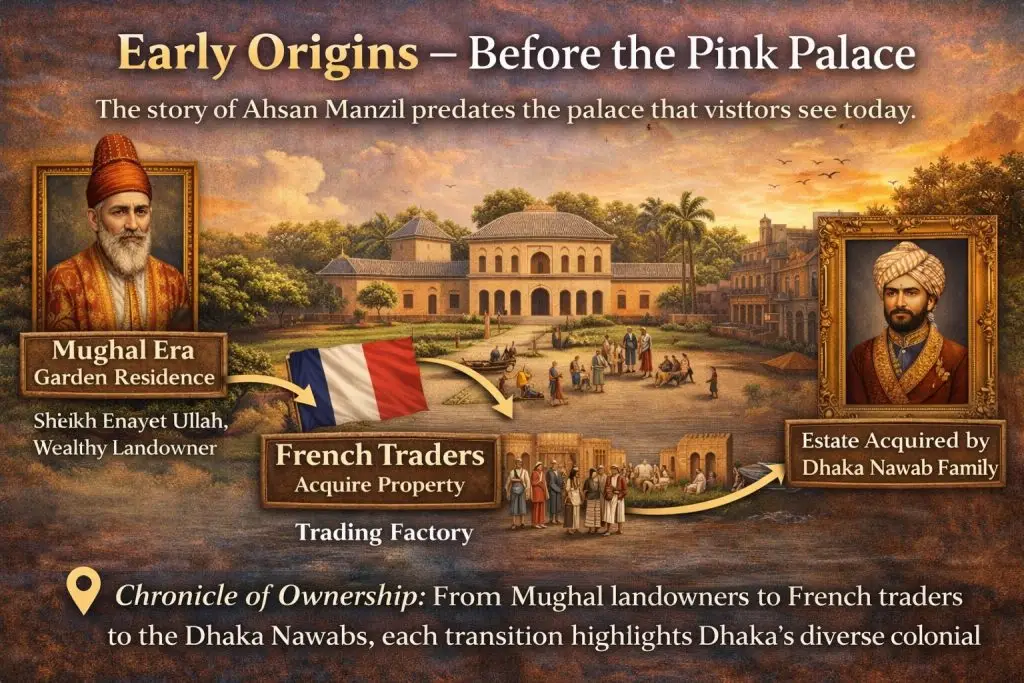
The story of Ahsan Manzil predates the structure visitors see today.
During the Mughal era, the site originally housed a garden residence belonging to Sheikh Enayet Ullah, a wealthy landowner. Later, the French traders of Dhaka acquired the property and used it as a trading factory. After the French departure, the estate passed through multiple hands before eventually becoming part of the Dhaka Nawab family’s possessions.
This layered ownership reflects Dhaka’s multicultural colonial history.
👑 Rise of the Dhaka Nawab Family
Ahsan Manzil rose to prominence under the powerful leadership of Khwaja Abdul Ghani, one of the most influential figures in 19th-century Bengal.

As a respected philanthropist and political leader, he envisioned transforming the estate into a magnificent palace that would reflect the prestige of the Dhaka Nawab family. His goal extended beyond creating a luxurious residence; he aimed to establish a political and cultural center that symbolized authority, leadership, and aristocratic heritage.
Under his direction, Ahsan Manzil became a landmark of power, shaping Dhaka’s social and political landscape.
🏗️ Construction of Ahsan Manzil
The construction of Ahsan Manzil began in the mid-19th century under the supervision of Khwaja Abdul Ghani, who envisioned a grand palace reflecting the power and prestige of the Dhaka Nawab family.
The architectural style combined European neoclassical elements—such as symmetrical design, tall columns, and a prominent central dome—with traditional Mughal influences seen in its arches and decorative detailing. This unique fusion gave the palace its distinctive elegance.
The palace was named after Abdul Ghani’s son, Khwaja Ahsanullah, an educated, forward-thinking leader known for his reformist ideas. Under Ahsanullah’s influence, the palace evolved beyond a royal residence into a center for intellectual dialogue, cultural events, and important political discussions, shaping Dhaka’s social landscape.
🎨 Why Is Ahsan Manzil Pink?
One of the most frequently asked questions by visitors and online readers is: “Why is Ahsan Manzil pink?” The palace’s striking pink façade dates back to the British colonial era, when European architectural trends strongly influenced elite buildings in Bengal. During that period, soft pastel colors—especially pink—were associated with aristocracy, refinement, and social prestige.
The Nawab family chose this distinctive shade to reflect their wealth, elegance, and high status in society. The color also helped the palace stand out along the banks of the Buriganga River, making it instantly recognizable from a distance. Over time, the pink exterior became its defining identity, earning it the famous nickname “Pink Palace of Dhaka.”
Today, the beautifully restored pink façade remains one of the most photographed landmarks in Bangladesh and a favorite attraction for tourists and photographers alike.
🏛️ Architectural Beauty & Design of Ahsan Manzil
Ahsan Manzil stands as one of the finest examples of Indo-Saracenic Revival architecture in Bangladesh, beautifully blending European neoclassical symmetry with Mughal-inspired decorative elements. The palace’s balanced proportions, elegant detailing, and commanding riverside presence make it a masterpiece of 19th-century design.
One of its most striking features is the grand central dome, which rises prominently above the structure and serves as the visual focal point of the building. The wide ceremonial staircase leading up from the front lawn enhances its royal appearance, creating a dramatic entrance once used to welcome distinguished guests and British officials. The façade is lined with symmetrical colonnades and graceful ornamental arches, reflecting both strength and artistic refinement. The expansive river-facing veranda not only provided ventilation and natural light but also offered scenic views of the Buriganga River.
The palace is divided into two main sections. The Rang Mahal (Eastern Side) was designed for formal ceremonies, receptions, and elite gatherings. In contrast, the Andar Mahal (Western Side) served as the private residential quarters for the Nawab family. This architectural separation clearly reflects the aristocratic lifestyle and social customs of the era.
🌊 Natural Disasters & Reconstruction of Ahsan Manzil
The survival story of Ahsan Manzil is both dramatic and inspiring. In 1888, a powerful tornado struck Dhaka, causing severe damage to the palace. Large sections of the structure were destroyed, including parts of the dome, walls, and decorative features. The storm left the grand residence in a vulnerable condition and threatened its architectural beauty.
However, the Nawab family did not abandon their iconic home. Instead, they launched extensive restoration efforts to rebuild the damaged sections. The reconstruction phase not only repaired the destruction but also strengthened the building’s foundation and enhanced its design. Improved structural techniques were used, and additional decorative elements were incorporated to restore its royal charm.
This rebuilding period ultimately made the palace even more magnificent. Today, Ahsan Manzil stands as a symbol of resilience, preserving its historical grandeur despite natural disasters.
🏛️ Political Importance of Ahsan Manzil
Ahsan Manzil was far more than a royal residence; it functioned as a significant political center during the 19th and early 20th centuries. Under the leadership of influential Nawabs such as Khwaja Abdul Ghani, the palace became a meeting place for British officials, regional administrators, and prominent community leaders.
During the British Raj, important gatherings, policy discussions, and diplomatic receptions were frequently hosted within its grand halls. The palace served as a platform where ideas about governance, social reform, and education were debated. Many conversations that shaped Bengal’s administrative direction and Muslim political awareness took place here.
Because of these activities, Ahsan Manzil earned its reputation as a political nerve center of Dhaka. Its walls witnessed crucial moments that influenced regional leadership and contributed to the broader political evolution of Bengal.
📉 Decline of the Nawab Era
After the Partition of India in 1947, the political and economic influence of the Dhaka Nawab family gradually declined. Major socio-political changes reshaped the region, and aristocratic power structures weakened significantly. As a result, Ahsan Manzil no longer functioned as a center of authority or prestige.
Without consistent funding and maintenance, the palace began to deteriorate. Portions of the structure suffered from neglect, structural damage, and fading decorative elements. By the mid-20th century, the once-splendid residence had lost much of its former glory. The grand halls and elegant façade stood as reminders of a fading era, awaiting restoration and preservation.
🛠️ Restoration & Preservation
Recognizing its historical value, the government of Bangladesh initiated preservation efforts.
Ahsan Manzil underwent extensive restoration and was converted into a museum under the Bangladesh National Museum authority.
Today, it stands fully revived as:
✅ A national heritage site
✅ A public museum
✅ A major tourist attraction
What to See Inside Ahsan Manzil Museum
Many visitors are surprised by the richness and depth of the museum’s collection. Inside the beautifully restored palace, every gallery reveals a different layer of Dhaka’s aristocratic and colonial history.
You will find elegant antique furniture once used by the Nawab family, including grand wooden chairs, carved tables, and luxurious beds that reflect royal taste and lifestyle. The walls display rare royal portraits that present members of the Nawab family in formal attire, offering a glimpse into their status and influence. Personal artifacts such as clothing, household items, and handwritten letters provide a more intimate look at their daily lives.
The museum also preserves valuable historical documents that highlight political events and administrative activities during the British period. Sparkling decorative chandeliers hang from high ceilings, adding to the palace’s majestic atmosphere. In addition, traditional musical instruments and lifestyle exhibits showcase the cultural interests and refined entertainment of the elite class.
Together, these collections transform the museum into a living storybook, helping visitors understand Dhaka’s social, political, and cultural transformation over time.
📸 Photography & Visual Appeal
Ahsan Manzil is a paradise for photographers.
Best photo spots include:
📍 Front staircase view
📍 Dome-centered symmetry shot
📍 Riverside background frames
📍 Sunset lighting reflections
Morning and late afternoon offer ideal lighting conditions.
🧭 Travel Guide – Planning Your Visit
🚶 How to Reach Ahsan Manzil
From central Dhaka, you can travel via:
✔ Rickshaw
✔ CNG auto-rickshaw
✔ Ride-sharing services
✔ Local buses
Old Dhaka’s narrow streets add to the adventure.
⏰ Opening Hours (General Guidance)
While schedules may occasionally change, Ahsan Manzil typically operates during daytime museum hours.
Visitors are advised to:
✅ Arrive earlier in the day
✅ Avoid peak crowds on weekends
✅ Check official sources before visiting
📅 Weekly Off Day
Like many government-operated museums in Bangladesh, Ahsan Manzil observes a weekly closure day.
Travelers should confirm the off day before planning their trip to avoid inconvenience.
🎟️ Entry Fees
Ticket prices are generally affordable, with separate rates for:
✔ Local visitors
✔ Foreign tourists
✔ Students
The low cost makes it accessible to all.
🌟 Best Time to Visit Ahsan Manzil
Ideal visiting periods:
✅ Winter (November – February)
✅ Dry, comfortable weather
✅ Clear photography conditions
Avoid extremely hot midday hours during summer.
🏙️ Nearby Attractions in Old Dhaka
A visit to Sadarghat Riverfront offers a vibrant glimpse into the lifeline of the city. Located along the Buriganga River, it is one of the busiest river ports in the country, where colorful wooden boats, passenger launches, and daily commerce create an unforgettable scene of movement and tradition.
Just a short walk away stands the historic Armenian Church, built in 1781. This peaceful landmark reflects the legacy of the Armenian merchant community that once thrived in Old Dhaka.
History lovers should not miss Lalbagh Fort, a 17th-century Mughal fort complex featuring gardens, a mosque, and the tomb of Pari Bibi.
Finally, the stunning Star Mosque charms visitors with its beautiful mosaic star motifs and intricate tilework.
Together, these attractions create a rich historical walking experience through the heart of Old Dhaka.
💡 Travel Tips for Visitors
✔ Wear comfortable footwear
✔ Carry water in warm weather
✔ Respect museum rules
✔ Avoid touching artifacts
✔ Plan extra time for exploration
🏛️ Why Ahsan Manzil Matters Today
Ahsan Manzil is not merely a tourist destination — it stands as a living historical narrative of Dhaka’s past and present. The palace reflects the remarkable transformation of the city from a flourishing river port to a modern capital. Through its architecture and preserved collections, visitors can clearly see the marks of colonial encounters, especially during the British period, which shaped the region’s political and economic structure.
The palace also represents the aristocratic lifestyle of the Nawabs of Dhaka, highlighting their influence on society, culture, and governance. Important political meetings and social events were once held here, making it a silent witness to significant political shifts in Bengal’s history.
For many Bangladeshis, Ahsan Manzil is more than a historical building — it is a symbol of cultural identity, heritage, and national pride. It connects present generations with their roots and keeps Dhaka’s rich legacy alive.