

Discover why America attack Nazi Germany in 1941. From Pearl Harbor to Hitler’s declaration, learn how the U.S. entered the European theater of WWII.
Introduction: America Attack Nazi Germany In 1941
The entry of the United States into World War II is often simplified into a single, explosive event: the surprise attack on Pearl Harbor. However, while that morning in Hawaii ignited a direct conflict with Imperial Japan, the path that led America to attack Nazi Germany in 1941 was far more nuanced and strategically complex. It was the culmination of a high-stakes geopolitical chess match between President Franklin D. Roosevelt and Adolf Hitler, played out against a backdrop of shifting global power dynamics and an escalating undeclared war in the Atlantic.
By the end of 1941, the United States had shed its skin of isolationism. The transition from a cautious bystander to the “Arsenal of Democracy” was fueled by a growing realization that a Nazi-dominated Europe posed an existential threat to American security and democratic values. This article dives deep into the geopolitical, moral, and strategic imperatives that forced Washington’s hand.
We will examine the “Germany First” policy—the Allied decision to prioritize the defeat of the Third Reich—and how a formal declaration of war, which ironically originated in Berlin rather than Washington D.C., finally committed the industrial and military might of the United States to the liberation of the European continent.
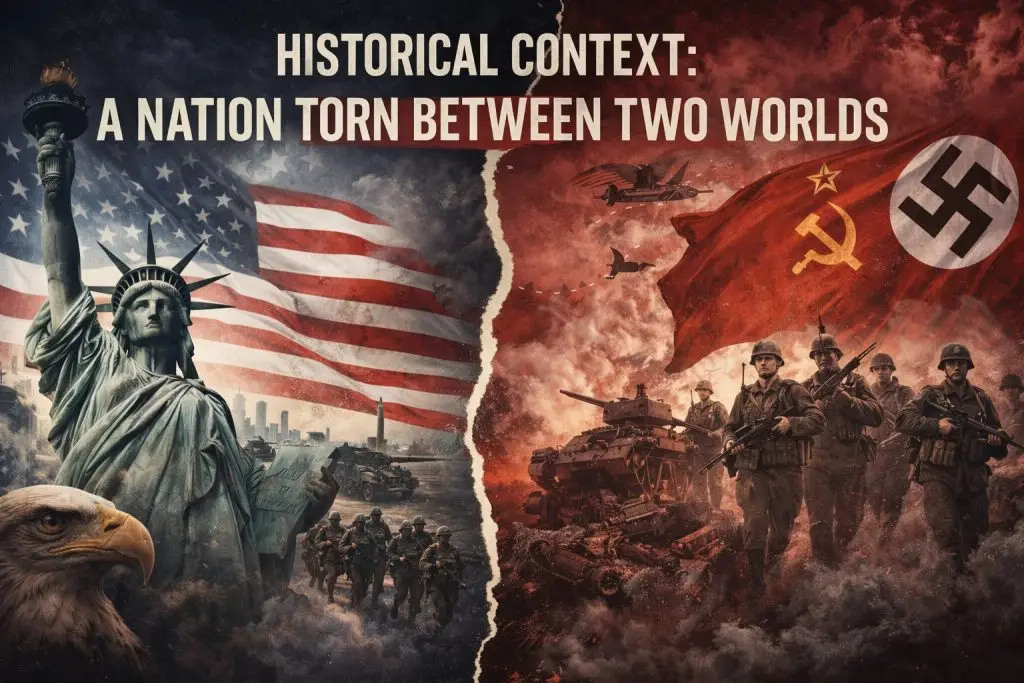
1. Historical Context: A Nation Torn Between Two Worlds
To fully grasp why America attacked Nazi Germany in 1941, one must look back at the tense years of 1939 and 1940. When Hitler’s invasion of Poland triggered World War II, the American public remained overwhelmingly isolationist. The scars of the “Great War” (WWI) were still fresh, leaving many convinced that distant European conflicts were not worth the cost of American lives. This sentiment was deeply rooted in the belief that the Atlantic Ocean provided a natural barrier against foreign tyranny.
The Impact of the Neutrality Acts
Throughout the 1930s, Congress codified this caution by passing several Neutrality Acts. These legislative measures were intentionally crafted to insulate the United States from overseas conflicts by banning both the supply of munitions and the extension of financial credit to warring countries.
However, as the geopolitical landscape shifted—marked by the fall of France and the brutal aerial bombardment of London during the Blitz—President Franklin D. Roosevelt grew increasingly concerned. He realized that the isolationist stance was becoming a liability. Roosevelt understood that a total Nazi victory would not bring peace; instead, it would leave the United States isolated and economically vulnerable in a global order dominated by totalitarianism. This realization began the slow, controversial pivot from strict neutrality toward active support for the Allies.
2. From Neutrality to the “Arsenal of Democracy”
President Franklin D. Roosevelt understood that a formal declaration of war was politically impossible without unified public backing. To bridge this gap, he orchestrated a strategic transition, famously arguing that the most effective way to keep the United States out of the conflict was to ensure the Allies had the means to win it themselves. This policy shift transformed America from a passive observer into a powerhouse of production.
The Significance of the Lend-Lease Act (March 1941)
The pivotal turning point of early 1941 was the passage of the Lend-Lease Act. This legislation granted the President the authority to “lend” or lease critical war materiel to any nation whose defense was considered vital to the security of the United States.
By funneling billions of dollars worth of aircraft, tanks, ammunition, and fuel to Great Britain and eventually the Soviet Union, the U.S. essentially became a “non-belligerent” ally. While American troops were not yet on the front lines, the country’s industrial might was already actively undermining German strategic goals. In the eyes of Adolf Hitler, this massive logistical support was an act of war in all but name, signaling that America had already chosen its side in the global struggle.

3. The Undeclared War in the Atlantic
By mid-1941, the Atlantic Ocean had transformed into a volatile battlefield. Although the United States maintained official neutrality, the U.S. Navy was locked in what historians term an “undeclared war” against German U-boats. To safeguard the critical flow of Lend-Lease supplies to Great Britain, American destroyers began escorting merchant convoys across the treacherous North Atlantic. This shift from passive observer to active protector marked a significant escalation in American involvement.
This aggressive defensive posture inevitably led to violent maritime encounters that pushed the nation toward formal conflict. High-profile incidents involving the USS Greer and the tragic sinking of the USS Reuben James resulted in the loss of American lives months before any official declaration. These skirmishes proved that the thin veil of peace was rapidly dissolving under the pressure of Nazi naval aggression.
Key Incidents in the Atlantic Conflict:
- The “Shoot on Sight” Policy: Following repeated provocations, President Roosevelt issued a “shoot on sight” order. This authorized the U.S. Navy to attack any German or Italian vessels found in waters deemed vital to American defense, effectively ending the pretense of maritime neutrality.
- The USS Greer Incident (September 1941): A German submarine targeted the USS Greer, a destroyer tracking the U-boat’s position. While the ship survived, Roosevelt used this event to justify his more aggressive naval stance to the American public.
- The Sinking of the USS Reuben James (October 1941): In a tragic escalation, a German U-boat sank the USS Reuben James during a convoy mission. This resulted in the deaths of 115 American sailors, marking the first time a U.S. naval vessel was lost to enemy action in the war.
- A Breaking Point in Diplomacy: These naval engagements meant that American blood was being spilled by Nazi forces months before the formal declaration of war. By late 1941, the technicality of “peace” was held together only by a thin diplomatic thread that was destined to snap.

4. The Catalyst: Pearl Harbor and the Tripartite Pact
The direct path to America’s war with Nazi Germany was paved by a catastrophic event in the Pacific. On December 7, 1941, the Japanese attack on Pearl Harbor shattered American isolationism instantly. However, the immediate result was a declaration of war against Japan, not Germany. For a brief window, many Americans believed the nation’s military focus would remain exclusively on the Pacific, leaving the European theater to Great Britain and the Soviet Union.
The shift toward Europe was triggered by the Tripartite Pact, a mutual defense agreement between Germany, Italy, and Japan. While the pact technically only required Germany to intervene if Japan was the victim of aggression, Adolf Hitler made what many historians consider his greatest strategic blunder.
Hitler’s Declaration of War (December 11, 1941)
On December 11, 1941, just four days after Pearl Harbor, Hitler addressed the Reichstag and formally declared war on the United States. He calculated that American forces would be too thinly stretched across the Pacific to pose a threat in Europe. This move was a strategic gift to President Roosevelt, providing the legal and political “clearance” required to engage the Nazi regime. Congress responded with a reciprocal declaration that same day, officially bringing the United States into the fight against the Third Reich.
5. Strategic Necessity: The “Germany First” Policy
Upon entering the conflict, American military leadership faced a critical strategic dilemma: should they prioritize the nation that attacked them, Japan, or the looming threat in Europe? At the Arcadia Conference in late 1941, the U.S. and Great Britain committed to the “Germany First” (or “Europe First”) strategy.
This decision was rooted in cold strategic necessity. Germany was viewed as the more dangerous adversary due to its superior industrial capacity and advanced scientific research, which threatened the development of terrifying new weapons. Furthermore, military planners realized that if the Soviet Union collapsed under Nazi pressure, Hitler would consolidate control over the entire European continent’s resources. By prioritizing the defeat of the Third Reich, the Allies aimed to preserve the British Isles as a vital staging ground and prevent a total Axis hegemony that would have been nearly impossible to dismantle later.
Why did America attack Nazi Germany as the priority?
- Scientific Prowess: Germany was developing advanced rockets and researching atomic energy. They were considered a far greater technological threat than Japan.
- The Soviet Union: If Germany defeated the USSR, they would control the vast resources of the Eurasian landmass, making them nearly impossible to defeat.
- The British Base: If Great Britain fell, the U.S. would lose its only “aircraft carrier” and staging ground for a liberation of Europe.
6. The Moral Dimension: Fighting Fascism
While treaties and naval skirmishes provided the formal justification for war, the underlying motivation to sustain such a massive conflict was deeply ideological. President Franklin D. Roosevelt sought to provide the American public with a clear sense of purpose by framing the struggle as a vital defense of the Four Freedoms: freedom of speech, freedom of worship, freedom from want, and freedom from fear. This vision transformed the war from a distant geopolitical dispute into a fundamental battle for human rights and dignity.
As American forces advanced toward the heart of Germany, the strategic nature of the war took on a darker, more urgent moral weight. The discovery of the Holocaust and the liberation of concentration camps revealed the incomprehensible brutality of the Nazi regime to the world. What had begun as a strategic necessity to protect global trade and democratic allies evolved into a moral crusade against systemic evil. America committed its full strength to attacking Nazi Germany to ensure that a world governed by the cynical principle of “might makes right” would not prevail. Instead, the objective became the establishment of a global order where individual liberty and the rule of law served as the primary foundations of civilization.
7. Key Milestones of the American Attack on Germany
The United States executed a methodical dismantling of the German war machine, moving strategically from the periphery of the conflict toward the heart of the Third Reich. This wasn’t merely a campaign of aerial bombardment; it was a multi-year, coordinated effort involving massive amphibious invasions, grueling ground combat, and the systematic destruction of enemy logistics.
Following early victories in North Africa and Italy, the turning point arrived with Operation Overlord on D-Day. By opening the Western Front in Normandy, U.S. and Allied forces forced Germany into a two-front war they could not sustain, ultimately crushing the Nazi regime between the advancing Western Allies and the Soviet Union.
| Phase | Year | Significance |
| Operation Torch | 1942 | U.S. troops land in North Africa to push back Rommel. |
| Invasion of Italy | 1943 | Forcing Germany to divert troops to the “soft underbelly” of Europe. |
| Operation Overlord | 1944 | The D-Day landings in Normandy, opening the Western Front. |
| Battle of the Bulge | 1944-45 | The final major German offensive thwarted by American grit. |
Summary: Why 1941 Changed Everything
The year 1941 marked a permanent shift in American foreign policy, ending decades of isolationism. While the U.S. was already a “silent partner” through the Lend-Lease Act, it was Hitler’s sudden declaration of war on December 11 that finally forced America’s hand. Through the implementation of the “Germany First” doctrine, American leadership conceded that the Third Reich’s combination of manufacturing capacity and technological innovation represented the most significant danger to world stability. This decision transformed a regional conflict into a total crusade to dismantle fascism and secure a democratic future.
- Hitler’s Declaration of War: By formally declaring war on December 11, 1941, Hitler removed Roosevelt’s political hurdles and forced a direct military response from the U.S.
- The Lend-Lease Act: This policy effectively ended American neutrality by turning the nation into a vital “non-belligerent” partner that sustained the Allied war effort through industrial supply.
- The “Germany First” Strategy: Military leaders prioritized the European theater because Nazi Germany possessed superior technology and industrial power, making them the most immediate threat to global stability.
- The Atlantic Charter: This joint declaration between Roosevelt and Churchill established a shared vision for a post-war world rooted in self-determination and the total destruction of Nazi tyranny.
The decision to attack Nazi Germany redirected the entire course of the 20th century, leading to the liberation of Europe and the emergence of the United States as a global superpower. Without the American intervention in 1941, the map of the world today would look drastically different.
People Also Asked About America Attacking Nazi Germany in 1941
When exploring why and how the United States engaged in the European theater during World War II, several common questions arise. Here are the most frequent queries and the facts behind them:
Did the US declare war on Germany first?
No. Following the attack on Pearl Harbor, the U.S. declared war on Japan. It was actually Adolf Hitler who declared war on the United States on December 11, 1941. Congress responded with a reciprocal declaration later that same day.
Why did Hitler declare war on the US?
Hitler believed that the U.S. would be fully occupied with a two-ocean war against Japan, rendering them unable to provide significant military aid to Europe. He also hoped that by supporting Japan, Japan would reciprocate by attacking the Soviet Union from the East.
Was America already fighting Germany before December 1941?
Technically, no, but practically, yes. Through the Lend-Lease Act, the U.S. was supplying Germany’s enemies with massive amounts of war materiel. Additionally, the U.S. Navy was engaged in an “undeclared war” in the Atlantic, protecting supply convoys and occasionally clashing with German U-boats.
What was the “Germany First” strategy?
This was an agreement between the U.S. and Great Britain to focus the majority of their resources on defeating Nazi Germany before turning their full attention to Japan. They believed Germany was the more dangerous threat due to its advanced industrial and scientific capabilities.
What was the main reason the U.S. entered WWII?
While the attack on Pearl Harbor was the immediate catalyst that ended American isolationism, the broader reasons included the threat of a global totalitarian takeover, the defense of democratic allies, and the moral imperative to stop Nazi expansionism.
Conclusion: The Legacy of American Intervention in 1941
The American decision to attack Nazi Germany was a defining moment for global leadership. While the U.S. began the decade entrenched in isolationism, the existential threat posed by the Axis powers forced a shift toward total engagement. This transition was not merely a reaction to military aggression, but a calculated commitment to preserving the democratic world order.
By the time American and Soviet forces famously linked up at the Elbe River in April 1945, the geopolitical landscape had been permanently altered. The “Germany First” strategy had successfully dismantled the Third Reich, but it also placed the United States in a position of unprecedented responsibility.
The conclusion of the war in Europe marked more than just a military victory; it signaled the end of European colonial dominance and the rise of the United States as a global superpower. This era established the framework for modern international relations, emphasizing collective security and the defense of democratic values that continue to shape the world today. America’s entry into the war was the catalyst for a century defined by its leadership and industrial might.