

Start your Ausbildung in Germany 2026. Learn requirements, salary, top jobs, and step-by-step application process for international students.
Introduction: Ausbildung in Germany 2026
Ausbildung in Germany is one of the most popular pathways for international students who want to build a strong and stable career while earning money during their training period. Germany is widely known for its world-class education system, strong economy, and high demand for skilled professionals across many industries. The Ausbildung program offers a unique combination of practical on-the-job training and classroom-based theoretical learning, making it an ideal choice for students who want real work experience without paying high university tuition fees.
In 2026, Germany continues to expand its vocational training opportunities due to ongoing labor shortages in key sectors such as healthcare, IT, engineering, and hospitality. As a result, Ausbildung has become an even more attractive option for international applicants from Asia, Africa, and other developing regions who are seeking better career opportunities abroad.
This program not only provides valuable skills but also allows students to earn a monthly salary while studying, which helps support living expenses in Germany. Many graduates also receive full-time job offers after completing their training.
In this complete guide, you will learn everything about Ausbildung in Germany, including eligibility requirements, average salary, benefits, step-by-step application process, visa procedures, and the most in-demand job opportunities available in 2026.
What is Ausbildung in Germany?
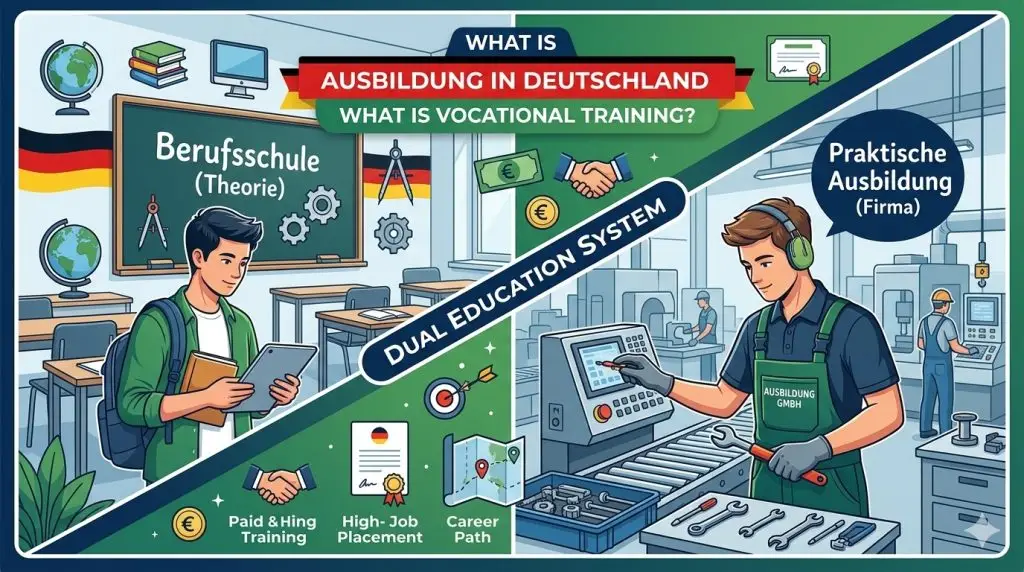
Ausbildung is Germany’s renowned dual vocational training system, designed to bridge the gap between classroom learning and professional expertise. It operates on a “Dual Education” model, where participants split their week between two locations: a host company for hands-on practical experience (3–4 days) and a specialized vocational school (Berufsschule) for theoretical instruction (1–2 days).
Unlike traditional university degrees that lean heavily on academic theory, an Ausbildung is strictly career-oriented. It transforms students into highly skilled professionals through direct immersion in their chosen trade. A standout feature of this system is that participants are considered employees from day one; they do not pay tuition and instead receive a monthly “training allowance” or salary. This makes it an attractive, debt-free pathway for individuals seeking to enter sectors like healthcare, IT, or engineering, ensuring they graduate with the exact skills German employers are looking for.
Key Features of Ausbildung:
- Duration: Most programs last between 2 to 3.5 years, depending on the complexity of the trade and your previous academic background.
- Paid training program: Participants receive a monthly stipend that increases each year, allowing you to cover living expenses while you learn.
- Recognized certificate: Upon graduation, you earn a state-recognized qualification that is highly respected across Germany and the European Union.
- High job placement rate: Due to the system’s focus on market needs, the vast majority of trainees are hired immediately by their training company.
- Opportunity to work in Germany: Completing the program grants you a legal pathway to secure a work permit and build a long-term professional life in the country.
Why Choose Ausbildung in Germany?
International students are increasingly choosing Ausbildung in Germany because it offers a unique blend of financial independence and professional stability. By combining practical workplace training with theoretical education, the dual system ensures students are career-ready from day one. Key advantages include earning a monthly salary while studying, the absence of tuition fees, and a direct path to a German work permit. With Germany’s current labor shortage, graduates enjoy exceptional job security and a globally recognized qualification that paves the way for long-term residency and international career success.
There are many reasons why international students prefer Ausbildung in Germany:
- Earn While You Learn: You receive a monthly stipend between €900 and €1,500+, providing a steady income to support yourself during your studies.
- No Tuition Fees: Unlike university degrees, these programs are government-funded and free, leaving you only with standard living expenses to manage.
- High Job Security: Due to Germany’s urgent skilled labor shortage, graduates enjoy immense stability and nearly guaranteed employment.
- International Career Opportunities: Holding a state-recognized German certificate provides a prestigious qualification that is valued by top employers globally.
- Permanent Residency Pathway: Graduation opens a direct legal route to a work permit, leading to permanent residency after a few years of employment.
Types of Ausbildung Programs in Germany
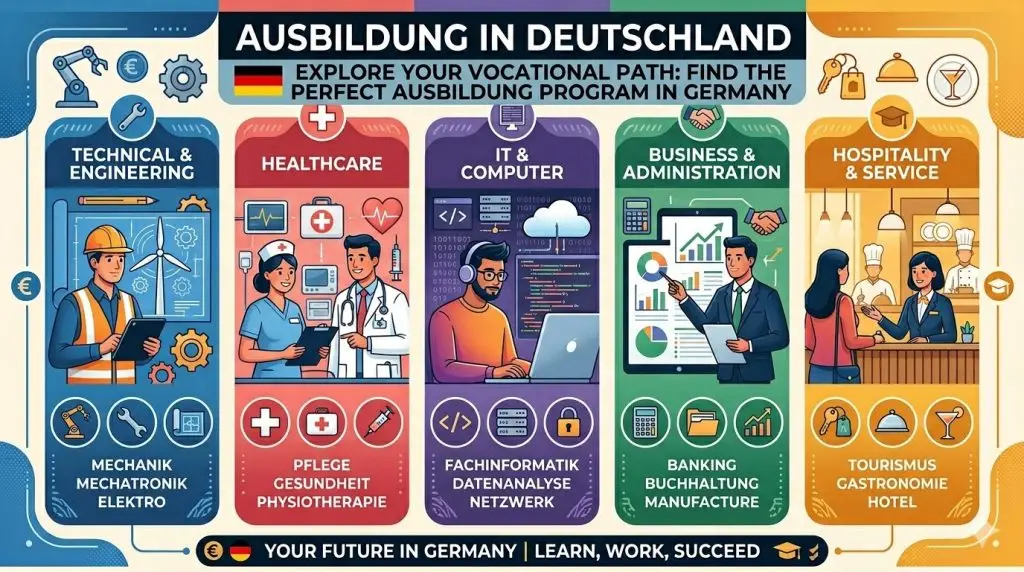
Germany offers a diverse landscape of vocational opportunities with over 300 recognized training occupations catering to various talents. These programs are broadly categorized into Dual Ausbildung, which balances company work with school, and Schulische Ausbildung, which is primarily classroom-based. Popular sectors include Healthcare (Nursing and Physiotherapy), IT and Technology (Software Development and Mechatronics), and Business (Banking and Management). This variety allows international students to find a niche that matches their skills while addressing Germany’s specific labor market needs, ensuring high employability upon graduation.
There are more than 300 recognized training occupations. Some popular categories include:
1. Technical & Engineering
- Mechatronics technician
- Electrician
- Automotive mechanic
- Industrial mechanic
2. Healthcare
- Nursing assistant
- Elderly care worker (Altenpfleger/in)
- Medical assistant
3. IT & Computer
- IT specialist
- Software developer trainee
- System administrator
4. Business & Administration
- Office management clerk
- Sales assistant
- Bank clerk
5. Hospitality & Service
- Hotel management
- Chef / Cook
- Restaurant specialist
Top High-Demand Ausbildung Jobs in 2026
In 2026, Germany’s labor market is characterized by an acute shortage of skilled workers, with over 163 occupations officially classified as “bottleneck” professions. This high demand translates into exceptional job security and rising stipends for international trainees. The most critical sectors include Healthcare, where an aging population drives a constant need for nursing specialists, and IT, which requires experts in software development and cybersecurity. Additionally, Technical and Engineering roles like mechatronics and electrical technicians remain vital to Germany’s industrial core, offering some of the highest-paying and most stable career paths for ambitious students.
Germany has a strong demand for skilled workers in the following fields:
1. Nursing & Healthcare
- Very high demand
- Fast visa approval chances
2. IT Specialists
- Software development
- Cybersecurity
3. Electricians & Technicians
- Industrial automation
- Smart factory systems
4. Automotive Industry
- Car mechanics
- Mechatronics
5. Hospitality Jobs
- Hotel management
- Restaurant services
Eligibility Requirements for Ausbildung in Germany
To apply for Ausbildung in Germany, you must meet certain requirements:
- Educational Qualification: You must have completed at least a high school diploma or its international equivalent, such as the HSC or 12th grade. Your certificates usually need to be recognized by German authorities to ensure they meet the standards required for your chosen vocational field.
- Age Limit: While the preferred age range for applicants is typically between 18 and 30 years, there is no strict legal ceiling. Due to labor shortages, many programs now welcome older candidates who can demonstrate a strong commitment to switching careers.
- German Language Skills: Proficiency is the most vital requirement, with most employers demanding at least a B1 level to ensure you can follow classroom lessons. While some manual roles might accept A2, highly technical or healthcare-related jobs often require B2 for clear communication.
- Passport: A valid international passport is mandatory for the application process and is a core requirement for obtaining your vocational training visa. It must remain valid for the entire duration of your stay or be easily renewable through your embassy in Germany.
- Health Certificate: Certain sectors, particularly healthcare and food services, require a medical fitness certificate to prove you are physically capable of performing the work. This document ensures that you do not have health conditions that could endanger yourself or the public while on duty.
- Motivation Letter & CV: To secure a placement, you must submit a professionally structured, German-style CV (Lebenslauf) alongside a persuasive motivation letter. These documents should be written in German, clearly detailing your career aspirations and articulating your specific interest in the benefits of the German dual education system.
Required Documents
When applying for Ausbildung in Germany, prepare the following documents:
- Updated CV: Your Lebenslauf must follow the German chronological format, including a professional photo and a clear overview of your education and skills.
- Motivation letter: This personal statement should be written in German, explaining your passion for the trade and why you chose a specific company.
- Educational certificates: You must provide your high school or university diplomas, which need to be officially translated into German or English by a certified translator.
- Passport copy: A clear, valid copy of your international passport’s data page is essential for verifying your identity and processing your visa application.
- Language certificate: You need an official certificate (like Goethe or Telc) proving at least A2 or B1 proficiency to ensure you can communicate effectively.
- Recommendation letters: While optional, a letter from a former teacher or employer can significantly strengthen your application by vouching for your character.
- Experience certificates: Documentation of past internships or jobs related to your chosen field provides valuable proof of your practical skills and dedication.
Step-by-Step Application Process
Here is how to apply for Ausbildung in Germany:
- Step 1: Choose Your Field: Research over 300 available occupations to find a trade that aligns with your personal interests and current German labor market shortages. Focusing on high-demand sectors like healthcare, IT, or mechatronics will significantly increase your chances of securing a placement and long-term residency.
- Step 2: Learn German Language: You must achieve at least B1 proficiency for most programs, though B2 is highly recommended for client-facing roles like nursing or management. Start your language journey early through recognized institutes like Goethe, as official certification is a non-negotiable requirement for your visa application.
- Step 3: Search for Positions: Use official portals like “Make it in Germany,” niche sites like Ausbildung.de, or the Federal Employment Agency to find current vacancies. Many large German corporations also advertise directly on their career pages, so checking specific company websites can reveal exclusive opportunities.
- Step 4: Submit Applications: Tailor your German-style CV (Lebenslauf) and motivation letter specifically to each employer to demonstrate your genuine interest in their company. Ensure all your educational certificates are officially translated into German to make the evaluation process easier for the hiring managers.
- Step 5: Interview: Prepare for online interviews by researching the company and practicing common questions in German to prove both your technical curiosity and language skills. This is your chance to show the employer that you are reliable, motivated, and ready to adapt to the German work culture.
- Step 6: Contract Signing: Once selected, you will receive a legally binding training contract (Ausbildungsvertrag) detailing your working hours, monthly stipend, and the duration of the program. This document is the most critical piece of evidence needed to prove your purpose of stay when applying for your visa.
- Step 7: Apply for Visa: Book an appointment at your local German embassy early, as processing usually takes 8 to 12 weeks and requires the “16a Vocational Training Visa.” You will need to present your signed contract, language certificate, and proof of financial means to cover any living cost gaps.
Ausbildung Visa Process for Germany
To study and work in Germany, you need an Ausbildung visa.
Requirements:
- Ausbildung contract
- Proof of financial resources (blocked account or sponsor)
- Health insurance
- Language certificate
- Valid passport
Processing Time:
- Usually 6 to 12 weeks
Once approved, you can travel to Germany and start your training.
Salary During Ausbildung in Germany
One of the biggest advantages is earning while learning.
Average Monthly Salary:
- 1st year: €900 – €1,100
- 2nd year: €1,000 – €1,200
- 3rd year: €1,100 – €1,500+
Salary depends on:
- Industry
- Location
- Company size
Healthcare and IT jobs often pay higher salaries.
Benefits of Ausbildung in Germany
- Practical Experience: You gain invaluable hands-on expertise from day one, allowing you to master your trade within a real-world professional environment.
- International Recognition: German vocational certificates are globally prestigious, ensuring your skills are highly respected by top-tier employers across the world.
- Career Growth: Upon graduation, you can transition directly into a full-time role with a higher salary and clear opportunities for leadership positions.
- Permanent Residency Option: Completing your training provides a stable legal foundation to secure a work permit and apply for permanent residency after a few years.
- Affordable Pathway: This is a zero-debt route to a career, as the lack of tuition fees and a steady monthly salary cover your essential living expenses.
Challenges of Ausbildung in Germany
While Ausbildung is beneficial, there are some challenges:
- Learning German language is mandatory
- Competitive application process
- Cultural adjustment in Germany
- Strict training schedules
- Initial low salary compared to full-time jobs
However, these challenges become easier with preparation and consistency.
Tips to Get Selected for Ausbildung in Germany
- Improve German Language Skills: Aim for at least a B1 or B2 level to show employers you can handle both technical workplace communication and academic lessons at the vocational school.
- Write a Strong Motivation Letter: Clearly articulate your long-term career goals and explain how this specific trade aligns with your passion to stand out from other applicants.
- Apply Early: Since the recruitment cycle for German companies is quite long, start your search 6 to 12 months before the program begins to secure the best spots.
- Choose High-Demand Fields: Focus your efforts on sectors like healthcare, IT, and engineering, where the acute labor shortage leads to significantly higher acceptance rates for international students.
- Prepare for Interviews: Practice answering common behavioral and technical questions in German so you can confidently demonstrate your reliability and motivation during the video call.
Common Mistakes to Avoid
- Applying without learning German
- Using poor CV format
- Sending generic motivation letters
- Applying for random jobs without research
- Ignoring visa requirements
Future Scope After Ausbildung in Germany
After completing Ausbildung, you can:
- Work full-time in Germany
- Apply for skilled worker visa
- Get permanent residency
- Continue higher education
- Work in other EU countries
This makes Ausbildung a long-term career investment.
FAQs about Ausbildung in Germany
1. Is Ausbildung free in Germany?
Yes, most programs are free and include paid training.
2. Can I apply without German language?
No, at least A2 or B1 German is required.
3. How long does Ausbildung take?
It usually takes 2 to 3.5 years.
4. Can I stay in Germany after Ausbildung?
Yes, you can apply for a work visa and permanent residency.
5. Is Ausbildung good for international students?
Yes, it is one of the best career pathways in Germany.
Conclusion
Ausbildung in Germany is a powerful and life-changing opportunity for students who want to build a stable, successful, and internationally recognized career in Europe. It combines hands-on practical training with classroom-based education, allowing students to gain real work experience while earning a monthly salary. This unique system not only helps you develop professional skills but also supports you financially during your training period.
One of the biggest advantages of Ausbildung is its strong global recognition and the clear pathway it provides toward long-term employment and permanent residency in Germany. Many international students choose this route because it offers a secure future, career growth, and access to one of the strongest economies in the world.
In 2026, the demand for skilled workers in Germany is higher than ever before, especially in sectors like healthcare, IT, engineering, and technical trades. This makes it the perfect time to apply and take advantage of these growing opportunities.
If you are ready to learn the German language, develop practical skills, and start a professional journey abroad, then Ausbildung in Germany can truly become your gateway to a better future. With proper preparation and dedication, it can open doors to long-term success and international career opportunities.