
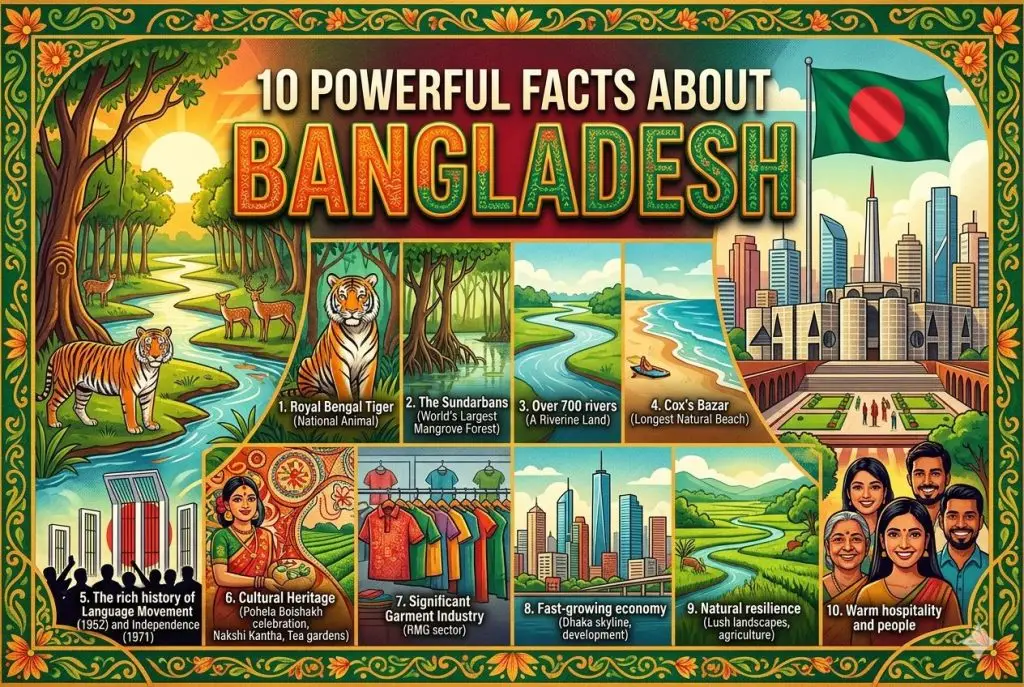
Discover 10 powerful facts about Bangladesh, including its history, capital, and map. Learn key insights about Bangladesh’s culture, population, and geography.
Introduction: 10 Powerful Facts About Bangladesh
Bangladesh is a vibrant South Asian country known for its rich history, diverse culture, and impressive economic growth. Located in the heart of South Asia, Bangladesh has transformed itself from a land of ancient civilizations into one of the fastest-growing economies in the region. Its unique blend of tradition and modernity makes it an intriguing destination for travelers, researchers, and history enthusiasts alike.
From the early days of powerful empires and cultural evolution to its hard-fought independence in 1971, Bangladesh carries a legacy of resilience and pride. The country is home to a dynamic population, colorful festivals, and a deep-rooted cultural heritage that continues to shape its national identity. At the same time, Bangladesh is making remarkable progress in areas such as technology, education, and infrastructure, positioning itself as a rising global player.
In this SEO-optimized article, we will uncover seven powerful facts about Bangladesh, focusing on its history, capital city, geographic map, population, and more. Whether you are a student, traveler, or curious reader, this guide will give you valuable insights into what makes Bangladesh truly unique and inspiring.
1. A Rich and Ancient History of BD
The history of BD spans thousands of years, making it one of the most historically rich countries in South Asia. In ancient times, the region was part of Bengal, a thriving area ruled by powerful dynasties such as the Maurya and Gupta empires. These early civilizations contributed significantly to trade, education, and culture, establishing Bangladesh as an important hub in South Asia. Ancient Bengal was also known for its art, literature, and learning, attracting scholars and merchants from far and wide.
During the medieval period, Muslim rulers brought new cultural, architectural, and administrative influences, shaping the social and political landscape of the region. Many historical monuments, mosques, and forts from this era still stand as a testament to Bangladesh’s rich heritage.
In the colonial era, the British took control of the region, making it part of British India. The partition of India in 1947 led to the creation of East Pakistan, which later became BD.
However, political, linguistic, and cultural differences between East and West Pakistan eventually sparked the Bangladesh Liberation War in 1971. After nine months of intense struggle, Bangladesh emerged as an independent nation. This remarkable achievement is commemorated every year on Victory Day, honoring the bravery and resilience of the Bangladeshi people.

2. The Capital City: Dhaka – Heart of BD
The capital of BD is Dhaka, a bustling metropolis and one of the most densely populated cities in the world. Known as the heart of BD, Dhaka serves as the political, economic, and cultural hub of the country. It is a city where tradition and modernity coexist, offering a unique glimpse into both the historical and contemporary life of BD.
Dhaka is famous for its vibrant street life, busy markets, and colorful festivals. The city is home to several historical landmarks that reflect its rich heritage, including Lalbagh Fort, a 17th-century Mughal fort complex; Ahsan Manzil, the Pink Palace that once housed the Nawabs of Dhaka; and the iconic National Parliament House, an architectural masterpiece designed by Louis Kahn. These attractions make Dhaka a center for history, culture, and tourism.
Economically, Dhaka plays a crucial role in driving the growth of Bangladesh. The city hosts major industries, multinational businesses, government institutions, and trade centers, contributing significantly to the nation’s GDP. Despite facing challenges such as traffic congestion and rapid urbanization, Dhaka continues to expand and modernize. With ongoing infrastructure development, transportation projects, and business opportunities, Dhaka is steadily emerging as a modern, global city while retaining its unique cultural identity.

3. Geographic Location and Map of BD
BD is a South Asian country strategically located on the northern coast of the Bay of Bengal. It shares borders with India on the west, north, and east, while Myanmar lies to its southeast. This unique geographic position makes Bangladesh a key link between South and Southeast Asia, offering access to important trade routes and regional connectivity. The Bay of Bengal to the south provides Bangladesh with vital maritime opportunities, including fishing, trade, and tourism.
The map of Bangladesh reveals a predominantly riverine landscape, with more than 700 rivers crisscrossing the country. Major rivers such as the Padma, Meghna, and Jamuna are central to the nation’s agriculture, transportation, and everyday life. These rivers provide fertile soil that supports the cultivation of rice, jute, tea, and other crops, making Bangladesh one of the most agriculturally productive regions in the world.
However, BD’s low-lying topography also makes it highly vulnerable to natural disasters, including seasonal flooding, cyclones, and river erosion. Despite these challenges, the people of Bangladesh have adapted over centuries through innovative farming techniques, river management, and resilient community practices. The country’s rich geography, combined with its abundant water resources, plays a crucial role in shaping the economy, culture, and daily lives of its population, making it a truly unique and remarkable nation in South Asia.

4. The Bangladeshi Flag: History, Symbolism, and Pride
The Bangladeshi flag is one of the most important national symbols, representing the country’s independence, culture, and identity. Adopted officially on January 17, 1972, shortly after Bangladesh gained independence in 1971, the flag holds deep historical and emotional significance for the nation.
The flag features a red circle on a green background. The green symbolizes the lush landscape of Bangladesh and the hope and vitality of its people. The red circle represents the blood of those who sacrificed their lives during the BD Liberation War, as well as the rising sun of a new and free nation. This simple yet powerful design embodies the courage, resilience, and patriotism of the Bangladeshi people.
The Bangladeshi flag is proudly displayed on national holidays, government buildings, and schools, serving as a constant reminder of the country’s hard-earned freedom and unity. It is also used during international events to represent Bangladesh, inspiring pride among citizens worldwide.
Understanding the history and symbolism behind the Bangladeshi flag helps people appreciate its importance as more than just a piece of cloth—it is a powerful emblem of national pride, identity, and the enduring spirit of BD.
5. Population and Cultural Diversity
BD is home to over 170 million people, making it one of the most densely populated countries in the world. Despite its relatively small land area, the country has a vibrant and dynamic population. The majority of people live in rural areas, where agriculture remains the main source of livelihood. However, urbanization is growing rapidly, with cities like Dhaka, Chittagong, and Khulna expanding to accommodate the increasing population and economic development.
The cultural diversity of BD is one of its greatest strengths. BD is inhabited by a variety of ethnic communities, each with its own languages and cultural traditions. Bengali (Bangla) is the official language and serves as a unifying element of national identity. Other indigenous languages are also spoken in various regions, contributing to the rich cultural tapestry of the country.
Festivals and traditions play a significant role in daily life. Events such as Pohela Boishakh, the Bengali New Year, are celebrated with music, dance, and vibrant fairs. Religious festivals like Eid-ul-Fitr, Eid-ul-Adha, and Durga Puja are observed with great devotion and enthusiasm. These cultural celebrations not only reflect the deep-rooted heritage of Bangladesh but also highlight the unity and diversity of its people, making the country a fascinating place to explore and experience.
6. A Fast-Growing Economy
BD has witnessed remarkable economic growth over the past few decades, establishing itself as one of South Asia’s fastest-growing economies. A key driver of this growth is the garment and textile industry, which is globally recognized and among the largest in the world. This sector not only provides employment to millions of people, especially women, but also contributes significantly to the country’s export revenue.
Beyond textiles, BD is diversifying its economy by investing in sectors such as information technology, agriculture, and manufacturing. The country’s IT industry is expanding rapidly, with software development and outsourcing creating new opportunities for skilled workers. Agriculture remains vital, as fertile lands and abundant water resources support rice, jute, tea, and other important crops. Additionally, millions of Bangladeshi workers abroad send remittances home, which play a crucial role in stabilizing the economy and supporting families.
The government of BD has also prioritized infrastructure development to sustain economic growth. Investments in bridges, highways, ports, and digital connectivity have improved transportation and business efficiency. Projects like the Padma Bridge have opened new avenues for trade and regional connectivity. With a combination of strong industry, skilled labor, and strategic infrastructure development, Bangladesh continues its journey toward achieving middle-income status and becoming an emerging player on the global economic stage.
7. Natural Beauty and Tourist Attractions
BD is a country renowned for its breathtaking natural beauty, offering a diverse landscape that ranges from lush green plains to winding rivers, serene lakes, and dense forests. Its unique geography and abundant natural resources make it a haven for travelers and nature enthusiasts alike. One of the country’s most famous attractions is the Sundarbans, the largest mangrove forest in the world. This UNESCO World Heritage Site is home to the iconic Royal Bengal Tiger, as well as numerous bird species, reptiles, and aquatic life, making it a hotspot for wildlife lovers and ecotourism.
Another must-visit destination is Cox’s Bazar, known as the world’s longest natural sea beach. Its golden sands, rolling waves, and scenic sunsets attract both domestic and international tourists throughout the year. For those who love hills and cooler climates, the Chittagong Hill Tracts, including Bandarban and Rangamati, offer picturesque landscapes with mountains, waterfalls, and tribal villages, providing a peaceful escape from the bustle of city life.
BD also features numerous rivers, such as the Padma, Jamuna, and Meghna, which enhance the country’s natural charm and play a central role in its culture and economy. From boating and fishing to exploring forests and hills, the country provides countless opportunities for adventure, relaxation, and cultural experiences. Truly, BD is a destination where natural beauty and cultural heritage meet.
8. Bangladeshi Tourism Spot: Explore the Beauty of BD
BD is a country full of natural beauty, cultural heritage, and unique tourist attractions. From serene rivers and lush green landscapes to historical landmarks and vibrant cities, Bangladesh offers a wide range of experiences for travelers.
One of the most famous tourism spots is Cox’s Bazar, home to the world’s longest natural sea beach. Its golden sands, rolling waves, and stunning sunsets attract visitors from around the globe. Another popular destination is the Sundarbans, the largest mangrove forest in the world and a UNESCO World Heritage Site. It is home to the majestic Royal Bengal Tiger and a variety of unique wildlife, making it a haven for nature lovers.
For those who love hills and scenic landscapes, the Chittagong Hill Tracts, including Bandarban and Rangamati, offer breathtaking mountains, waterfalls, and tribal villages. Historical sites like Lalbagh Fort in Dhaka and ancient temples in Paharpur provide a glimpse into Bangladesh’s rich history and culture.
Bangladesh’s tourism spots are ideal for adventure, relaxation, and cultural exploration. With growing infrastructure, easy accessibility, and warm hospitality, exploring these Bangladeshi tourism spots has become easier than ever, offering travelers unforgettable experiences in a unique and diverse country.
9. A Nation of Resilience and Progress
The people of Bangladesh are widely recognized for their resilience, determination, and ability to overcome challenges. Throughout history, Bangladesh has faced numerous difficulties, including natural disasters like floods and cyclones, as well as economic and political struggles. Despite these obstacles, the nation has made remarkable progress in building a stable and thriving society. The collective strength and perseverance of its people have played a crucial role in shaping modern Bangladesh.
Significant improvements have been achieved in key areas such as education, healthcare, and women’s empowerment. Literacy rates are steadily rising, and more children now have access to quality education than ever before. Healthcare facilities have expanded across the country, improving maternal and child health outcomes. Bangladesh has also become a global leader in microfinance, with innovative programs that empower women and small entrepreneurs to achieve financial independence and contribute to the economy.
The nation’s young population is another driving force behind its progress. With growing opportunities in technology, industry, and entrepreneurship, Bangladesh is positioning itself for sustainable economic and social development. The country continues to focus on infrastructure, digitalization, and social welfare programs, ensuring inclusive growth. With determination, innovation, and a forward-looking mindset, Bangladesh is steadily moving toward a brighter, more prosperous, and sustainable future.
10. Bangladeshi Food: A Delicious Journey of Flavors
Bangladeshi food is a rich blend of flavors, spices, and traditions that reflect the country’s culture and history. Known for its aromatic rice, fish, and curry dishes, Bangladeshi cuisine is diverse and mouth-watering, offering something for every palate.
Rice is the staple food of Bangladesh, often served with dal (lentils), vegetables, and fish curry. Fish, especially freshwater varieties like hilsa (ilish), rohu, and catla, is highly popular and an essential part of the Bangladeshi diet. Traditional curries and meat dishes are cooked with mustard oil, garlic, ginger, and a variety of spices, giving each dish a unique and flavorful taste.
Street food is another highlight of Bangladeshi cuisine. Popular items include fuchka (pani puri), chotpoti, singara, and jhalmuri, which are enjoyed by locals and tourists alike. Sweets such as roshogolla, chomchom, and mishti doi add a delightful finish to meals.
Bangladeshi food is not just about taste; it represents the culture, hospitality, and culinary traditions passed down through generations. Whether dining at home, in restaurants, or at street stalls, experiencing Bangladeshi food is a journey into the heart of the country’s vibrant and flavorful heritage.
Frequently Asked Questions (FAQ)
1. What is the country famous for?
The country is famous for its rich cultural heritage, natural beauty, vibrant rivers, the Sundarbans mangrove forest, and its thriving textile industry.
2. What is the capital of this country?
The capital of this country is Dhaka, which is also the largest city and the economic and cultural hub of the country.
3. What is the population of this country?
This country has a population of over 170 million people, making it one of the most densely populated countries in the world.
4. What is the official language of this country?
The official language of this country is Bengali (Bangla), which is spoken by the majority of the population.
5. What are the major tourist attractions in this country?
Popular tourist spots include Cox’s Bazar, Sundarbans, Sylhet, Chittagong Hill Tracts, Dhaka’s Lalbagh Fort, and Paharpur’s ancient ruins.
6. What does the Bangladeshi flag symbolize?
The green background represents the country’s lush landscape, while the red circle symbolizes the blood of those who fought for independence and the rising sun of a new nation.
7. When did this country gain independence?
Bangladesh gained independence from Pakistan in 1971, following the Bangladesh Liberation War.
8. What is the currency of BD?
The currency of Bangladesh is the Bangladeshi Taka (BDT).
Conclusion
In summary, Bangladesh is a country rich in history, culture, and future potential. From its ancient roots shaped by powerful empires to its inspiring journey toward independence in 1971, Bangladesh has continuously evolved into a dynamic and resilient nation. Its strong cultural identity, vibrant traditions, and deep sense of unity make it truly unique in South Asia.
Today, Bangladesh is not only known for its historical significance but also for its rapid economic growth and development. The country has made impressive progress in key areas such as education, technology, infrastructure, and social development. With a growing economy and a young, energetic population, Bangladesh is steadily positioning itself as an emerging global player.
These ten powerful facts about Bangladesh clearly highlight its importance on the world stage. From the bustling capital city of Dhaka to its diverse geography and large population, every aspect of Bangladesh tells a story of strength, diversity, and progress.
Whether you are interested in history, geography, culture, or economic opportunities, Bangladesh offers a fascinating and inspiring journey. Exploring Bangladesh means discovering a nation that continues to rise, adapt, and shine with endless possibilities for the future.