
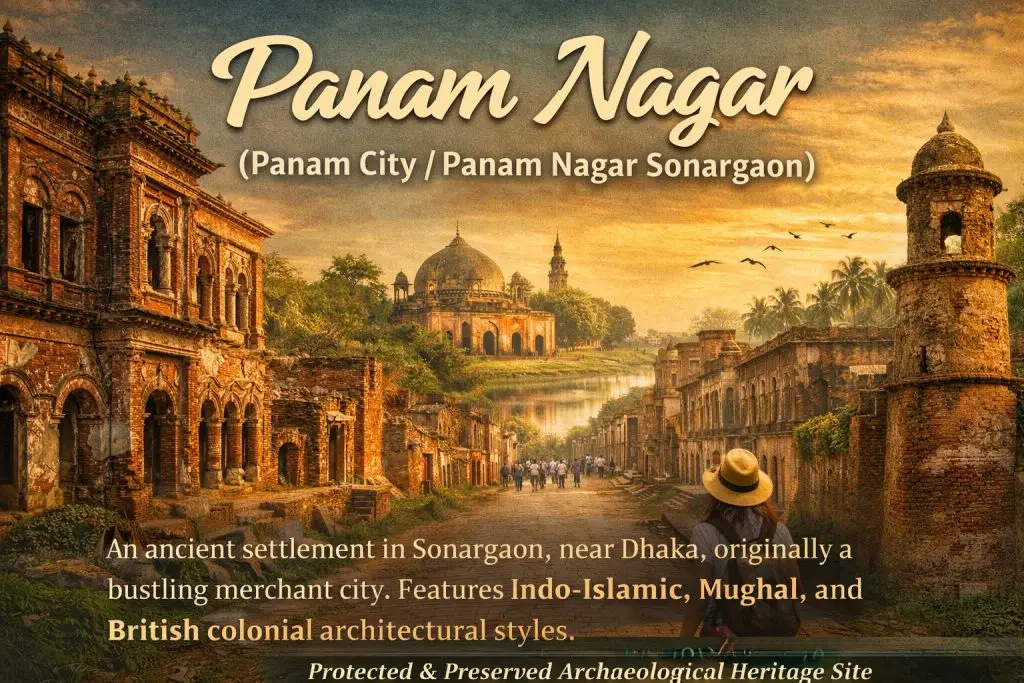
Explore Panam Nagar Sonargaon rich history, travel tips, local food, nearby resorts, best hotels, and must-see heritage sites near Dhaka.
📜 Introduction to Panam Nagar Sonargaon
Panam Nagar (also spelled Panam City or Panam Nagar Sonargaon) is an ancient settlement located within Sonargaon Upazila of Narayanganj District, roughly 30–35 km southeast of Dhaka.
It holds a unique place in Bengali history as a merchant city and elite residential area with structures blending Indo-Islamic, Mughal, and British colonial architectural styles.
Once a thriving town bustling with muslin-trading merchants, Panam Nagar is now an archaeological heritage site, protected and maintained for tourists, history lovers, photographers, and architects alike.
🏛️ History of Panam Nagar
The Origins – Medieval Bengal
Panam Nagar’s origins are deeply connected to the rise of Sonargaon as a powerful medieval city in eastern Bengal during the late 13th century.
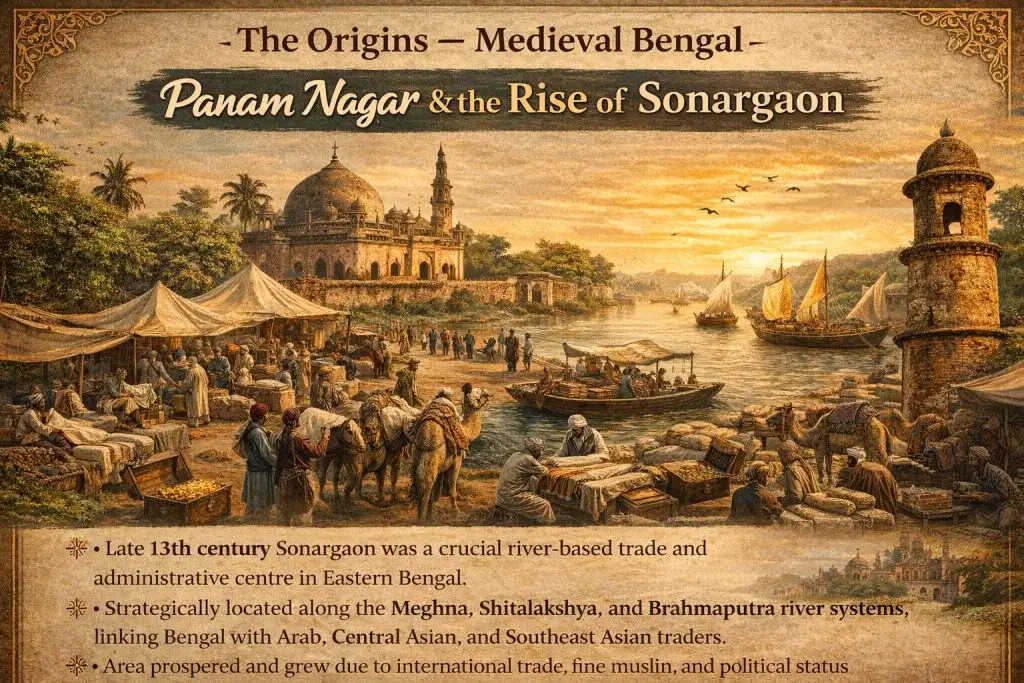
At that time, Sonargaon emerged as a crucial river-based trade and administrative center, strategically positioned along major waterways connected to the Meghna, Shitalakshya, and Brahmaputra river systems. These rivers allowed Sonargaon to function as an international trading port, linking Bengal with Arab merchants, Central Asian traders, and Southeast Asian markets. Because of this strategic location, the surrounding areas, including what would later become Panam Nagar, began developing as prosperous settlements for merchants, artisans, and officials.
During the period of the Delhi Sultanate, Sonargaon gained political importance as a provincial capital. Administrative officers, military commanders, and wealthy traders settled in the region, encouraging urban growth and cultural exchange. This importance continued under the Bengal Sultanate, when Sonargaon became famous for producing and exporting fine muslin and cotton textiles, which were highly valued across Asia, the Middle East, and Europe. The economic prosperity of this era laid the foundation for Panam Nagar’s later development as a merchant residential quarter.
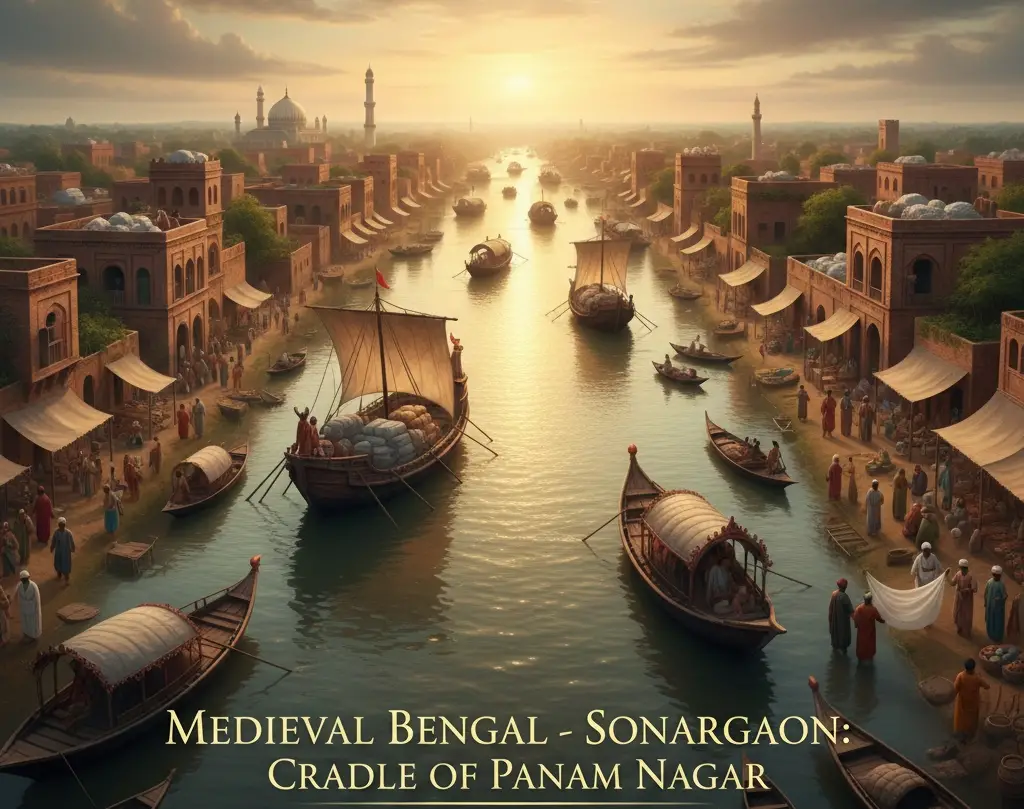
With the arrival of the Mughal Empire in the 16th century, Sonargaon retained its relevance as a commercial and cultural hub, even as political power shifted. Mughal governors supported trade, improved infrastructure, and maintained river ports, further strengthening the region’s economy. Sonargaon’s fame reached distant lands, appearing in the writings of foreign travelers and historians, who described it as a wealthy and well-organized city. These centuries of continuous political influence, trade activity, and cultural interaction ultimately shaped the historical groundwork from which Panam Nagar would later emerge as an important urban settlement in Bengal.
Rise Under British Colonial Influence
Although Panam Nagar had earlier roots connected to medieval Sonargaon, its most visible and well-organized development took place during the 19th century under British colonial rule.

This period marked a significant transformation, as Sonargaon once again gained economic importance due to expanding river trade and colonial commercial networks. Taking advantage of this renewed prosperity, wealthy Hindu and Muslim merchants, many of whom were involved in the textile, jute, cotton, and trading businesses, chose Panam Nagar as a prestigious residential and commercial area.
During this time, merchants invested heavily in constructing grand mansions, warehouses, and business houses along a long, straight street that later became the defining feature of Panam Nagar. These structures were not only symbols of wealth but also reflections of global influence. The architecture combined European colonial elements—such as arched doorways, Corinthian columns, decorative cornices, and symmetrical facades—with traditional Bengali design, including inner courtyards, raised plinths, and ventilated verandas suited to the tropical climate.
This unique architectural fusion gave Panam Nagar a refined yet practical character, setting it apart from other historic towns in Bengal. The carefully planned street layout and consistent architectural style helped preserve the area’s original form. As a result, Panam Nagar stands today as one of South Asia’s best-preserved merchant streets, offering rare insight into the lifestyle, cultural harmony, and economic power of colonial-era Bengal.
Decline and Abandonment
The decline of Panam Nagar began in the turbulent years following World War II, when political instability and social unrest started to reshape the demographic and economic structure of Bengal.
The most significant turning point came with the Partition of India in 1947, which divided the region along religious lines. As communal tensions intensified, many Hindu merchant families who had lived in Panam Nagar for generations chose to migrate to India, fearing violence and uncertainty. This sudden population shift severely disrupted the city’s commercial activities and social harmony.
The situation worsened during recurring episodes of political unrest and riots in the following decades. Trade routes that once sustained Panam Nagar lost their importance, and businesses gradually closed down. The Indo-Pak War of 1965 further accelerated this decline, creating widespread fear and insecurity in border and river-connected regions. As a result, the remaining residents—both Hindu and Muslim—began leaving the area in search of safer and more stable living conditions.
By the early 1960s, Panam Nagar had lost most of its inhabitants, and its elegant mansions and bustling marketplaces stood silent. Once a thriving merchant enclave, the town slowly transformed into an abandoned settlement. Over time, nature reclaimed the buildings, and the deserted streets earned Panam Nagar its haunting reputation as a “ghost city,” symbolizing the dramatic impact of political upheaval on Bengal’s historic urban centers.
🌍 World Monument Fund Recognition & Preservation
In 2006, Panam Nagar gained international recognition when the World Monument Fund (WMF) included it on its prestigious list of the 100 Most Endangered Sites in the World.
This listing highlighted the severe threats facing the historic merchant city, including structural decay, environmental damage, unregulated tourism, and years of neglect. The global attention brought renewed awareness to Panam Nagar’s unique architectural and cultural value, as it represents a rare example of 19th-century urban settlement from the Bengal Sultanate and British colonial periods.
Following this recognition, preservation efforts slowly began to take shape. The Government of Bangladesh, along with archaeological experts and heritage conservation authorities, initiated restoration projects to stabilize fragile buildings and prevent further deterioration. Protective fencing and controlled access points were installed to safeguard the structures from vandalism and overcrowding.
Conservation-focused tourism policies were also introduced, allowing visitors to explore the site while minimizing damage to its historic fabric. Today, Panam Nagar stands as a carefully preserved heritage destination near Dhaka, symbolizing both the challenges and successes of cultural conservation in Bangladesh and attracting historians, researchers, and travelers from around the world.
🗺️ What Makes Panam Nagar Special?
🧱 1. Ancient Mansion Street
The Ancient Mansion Street is the most iconic and visually striking feature of Panam Nagar, stretching for approximately 600 metres through the heart of this historic settlement.
On both sides of the narrow brick-paved lane stand more than 50 centuries-old mansions, once owned by wealthy merchants and traders. These buildings beautifully reflect a fusion of European colonial architecture and traditional Bengali design, with elements such as arched doorways, decorative cornices, wooden balconies, and ornate plasterwork. Walking along this street feels like stepping back in time, as each structure tells a story of Panam Nagar’s prosperous past.
The symmetry of the mansions, combined with natural light and shadow, makes the street a true photographer’s paradise, attracting history lovers, architecture enthusiasts, and cultural travelers alike.
🕌 2. Sufi Shrines & Medieval Mosques
The area surrounding Panam Nagar is rich in Islamic heritage, featuring several Sufi shrines and medieval mosques that date back to the Bengal Sultanate period.
These sacred sites reflect the deep spiritual and cultural roots of Sonargaon, which once served as an important center of Islamic learning and administration. The mosques are known for their simple yet elegant architectural style, including thick brick walls, domed roofs, and intricate terracotta designs typical of medieval Bengal.
Nearby Sufi shrines continue to attract devotees and visitors seeking spiritual peace, making the area both a religious and historical landmark. Together, these sites offer valuable insight into the spread of Islam in Bengal and add a serene, spiritual dimension to any visit.
🏛️ 3. Sonargaon – The Old Capital
Panam Nagar is located within the greater Sonargaon Historic Region, one of the most important ancient cities of Bangladesh and a former capital of eastern Bengal during different historical periods.
For centuries, Sonargaon functioned as a thriving center of trade, education, administration, and religious activity, attracting merchants, scholars, and travelers from across South and Southeast Asia. Its strategic position along major river routes helped it flourish as a commercial hub. Today, visitors can uncover this rich legacy by exploring nearby museums, archaeological remains, and preserved artifacts, including ancient inscriptions, coins, textiles, and architectural fragments.
Together, these elements vividly illustrate Sonargaon’s long journey through Hindu, Buddhist, Sultanate, and colonial eras, offering a deeper understanding of Bengal’s evolving cultural identity.
📌 How to Reach Panam Nagar
If you’re traveling from Dhaka (বাংলাদেশের রাজধানী):
🚍 Public transport:
Take a bus from Gulistan or Sayedabad to Mograpara Bus Stop (near Sonargaon). From there, take a rickshaw or CNG auto-rickshaw to the Panam Nagar site.
🚗 Private car/cab:
A taxi or private car ride from Dhaka typically takes 1.5–2.5 hrs, depending on traffic.
🚤 River route (optional):
Some visitors prefer taking a launch to Baidyer Bazar Ghat, then a short local ride to Panam Nagar.
🍜 Local Food & Culinary Experience (Not to Miss)
While Panam Nagar itself mainly offers heritage tours, nearby Sonargaon and Narayanganj food scenes are great for local seasoning and authentic flavors. Try:
🍗 Must-Try Local Eats
- Bhuna Khichuri & Tehari – fragrant rice with spices.
- Muri with Jhalmuri – spicy puffed rice snack, perfect street food.
- Ilish & Local Fish Dishes – if nearby local eateries offer river-fresh fish.
- Pitha & Mishti – traditional sweets and cakes at local stalls.
🏨 Best Hotels & Resorts Near Panam Nagar (Stay Guide)
Looking for comfort after a day of heritage exploration? Here are the top-recommended stays:
🌟 Resorts & Hotels in Sonargaon Area
1. Sonargaon Royal Resort
A highly rated resort just minutes from Panam Nagar, offering scenic views, a swimming pool, and insulated greenery surroundings — ideal for families and domestic travelers.
2. (Nearby in Dhaka) Pan Pacific Sonargaon Dhaka
One of Bangladesh’s top upscale hotels, perfect if you’re combining Dhaka city touring with your Sonargaon visit. Elegant rooms, restaurants, and modern amenities.
🏨 Additional Comfort Options Within ~1–1.5 hours
(These are valuable options that travelers often book for return stays.)
- Shaira Garden Resorts — decent budget-friendly getaway.
- Fortis Downtown Resort — great for relaxation and events.
- Imperial Hotel International — clean, comfortable rooms.
- FARS Hotel & Resorts — good food and hospitable staff.
These options are within a short drive from Panam Nagar and provide good day-trip or overnight stay alternatives for different budgets.
📍 Top Nearby Attractions in Sonargaon
While Panam Nagar is a magnet for history lovers, Sonargaon has even more gems:
🖼️ 1. Shilpacharya Zainul Folk & Craft Museum
A cultural treasure preserving rural Bangladesh’s folk art, crafts, and traditional objects — an excellent follow-up stop to Panam Nagar.
🕌 2. Goaldi Mosque
A beautifully preserved medieval mosque from the Bengal Sultanate era.
🏛️ 3. Sonargaon Bazaar Ruins & Archaeological Sites
Here you’ll see remnants of old bazaars, city boundaries, and lifestyles from centuries gone by.
📅 Best Time to Visit
- Dry Season (Nov–Mar): Ideal for walking tours and photography.
- Winter Evenings: Comfortable weather for exploring outdoor ruins and nearby picnic spots.
💡 Tip: Avoid monsoon months (Jun–Sep) — heavy rains may make outdoor heritage tours less pleasant.
💡 Travel Tips for Visitors
✔ Entry Fees: There’s usually a small entry fee to enter Panam Nagar — check locally before arrival.
✔ Guided Tours: Hiring a local guide enriches your experience with historical insights.
✔ Photography: The best light for photos is early morning or late afternoon.
✔ Respect Heritage: Some buildings are delicate — avoid entering restricted spaces.
🏛️ Summary – Why Panam Nagar Deserves a Visit
Panam Nagar offers far more than a simple escape from the busy streets of Dhaka—it delivers a deeply immersive journey through the layered history of Bengal.
Walking along its silent yet majestic streets, visitors are surrounded by centuries-old architecture that reflects the rise and fall of medieval trade centers, the influence of colonial rule, and the enduring cultural identity of the region. Each weathered mansion, arched doorway, and brick-paved lane tells a story of prosperity, decline, and preservation, making the site especially captivating for history lovers and cultural explorers.
For travel bloggers and photographers, Panam Nagarprovides endless visual inspiration, from symmetrical mansion facades to dramatic light and shadow at sunrise and sunset. Curious local travelers will appreciate the nearby museums, archaeological sites, and historical landmarks that expand the narrative of Sonargaon’s past.
The experience is further enriched by authentic local cuisine, welcoming communities, and comfortable resorts and hotels located close to the heritage zone. Altogether, Panam Nagar is not merely a forgotten town—it is a living cultural treasure that invites discovery, reflection, and a renewed appreciation for Bangladesh’s remarkable historical legacy.