

Learn Complete Zakat Rules 2026 in this simple and easy guide for Muslims. Understand nisab, calculation methods, eligibility, and payment steps.
Introduction to Zakat Rules 2026
Zakat is one of the Five Pillars of Islam and an obligatory act of worship for financially eligible Muslims. It serves as a powerful system for purifying wealth, promoting social equality, and supporting those in need. Every year, Muslims whose savings and assets reach the required nisab threshold must carefully calculate and pay Zakat on qualifying wealth.
In 2026, understanding accurate Zakat rules is essential to ensure correct calculation and fair distribution. This complete and easy guide covers everything you need to know, including eligibility criteria, nisab limits, asset types, calculation methods, payment timing, and common mistakes to avoid, helping Muslims fulfill their religious duty properly and confidently.
What Is Zakat?
Zakat is a mandatory form of charity that eligible Muslims must pay once a year when their wealth meets specific financial conditions. The term “Zakat” means purification and growth, reflecting its purpose of cleansing wealth and increasing blessings by sharing a portion with those in need. It is one of the core pillars of Islam and holds great spiritual importance. Unlike voluntary charity (Sadaqah), Zakat is a compulsory obligation for Muslims whose savings exceed the nisab threshold for a full lunar year.
Key Purpose of Zakat:
- Purifies wealth: Zakat cleanses a person’s earnings by giving a rightful share to those in need.
- Supports poor and needy people: It provides financial assistance to vulnerable individuals and families struggling to meet basic needs.
- Reduces economic inequality: Zakat helps balance wealth distribution by transferring resources from the wealthy to the less fortunate.
- Strengthens Islamic community bonds: It promotes unity, compassion, and social responsibility within the Muslim community.

Importance of Zakat in Islam
Zakat holds deep spiritual and social significance in Islam. It is not only an act of worship but also a system that promotes fairness and compassion in society. By giving Zakat, Muslims purify their wealth, strengthen their faith, and help reduce poverty. It builds unity, responsibility, and mutual care within the community.
- Religious Obligation: Zakat is clearly instructed in the Quran and the teachings of the Prophet Muhammad (peace be upon him).
Fulfilling this duty with sincerity reflects obedience to Allah and commitment to Islamic principles. - Wealth Purification: Giving Zakat helps cleanse one’s earnings by sharing a portion with those in need.
It reduces greed and reminds believers that wealth is a trust from Allah. - Social Welfare: Zakat provides financial support to the poor, debtors, travelers, and other deserving individuals.
It ensures that vulnerable members of society receive necessary assistance and care. - Economic Stability: By redistributing wealth, Zakat promotes financial balance within the community.
It helps minimize economic gaps and encourages fairness in society.
Who Must Pay Zakat 2026?
Not every Muslim is required to pay Zakat. It becomes obligatory only for those who meet specific financial and religious conditions. A person must be Muslim, an adult, mentally sound, and possess wealth above the nisab threshold for a complete lunar year. If these requirements are fulfilled, Zakat must be calculated and paid accordingly to eligible beneficiaries.
Conditions for Zakat Eligibility:
- Must be Muslim: Zakat is required only for individuals who follow Islam and believe in its obligations.
- Must be an adult (reached puberty): The duty of paying Zakat applies to Muslims who have reached the age of religious responsibility.
- Must own wealth above nisab: A person becomes eligible to pay Zakat when their total assets exceed the minimum nisab limit.
- Wealth must be held for one lunar year: Zakat is due on wealth that remains above the nisab threshold for a full Islamic year.
If these conditions apply to you, then Zakat becomes mandatory.
What Is Nisab in Zakat 2026?
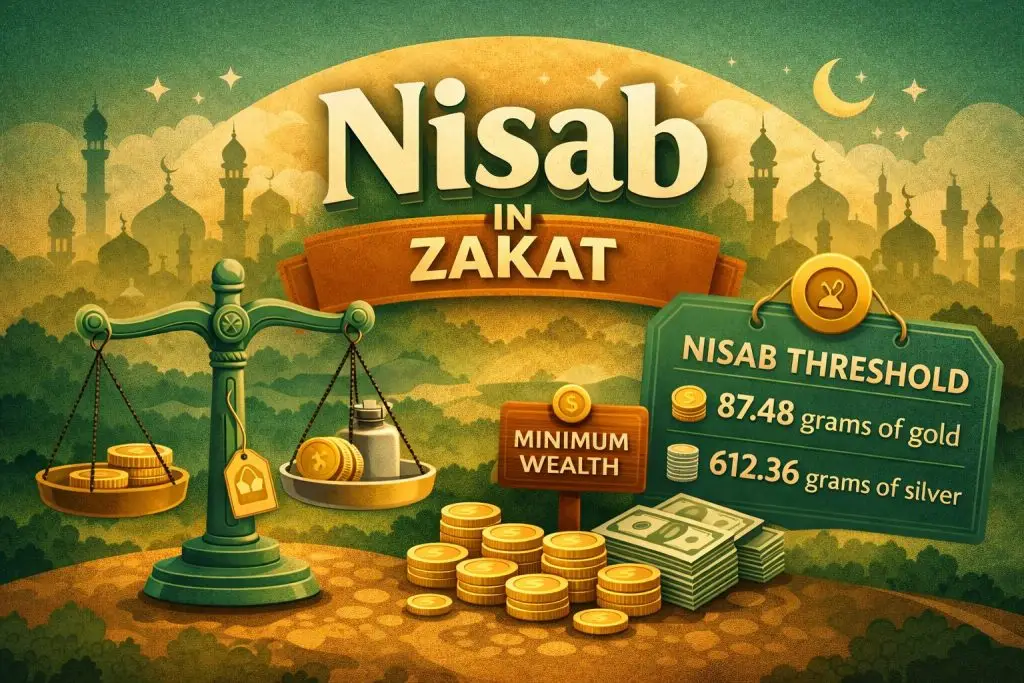
Nisab refers to the lowest level of wealth a Muslim must have before being obligated to pay Zakat. When a person’s total eligible assets meet or surpass this threshold and remain for a full lunar year, Zakat becomes mandatory. The nisab amount is determined according to the current value of gold or silver and may change based on market prices and financial conditions.
In 2026:
Nisab is generally equivalent to:
- 85 grams of gold
OR - 595 grams of silver
The exact value depends on current market prices in your country.
If your total eligible wealth exceeds the nisab amount and remains for one lunar year, you must pay Zakat.
Types of Wealth Subject to Zakat
Zakat is not required on all possessions a person owns. It applies only to certain types of wealth that meet specific conditions under Islamic guidelines. Generally, Zakat is due on assets that have growth potential or are held for savings and investment purposes. Personal belongings used in daily life, such as homes, clothing, and household items, are not included in Zakat calculation.
1. Cash and Savings
- Bank balance
- Cash at home
- Digital money
Zakat = 2.5% of total savings after one year.
2. Gold and Silver
Gold and silver are always subject to Zakat if above nisab.
Even:
- Jewelry
- Investment gold
- Stored gold
Must be included in calculation.
3. Business Assets
If you own a business, Zakat applies to:
- Stock inventory
- Merchandise
- Business profits
- Trade goods
Liabilities are deducted before calculation.
4. Investment Assets
Zakat applies to:
- Stocks (market value)
- Shares
- Investment funds
Only profitable and tradable assets are included.
5. Agricultural Produce
Zakat applies to crops and harvests.
- 10% if naturally irrigated
- 5% if irrigation costs apply
Assets That Are NOT Subject to Zakat
Not all possessions are included in Zakat calculation. Personal-use items such as your primary home, clothing, furniture, and household appliances are not subject to Zakat. Vehicles used for daily transportation are also exempt. Additionally, business equipment, tools, and machinery used for operations are excluded, ensuring Zakat applies only to qualifying wealth and savings.
Some possessions are exempt:
❌ Personal house
❌ Personal car
❌ Household furniture
❌ Personal clothes
❌ Personal tools
These are not counted unless used for business.
How to Calculate Zakat (Step-by-Step Guide)
Step 1: Calculate Total Eligible Assets
Add:
- Cash
- Gold value
- Silver value
- Business stock
- Investments
Step 2: Deduct Liabilities
Subtract:
- Loans due
- Bills payable
- Immediate debts
Step 3: Check Against Nisab
If remaining amount exceeds nisab, Zakat is required.
Step 4: Calculate 2.5%
Formula:
Zakat = Total Eligible Wealth × 2.5%
Example:
If total eligible wealth = $10,000
Zakat = 10,000 × 2.5%
= $250
When Should Zakat Be Paid?
Zakat should be paid once your wealth reaches the nisab threshold and remains above it for one complete lunar year. The due date is based on the Islamic calendar, not the Gregorian year. Many Muslims prefer paying Zakat during Ramadan for greater reward, but it must be paid immediately once it becomes obligatory.
Zakat is paid:
- After completing one lunar year
- On the same date each year
- Or during Ramadan (recommended for extra reward)
Many Muslims prefer paying Zakat in Ramadan for increased blessings.
Who Can Receive Zakat?
The Quran specifies eight categories of Zakat recipients:
- Poor people: Individuals who have very little income or resources and cannot meet their basic living expenses.
- Needy individuals: Those who struggle financially and require assistance to cover essential needs like food, shelter, and clothing.
- Zakat administrators: People appointed to collect, manage, and distribute Zakat funds properly.
- New Muslims: Recent converts who may need financial support to strengthen their stability and faith.
- Debt-ridden people: Individuals burdened with legitimate debts they are unable to repay.
- Freeing slaves: Funds allocated to help liberate those in bondage or captivity.
- Travelers in need: Stranded travelers who lack resources to return home safely.
- In the path of Allah: Causes that serve and uphold the welfare and advancement of the Muslim community.
Zakat must be distributed only to these groups.
Best Practices for Paying Zakat in 2026
- Calculate accurately: Carefully assess all eligible assets and apply the correct percentage to ensure precise Zakat payment.
- Keep financial records: Maintain clear documentation of savings, investments, and debts to simplify annual Zakat calculation.
- Pay to verified organizations: Choose trustworthy and authentic institutions to guarantee proper and lawful distribution of Zakat.
- Prioritize local needy people: Supporting vulnerable individuals within your community helps strengthen local welfare and unity.
- Avoid delaying payment: Pay Zakat promptly once it becomes due to fulfill your obligation responsibly and sincerely.
Common Mistakes in Zakat Calculation
- Ignoring Gold Jewelry: Many people forget to include gold in calculation.
- Not Deducting Debts Properly: Some deduct all loans incorrectly instead of only due payments.
- Confusing Zakat With Charity: Zakat is mandatory, charity is optional.
- Paying Without Proper Calculation:Always calculate carefully before payment.
Zakat vs Sadaqah – Key Difference
| Zakat | Sadaqah |
|---|---|
| Mandatory | Voluntary |
| Fixed percentage (2.5%) | No fixed amount |
| Paid yearly | Paid anytime |
Benefits of Paying Zakat
- Gains Allah’s blessings:Paying Zakat earns spiritual rewards and increases divine blessings in one’s wealth and life.
- Protects wealth from loss: It safeguards earnings by bringing stability and protection through fulfilling a religious duty.
- Purifies income: Zakat cleanses earnings from excess attachment and ensures lawful and ethical wealth.
- Helps poor communities: It provides financial support to those in need and improves living conditions for vulnerable people.
- Brings social harmony: By promoting fairness and sharing, Zakat strengthens unity and cooperation within society.
Zakat strengthens faith and financial discipline.
Zakat for Salary Earners (Detailed Explanation)
Many Muslims earn a regular monthly income and often wonder if Zakat is required on their salary. Zakat does not apply to income immediately, but it becomes obligatory when savings from that salary reach the nisab threshold and remain above it for one full lunar year.
Does Salary Require Zakat?
Yes — if your total savings from salary exceed the nisab and remain for one lunar year, you must pay Zakat.
How to Calculate Zakat on Salary
There are two common methods:
✅ Method 1: Annual Savings Method
- Determine the full amount of your savings at the close of the year.
- Deduct necessary expenses and debts.
- Apply 2.5% on remaining amount.
Example:
If you saved $20,000 in one year:
Zakat = 20,000 × 2.5% = $500
✅ Method 2: Monthly Payment Method
Some people prefer paying Zakat monthly.
Formula:
(Monthly Savings × 2.5%) ÷ 12
This method helps manage payments easily and avoids lump-sum pressure.

Zakat for Business Owners
Business owners are required to pay Zakat on eligible business assets once they reach the nisab threshold and complete one lunar year. This includes inventory, trade goods, and retained profits. Zakat is calculated on the net value after deducting immediate business liabilities and outstanding debts.
What to Include:
- Inventory stock
- Goods for sale
- Cash in business account
- Profits retained
What to Exclude:
- Business property
- Equipment
- Machines used for operations
Business Zakat Formula:
Total Business Assets – Business Debts = Net Amount
Then apply:
Net Amount × 2.5%
Example:
Inventory value = $50,000
Business debts = $10,000
Net = $40,000
Zakat = 40,000 × 2.5% = $1,000
Zakat on Gold and Jewelry
Gold is always subject to Zakat if it exceeds nisab.
Important Rules:
- Even personal gold jewelry is included.
- Gold used occasionally still counts.
- Only gold above nisab is taxable.
Calculation Example:
If you own gold worth $10,000:
Zakat = 10,000 × 2.5% = $250
Silver is calculated similarly.
Zakat on Stocks and Investments
Investments such as shares and stocks require Zakat depending on intention.
If Held for Trading:
Calculate market value and apply 2.5%.
If Long-Term Investment:
Zakat is paid on:
- Dividends
- Profits
- Liquid value
Formula:
Investment Value × 2.5%
Zakat on Cryptocurrency
Cryptocurrency is subject to Zakat if it meets the nisab threshold and is held for investment or trading purposes. Many scholars consider digital assets taxable when they retain value for one lunar year. Zakat is calculated at 2.5% on the current market value after deducting liabilities. Accurate record-keeping is essential for proper calculation and compliance.
- It is owned for investment
- It reaches nisab
- It is held for one lunar year
Calculation:
Crypto Market Value × 2.5%
Since digital assets fluctuate, calculate based on current market value.
Zakat on Agricultural Products
Zakat is applicable to agricultural products such as crops and harvests when they reach the required amount. It is paid at the time of harvest rather than annually. The rate is either 10% for naturally irrigated land or 5% if irrigation costs are involved. This ensures fair contribution from agricultural income toward supporting those in need.
Rules:
- 10% if land is naturally watered
- 5% if irrigation costs apply
Example:
If harvest value = $5,000
Zakat = $500 (if natural irrigation)
This is paid at harvest time, not yearly.
Zakat on Livestock
Livestock such as:
- Cattle
- Sheep
- Goats
Are subject to Zakat if they reach minimum required numbers and are grazing freely.
Specific calculation depends on quantity and type of animals.
Zakat Payment Methods in 2026
Muslims can pay Zakat through different channels:
✅ Direct payment to poor families
✅ Islamic charities
✅ Mosque distribution programs
✅ Authorized Zakat institutions
✅ Online Zakat platforms
Always verify authenticity before donating.
Can Zakat Be Paid in Installments?
Yes, Zakat can be paid in installments if necessary.
However:
- Full amount must be calculated first
- Payment should not be delayed unnecessarily
Best practice is paying as soon as it becomes due.
Can Zakat Be Paid in Advance?
Yes, paying Zakat before the due date is allowed.
Many Muslims pay early during Ramadan for greater reward.
If wealth increases later, adjust calculation accordingly.
Zakat vs Tax – Key Difference
| Zakat | Tax |
|---|---|
| Religious obligation | Government obligation |
| Fixed percentage | Variable rate |
| Paid to specific groups | Used for public services |
Paying tax does not replace Zakat.
Common Zakat Calculation Errors
- Ignoring Hidden Assets: Some people forget savings accounts, digital money, or investment profits.
- Not Updating Asset Value: Always calculate based on current market value.
- Excluding Gold Jewelry: Jewelry is often mistakenly ignored.
- Delaying Payment: Delays reduce spiritual benefits.
Benefits of Paying Zakat in 2026
Spiritual Benefits
- Strengthens faith
- Removes sins related to wealth
- Increases blessings
Social Benefits
- Supports poor families
- Reduces poverty
- Promotes economic equality
Financial Benefits
- Encourages savings discipline
- Purifies income sources
Frequently Asked Questions About Zakat (FAQ Section)
1. Is Zakat mandatory every year?
Yes, if wealth exceeds nisab and completes one lunar year.
2. Can Zakat be given to relatives?
Yes — if they qualify as eligible recipients (except parents and children).
3. Can Zakat be given to build mosques?
No — mosques do not fall under eligible categories.
4. What happens if someone delays Zakat?
They remain obligated and must pay it as soon as possible.
5. Does debt reduce Zakat?
Only immediate payable debts can be deducted.
Conclusion on Zakat Rules
Understanding Zakat Rules is vital for every Muslim who meets the required financial conditions. Zakat is more than a yearly payment; it is a sacred act of worship that purifies wealth and nurtures spiritual growth. Learning the correct nisab threshold, identifying eligible assets, applying accurate calculation methods, and ensuring proper distribution are all essential steps in fulfilling this obligation correctly.
By following authentic Zakat Rules, Muslims contribute to social justice and help reduce poverty within the community. It strengthens compassion, responsibility, and unity among believers. Paying Zakat sincerely and on time not only supports those in need but also brings blessings and balance to personal wealth. Proper understanding ensures that this important pillar of Islam is fulfilled with confidence and accountability.