
Pakistan peace talks Iran US conflict deepens as Iran warns of US ground assault plans, raising fears of a dangerous regional war and global crisis.

Introduction
The geopolitical landscape of the Middle East has entered one of its most volatile phases in recent years, as tensions between Iran and the United States continue to escalate dangerously. Amid intensifying military exchanges, rising civilian casualties, and global economic fears, Pakistan has stepped forward with a bold diplomatic initiative—offering to host peace talks between the two adversaries.
At the same time, Iran has issued alarming accusations that the United States is not merely posturing but actively preparing for a potential ground assault. These claims, coupled with visible military deployments in the region, have raised fears of a broader war that could engulf multiple countries and destabilize critical global trade routes.
This unfolding crisis presents a stark contrast: while diplomacy struggles to gain traction, military preparations continue to intensify. The world now watches closely as Pakistan attempts to position itself as a mediator in one of the most dangerous conflicts of the decade.
Escalating Conflict: From Airstrikes to Ground War Fears

The conflict between Iran and a US-led coalition has rapidly evolved from limited engagements into a multi-front confrontation involving regional powers and proxy forces. Israeli airstrikes across Iranian territory, Iranian missile retaliation, and involvement from groups such as Hezbollah and the Houthis have expanded the scope of the conflict significantly.
What makes the current moment particularly alarming is the growing speculation—and now direct accusation—of a potential US ground invasion. Iranian officials have publicly warned that any deployment of American ground troops would trigger severe retaliation, signaling a shift from conventional conflict to potentially prolonged warfare.
Reports indicate that US military assets, including Marines and airborne units, are being deployed to strategic locations across the Middle East. While Washington has maintained that these deployments are precautionary, Tehran interprets them as evidence of imminent offensive plans.
The possibility of ground operations marks a critical escalation point. Unlike airstrikes or naval blockades, a ground invasion would significantly increase casualties, prolong the conflict, and deepen regional instability.
Iran’s Accusations: Distrust and Strategic Messaging
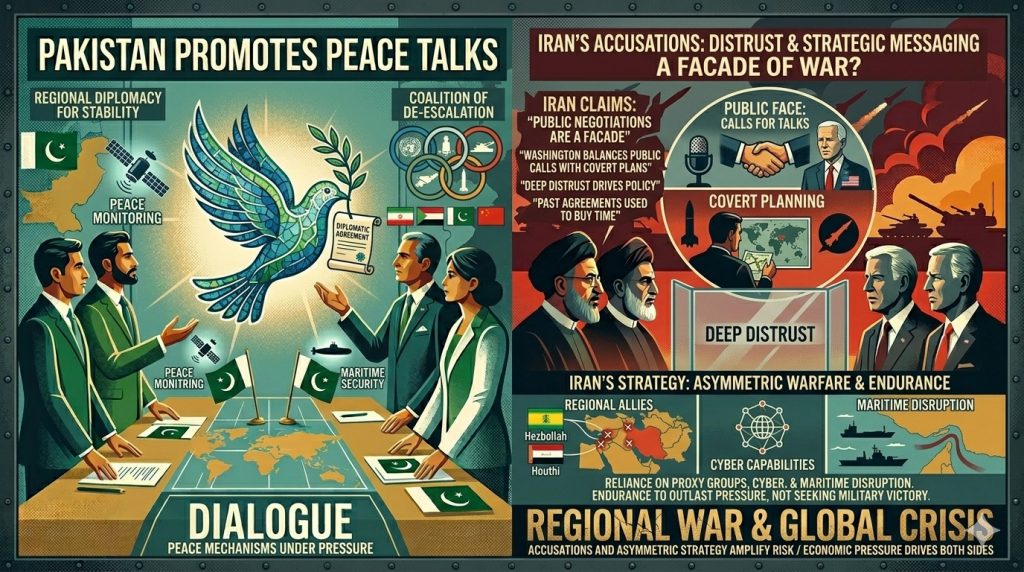
Iran’s leadership has been vocal in its accusations against the United States, claiming that diplomatic overtures are merely a façade masking preparations for war. According to Iranian officials, Washington is attempting to balance public calls for negotiations with covert military planning.
This dual-track perception has fueled deep distrust. Iranian authorities argue that past experiences have shown negotiations can be used strategically to buy time or create favorable conditions for military action.
Moreover, Iran has emphasized its readiness for asymmetric warfare. Rather than engaging in direct confrontation with US forces, Tehran is expected to rely on regional allies and proxy groups, cyber capabilities, and disruption of critical maritime routes.
This approach reflects a broader strategy of endurance—surviving long enough to outlast political and economic pressure rather than seeking outright military victory.
Pakistan’s Diplomatic Initiative: A Calculated Move
Against this backdrop of escalating tensions, Pakistan has emerged as an unexpected but significant diplomatic actor. The country has announced its willingness to host peace talks between Iran and the United States, positioning itself as a neutral facilitator capable of bridging the gap between the two sides.
Pakistan’s leadership has emphasized that dialogue remains the only viable path toward de-escalation. Officials have also confirmed that Islamabad is already playing a behind-the-scenes role, relaying messages between Washington and Tehran in an effort to keep communication channels open.
The proposed talks would not only involve the US and Iran but also include regional stakeholders such as Saudi Arabia, Turkey, and Egypt—countries that have a direct interest in preventing further escalation.
Pakistan’s involvement is not entirely unprecedented. The country has previously played mediating roles in international conflicts, including facilitating negotiations between the United States and the Taliban. However, the stakes in the current crisis are significantly higher, with global implications.
Why Pakistan? Strategic Position and Motivations
Pakistan’s decision to step into this role is driven by a combination of strategic, political, and economic considerations.
1. Regional Stability
As a neighboring country with close ties to both Iran and Gulf states, Pakistan has a vested interest in preventing a full-scale war. Instability in the Middle East could have direct consequences for Pakistan’s security and economy.
2. Diplomatic Relevance
By hosting peace talks, Pakistan aims to enhance its global diplomatic standing and reassert itself as a key player in international conflict resolution.
3. Balancing Alliances
Pakistan maintains relationships with multiple stakeholders, including Saudi Arabia, Iran, and the United States. Acting as a mediator allows Islamabad to balance these relationships without taking sides.
4. Economic Concerns
The conflict has already disrupted global oil markets and shipping routes, particularly through the Strait of Hormuz. A prolonged crisis could have severe economic repercussions for energy-importing countries like Pakistan.
Challenges Facing the Peace Talks
Despite Pakistan’s efforts, significant obstacles remain.
Lack of Trust
One of the biggest challenges is the deep mistrust between Iran and the United States. Tehran’s accusations of a planned ground assault make it unlikely that negotiations will begin on a positive footing.
Conflicting Objectives
The United States has proposed a comprehensive plan that includes restrictions on Iran’s nuclear program and regional activities. Iran, however, has rejected these terms and presented its own counterproposals.
Ongoing Military Operations
Active hostilities make diplomacy extremely difficult. As long as missile strikes and air raids continue, the chances of meaningful dialogue remain limited.
Regional Complications
The involvement of multiple actors—Israel, Hezbollah, the Houthis, and Gulf states—adds layers of complexity to the conflict. Any peace agreement would need to address these interconnected issues.
Global Implications: النفط, Trade, and Security
The crisis extends far beyond the Middle East, with significant global implications.
Energy Markets
The Strait of Hormuz, a critical chokepoint for global oil supply, has been partially disrupted. Any further escalation could lead to a sharp increase in oil prices, affecting economies worldwide.
Maritime Security
Attacks on shipping routes, including the Bab el-Mandeb Strait, threaten international trade. These disruptions could lead to increased shipping costs and delays.
Economic Fallout
Rising energy prices and supply chain disruptions could trigger inflation and slow economic growth globally.
Political Divisions
The conflict has also sparked political debates within countries, including the United States, where public opinion remains divided over military involvement.
The Role of Regional Powers
Countries such as Saudi Arabia, Turkey, and Egypt are actively involved in diplomatic efforts to prevent further escalation. These nations have participated in discussions hosted by Pakistan, emphasizing the need for a coordinated regional response.
Their involvement highlights the broader regional stakes. A full-scale war would not only affect Iran and the United States but could also draw in neighboring countries, leading to a much wider conflict.
Military Build-Up: Signals and Risks
The deployment of US forces to the region has been interpreted in different ways. While American officials describe these movements as defensive, Iran views them as preparation for offensive operations.
This divergence in interpretation increases the risk of miscalculation. Even a minor incident could escalate into a larger conflict if both sides perceive the other’s actions as aggressive.
Military analysts warn that once ground troops are deployed, de-escalation becomes significantly more difficult. The presence of troops on the ground often leads to prolonged engagements and higher casualties.
Can Diplomacy Prevail?
The success of Pakistan’s initiative will depend on several factors:
- Willingness of both the US and Iran to engage in dialogue
- Reduction in active hostilities
- Support from regional and global powers
- Flexibility in negotiating positions
While the prospects for immediate success appear uncertain, the very existence of a diplomatic channel offers a glimmer of hope.
History has shown that even the most entrenched conflicts can be resolved through sustained dialogue and compromise. However, achieving this requires political will and mutual trust—both of which are currently in short supply.
Conclusion: Pakistan peace talks
The current crisis represents a critical juncture in international relations. As Iran accuses the United States of preparing for a ground assault, the risk of a full-scale war looms large. At the same time, Pakistan’s efforts to host peace talks offer a potential pathway toward de-escalation.
The coming weeks will be निर्णायक. If diplomacy gains momentum, it could prevent a catastrophic conflict with global consequences. If it fails, the world may witness one of the most significant military confrontations of the 21st century.
In this high-stakes environment, the balance between الحرب and السلام remains fragile. Pakistan’s role as a mediator could prove pivotal—but only if all parties are willing to choose dialogue over destruction.