

Learn the correct Eid ul Adha Prayer Rules 2026. Find the perfect Niyyah, exact number of extra Takbeers, and a simple step-by-step Hanafi Namaz guide.
Instroduction: Eid ul Adha Prayer Rules 2026
Eid-ul-Azha (the Festival of Sacrifice) stands as one of the most sacred landmarks on the Islamic calendar. In Bangladesh, Eid-ul-Azha 2026 will be observed on Wednesday, May 27, 2026 (dependent on the regional sighting of the Zil Hajj crescent moon). Aside from the deeply profound act of Qurbani (animal sacrifice), the cornerstone of this holy day is the congregational Eid salah performed on Eid morning.
Because the Eid congregation happens only twice a year, it is incredibly common for believers to feel slightly unsure about the specific steps. Unlike daily prayers or the weekly Juma’ah congregation, Eid namaz features a unique structure, including an exact layout of additional Takbeers (proclamations of “Allahu Akbar”) and a distinct script for your Niyyah (intention).
Whether you are praying at the historic National Eidgah in Dhaka, a local regional Jame Masjid, or reviewing the steps at home, mastering the Eid ul Adha Prayer Rules ensures your worship is performed perfectly without mistakes. This definitive guide covers the complete step-by-step Hanafi method—the primary school of thought followed across Bangladesh—complete with Arabic transliterations, timing guidelines, and crucial Sunnah etiquettes.
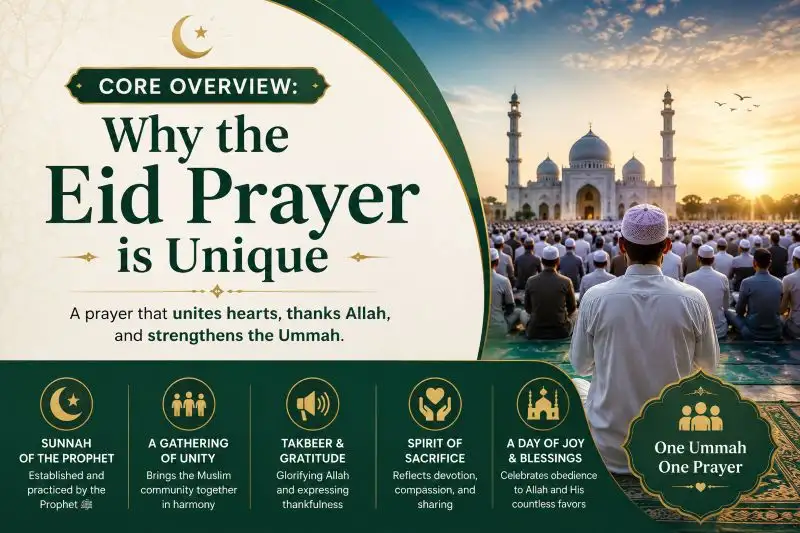
🕋 Core Overview: Why the Eid Prayer is Unique
Before diving into the steps, it is essential to understand the theological classification of Eid namaz. According to the Hanafi school of jurisprudence, performing the Eid prayer is Wajib (necessary/compulsory) upon every sane, adult male who is physically capable.
There are three major characteristics that separate the Eid congregation from your typical daily prayers:
- No Adhan or Iqamah: There is no standard call to prayer (Adhan) or secondary call (Iqamah) proclaimed before the lines form. The Imam will simply call the rows to straighten by saying “As-Salatu Jami’ah” or a similar phrase.
- The Six Additional Takbeers: The prayer consists of exactly two Rak’ats (units). However, it contains six extra Takbeers (three in the first Rak’at, three in the second Rak’at) where you will raise your hands to your ears.
- The Khutbah is Post-Prayer: For Friday Juma’ah prayers, the sermon is delivered before the prayer. For Eid, the sequence is flipped: the two Rak’ats of prayer are performed first, followed immediately by the mandatory two-part Arabic sermon (Khutbah).
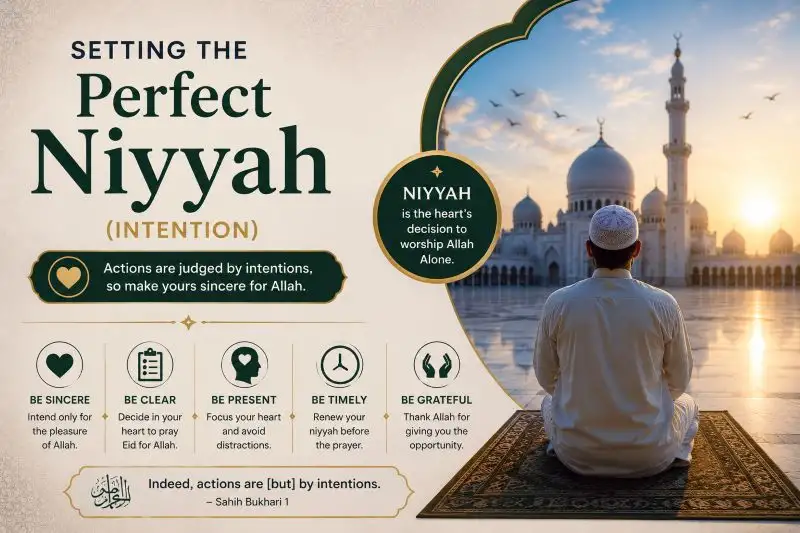
🎯 Step 1: Setting the Perfect Niyyah (Intention)
Every act of worship in Islam begins with the heart. Your Niyyah does not necessarily need to be verbalized out loud; clarifying your exact mental focus is what matters most. However, many find comfort in silently reciting the intention in their native tongue or Arabic to steady their focus.
To formulate your intention properly for the Hanafi method, you must explicitly account for four things:
- The specific prayer (Eid-ul-Azha)
- The number of Rak’ats (Two)
- The presence of the additional Takbeers (Six)
- Following the Imam in congregation
Formulating Your Niyyah:
In English: “I intend to pray two Rak’ats of Wajib Eid-ul-Azha prayer with six additional Takbeers, following this Imam, for the sake of Allah Almighty.”
In Bangla (নিয়ত): “আমি আল্লাহর সন্তুষ্টির জন্য ইমামের পিছনে অতিরিক্ত ৬ তাকবীরসহ ওয়াজিব ঈদুল আজহার দুই রাকাত নামাজ আদায়ের নিয়ত করছি।”
Once your intention is clear in your heart, stand straight with your shoulders aligned in the row, leaving no gaps between you and the person next to you.
📜 Step 2: First Rak’at Breakdown (The Opening Extra Takbeers)
The first Rak’at can surprise people because the extra Takbeers happen right at the beginning, immediately after the opening of the prayer. Pay close attention to what your hands should do after each proclamation.
1. Takbeer-e-Tahrimah (The Opening)
The Imam will raise his hands to his earlobes and say “Allahu Akbar” out loud. You will mirror this action: raise your hands to your ears, recite “Allahu Akbar” softly to yourself, and then fold your hands neatly below your navel (or on your chest, depending on your school of practice).
2. Reciting the Sana
Once your hands are folded, remain completely silent and recite the Sana (opening praise) quietly to yourself:
“Subhanaka Allahumma wa bihamdika, wa tabarakasmuka, wa ta’ala jadduka, wa la ilaha ghairuk.”
3. The 3 Extra Takbeers (Crucial Phase)
This is where the unique Eid ul Adha Prayer Rules come into play. The Imam will now say three additional Takbeers back-to-back. Follow this hand movement carefully:
- First Extra Takbeer: The Imam says “Allahu Akbar”. You raise your hands to your ears, say it quietly, and then drop your hands down to your sides (do not fold them).
- Second Extra Takbeer: The Imam says “Allahu Akbar”. You raise your hands to your ears again, say it quietly, and drop your hands down to your sides a second time.
- Third Extra Takbeer: The Imam says “Allahu Akbar”. You raise your hands to your ears, say it quietly, and this time fold your hands together below your navel.
The Golden Rule for the First Rak’at: Drop, Drop, Fold. You only fold your hands on the final Takbeer before the Quranic recitation begins.
4. Quranic Recitation & Ruku
Once your hands are safely folded, the Imam will quietly recite Ta’awwudh (A’udhu billahi minash-shaitanir-rajim) and Tasmiah (Bismillahir-Rahmanir-Rahim). He will then loudly recite Surah Al-Fatiha followed by another secondary Surah (frequently Surah Al-A’la).
Your job during this phase is to listen silently and attentively. After the recitation, the Imam will say “Allahu Akbar” and transition into the bowing position (Ruku), followed by the two traditional prostrations (Sajdah), exactly like a regular daily prayer.

🔄 Step 3: Second Rak’at Breakdown (The Closing Extra Takbeers)
After completing the second Sajdah of the first Rak’at, the Imam will say “Allahu Akbar” and rise to stand up for the second Rak’at. Immediately upon standing, fold your hands below your navel. Do not wait for a Takbeer here.
1. Quranic Recitation First
Unlike the first Rak’at, the second unit flips the order. The Imam will immediately begin reciting Surah Al-Fatiha followed by another Surah (frequently Surah Al-Ghashiyah) while your hands remain folded. Listen calmly.
2. The 3 Extra Takbeers (Pre-Ruku)
As soon as the Imam finishes the secondary Surah, he will pause for a brief moment and then proclaim the three additional pre-Ruku Takbeers.
- First Extra Takbeer: The Imam says “Allahu Akbar”. Raise your hands to your ears, say it quietly, and drop your hands to your sides.
- Second Extra Takbeer: The Imam says “Allahu Akbar”. Raise your hands to your ears, say it quietly, and drop your hands to your sides.
- Third Extra Takbeer: The Imam says “Allahu Akbar”. Raise your hands to your ears, say it quietly, and drop your hands to your sides.
The Golden Rule for the Second Rak’at: Drop, Drop, Drop. You do not fold your hands at all during these extra Takbeers because you are about to go directly into Ruku.
3. Transitioning to Ruku (The Fourth Takbeer)
Right after the third extra Takbeer, the Imam will say a fourth “Allahu Akbar”.
Warning Note: Do not raise your hands for this fourth Takbeer! This is the normal transition Takbeer to enter the bowing position. Simply bow directly into Ruku upon hearing it.
4. Completing the Namaz
From the Ruku, the prayer returns to standard operating procedure:
- Rise with Praise: Stand up straight from the bowing position while listening to the Imam say “Sami’ Allahu liman hamidah,” and silently respond with “Rabbana lakal hamd.”
- Perform Prostrations: Move smoothly down to the floor to complete two standard, deeply focused prostrations (Sajdah) just like daily prayers.
- The Final Sitting: Sit upright for the final Tashahhud posture to quietly recite Attahiyyaat, Durood-e-Ibrahim, and Dua Masoorah.
- Conclude the Prayer: Complete the congregation by mirroring the Imam as he turns his face right then left, proclaiming “Assalamu Alaikum wa Rahmatullah.”
The Quick-Glance Eid Takbeer Matrix
To ensure you never get confused during the live congregation, use this simplified structural cheat sheet. It maps out your exact physical hand movements relative to the leader’s vocal announcements.
| Congregational Phase | Vocal Command | Mandatory Physical Reaction |
| Opening of First Unit | Takbeer-e-Tahrimah | Lift palms to earlobes ➔ Fold below navel |
| First Unit: Bonus #1 | Allahu Akbar | Lift palms to earlobes ➔ Release down to sides |
| First Unit: Bonus #2 | Allahu Akbar | Lift palms to earlobes ➔ Release down to sides |
| First Unit: Bonus #3 | Allahu Akbar | Lift palms to earlobes ➔ Fold below navel |
| Starting Second Unit | Arising from Floor | Stand straight immediately ➔ Fold below navel |
| Second Unit: Bonus #1 | Allahu Akbar (Post-Verses) | Lift palms to earlobes ➔ Release down to sides |
| Second Unit: Bonus #2 | Allahu Akbar | Lift palms to earlobes ➔ Release down to sides |
| Second Unit: Bonus #3 | Allahu Akbar | Lift palms to earlobes ➔ Release down to sides |
| Transition to Bowing | Allahu Akbar | Keep arms relaxed ➔ Incline directly into Ruku |
Reviewing this specific rhythm right before leaving your house will help lock your physical muscle memory into place, allowing you to focus entirely on your spiritual devotion without worrying about making a technical mistake in the rows.
📢 Step 4: The Post-Prayer Eid Khutbah (Sermon)
Once the final Salaam is completed, the prayer itself is officially over, but your worship is not yet complete. The Imam will immediately step up to the minbar (pulpit) to deliver the two-part Eid Khutbah.
Critical Rule: Listening to the Eid Khutbah is Wajib (mandatory).
It is a common error among many attendees to stand up right after the Salaam to greet friends or leave the prayer ground early to beat traffic. Doing so is highly discouraged (Makruh). Sit silently, avoid talking, texting, or making noise, and listen to the spiritual reminders regarding sacrifice, charity, and community brotherhood. Once the Khutbah concludes, the Imam will lead a collective Dua (supplication), marking the official end of the congregation.
🕌 Sacrosanct Morning Protocols: 5 Essential Sunnah Traditions
To fully immerse yourself in the spiritual blessings of this holy morning and mirror the exact traditions of Prophet Muhammad (ﷺ), integrate these highly rewarded acts into your holiday routine:
1. Prioritize Ritual Purification and Oral Hygiene: Start your morning early by performing Ghusl (a full ritual bath) to ensure complete physical cleanliness. Clean your teeth thoroughly using a traditional Miswak or toothbrush to freshen your breath. Before stepping out, apply a generous amount of premium, non-alcoholic fragrance (Attar) to signify the sacred importance of the day.
2. Adorn Yourself in Elegant Attire: Embrace the prophetic tradition of excellent personal presentation by dressing in your finest garments. Your outfit does not need to be newly purchased; simply choosing your most immaculate, well-pressed traditional clothing—such as a clean, white Panjabi—respects the dignity and communal joy of the celebration.
3. Observe the Prophet’s Fasting Routine: Maintain a crucial distinction from the guidelines of Eid-ul-Fitr. For this occasion, it is a highly encouraged prophetic practice to abstain from consuming any food or water prior to the morning congregation. Ideally, break this short fast after the prayer concludes, making your initial meal from the cooked meat of your household’s personal animal sacrifice (Qurbani).
4. Proclaim the Praises of Allah Along the Journey: As you make your way toward the open-air prayer ground (Eidgah) or local mosque, keep your tongue busy with remembrance. It is a Sunnah for men to recite the Takbeer-e-Tashreeq audibly, and for women to whisper it silently, continuously declaring the greatness of God throughout the entire commute.
5. Switch Your Travel Routes: Choose a different path when heading to and returning from the prayer venue. Walk or drive along one specific street to arrive at the congregation, but deliberately take an alternate road when going home. This prophetic custom maximizes your spiritual rewards by tracking more steps and allows you to encounter, smile at, and exchange warm holiday wishes with a completely different group of neighbors.
❓ Frequently Asked Questions (FAQs)
Q1: What happens if I miss the first Rak’at and join late?
If you arrive late and find the Imam already in the second Rak’at, do not panic. Join the congregation normally. Once the Imam says the final dual-sided Salaam to end the prayer, do not perform Salaam. Instead, stand up immediately to complete your missed first Rak’at. You will quietly recite the Sana, perform the 3 extra Takbeers (Drop, Drop, Fold), recite Surah Al-Fatiha and a secondary Surah silently, and then finish the Rak’at, Ruku, and Sajdah on your own.
Q2: Is the Eid prayer mandatory for women in Bangladesh?
According to the Hanafi school, Eid namaz is Wajib specifically for adult males. However, in recent years, major open-air prayer venues across Bangladesh—such as the Central Eidgah grounds and specific model mosques—have set up dedicated, structurally secure partitions for female worshipers. If a woman wishes to attend to hear the sermon and benefit from the community Dua, it is completely permissible provided proper hijab and modest protocols are maintained.
Q3: What is the exact timeframe to perform the Eid prayer?
The timeframe for Eid salah begins roughly 15 to 20 minutes after sunrise (once the sun has cleared the horizon by the height of a spear) and lasts until just before Zawal (when the sun reaches its absolute peak at midday, preceding Dhuhr). Mosques in urban areas typically schedule their congregations between 7:00 AM and 8:30 AM to allow ample time for the later animal sacrifices.
Q4: What happens if the Imam forgets to perform the extra Takbeers?
If the Imam makes an error or bypasses the extra Takbeers accidentally, he must perform the Sajdah-e-Sahw (two compensatory prostrations of forgetfulness) during the final sitting of the prayer to validate the namaz. As a follower, you must remain patient and follow the Imam’s corrective physical movements completely.
Final Summary Checklist for Eid Morning
Before stepping onto your prayer rug this Eid-ul-Azha, take a moment to scan this quick operational blueprint. Keeping these structural steps fresh in your mind ensures complete spiritual focus and zero mistakes when the congregation begins.
- The Intent (Niyyah): In your heart, clarify that you are performing two mandatory (Wajib) units of Eid-ul-Azha prayer, incorporating the six unique additional Takbeers, while following the leadership of the present Imam.
- First Unit (Rak’at 1) Sequence: Listen for the opening Takbeer-e-Tahrimah and fold your hands to recite the Sana. Next, follow the Imam through three consecutive extra Takbeers. Remember the physical rule of thumb: Drop your hands, drop your hands, and fold them on the third. Listen silently to the loud Quranic recitation before moving into the standard bowing and prostration positions.
- Second Unit (Rak’at 2) Sequence: Rise straight up into a standing posture with your hands already folded. The Imam will immediately recite the Quranic verses. Following this, he will proclaim the final three extra Takbeers. The physical movement here flips: Drop your hands, drop your hands, and drop them a third time. On the fourth aloud Takbeer, transition immediately into the bowing posture (Ruku) without raising your hands to your ears.
- Post-Prayer Etiquette: Once the final Salaam concludes, remain seated calmly. It is mandatory (Wajib) to listen to the two-part Arabic sermon (Khutbah) before standing up to exchange holiday greetings.
May your dedicated acts of devotion, morning prayers, and sacred sacrifices be profoundly accepted by Allah Almighty during this holy season. Taqabbalallahu Minna Wa Minkum—may divine blessings be upon us and upon you!