
Donald Trump pressures Congress to pass the SAVE America Act, warning he may block other bills, raising tensions ahead of the U.S. midterm elections.
By Nandita Bose and Steve Holland – March 8, 2026

In a dramatic escalation of political pressure in Washington, Donald Trump has warned that he may refuse to sign any new legislation unless Congress approves a controversial voting bill backed by Republicans. The move signals a deepening political standoff over election laws ahead of the upcoming U.S. midterm elections later this year.
The legislation at the center of the debate — the SAVE America Act — has already passed the Republican-controlled United States House of Representatives but faces significant obstacles in the United States Senate. While Republicans currently hold the Senate majority, the bill would still require bipartisan support to overcome procedural barriers.
Trump’s ultimatum has sparked intense reactions from both parties, raising concerns about legislative gridlock, election integrity debates, and the future of voting laws in the United States.
Donald Trump’s Latest Political Ultimatum
Speaking through a post on his social media platform Truth Social, Trump made it clear that the SAVE America Act is now a top priority for his administration. He warned lawmakers that he could block other bills unless they prioritize the voting legislation.
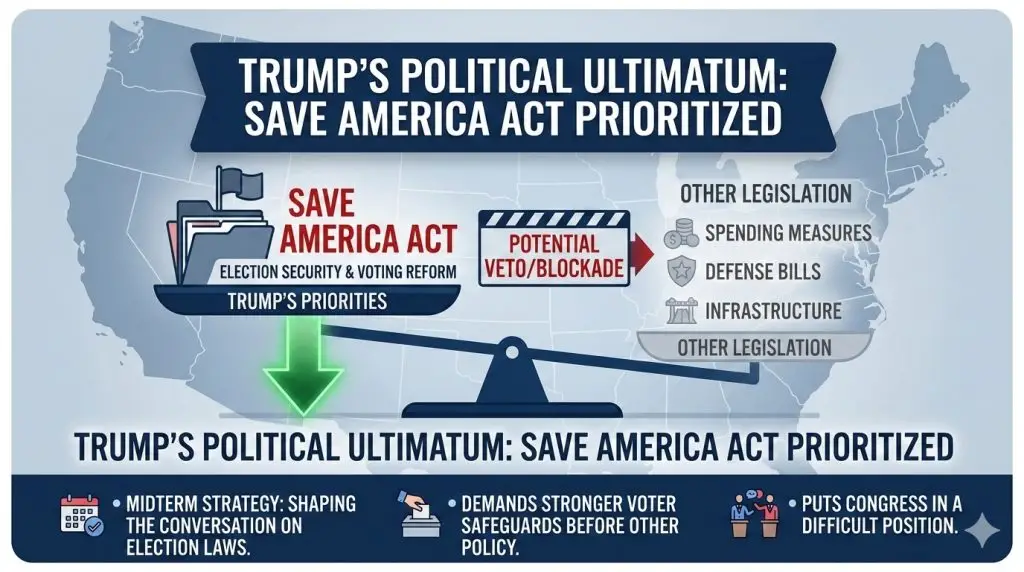
Trump wrote that election security must be strengthened and that the country cannot move forward with other policies while what he describes as “weak voter safeguards” remain in place.
The president’s message effectively places Congress in a difficult position. If lawmakers want other policy initiatives to move forward — including spending measures, defense bills, and infrastructure legislation — they may need to address the voting bill first.
Political analysts say the move reflects Trump’s aggressive strategy to reshape the national conversation around election laws before the November midterm elections.
What Is the SAVE America Act?
The SAVE America Act is a Republican-backed voting bill designed to tighten voter identification rules and strengthen federal election oversight.
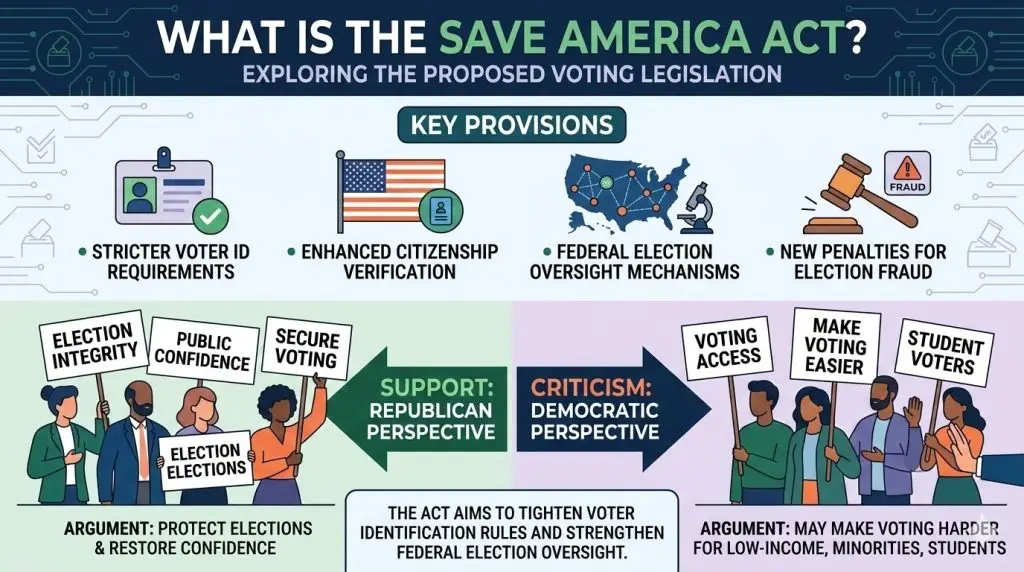
Supporters of the bill say it aims to ensure election integrity and restore public confidence in the electoral system. Key provisions of the legislation reportedly include:
- Stricter voter identification requirements
- Enhanced verification of voter citizenship
- Federal oversight mechanisms for voter registration systems
- New penalties for election fraud
Republican lawmakers argue that these changes are necessary to protect U.S. elections from potential irregularities.
However, critics — mostly from the Democratic Party — argue that the bill could make voting more difficult for certain groups, particularly low-income citizens, students, and minority voters.
Senate Challenge and Filibuster Barrier
Even though Republicans hold a majority in the Senate, passing the SAVE America Act will not be easy.

Under Senate rules, most major legislation must overcome the filibuster, which requires 60 votes to advance to a final vote. This means that several Democratic senators would need to support the bill — something that currently appears unlikely.
Chuck Schumer, the Senate Democratic leader, has already indicated that Democrats do not support the measure.
Schumer stated that Democratic lawmakers believe the bill could undermine voting access rather than strengthen democracy.
Without bipartisan backing, the bill could remain stalled in the Senate despite Trump’s pressure campaign.
Rising Political Tensions in Washington
Trump’s warning has intensified political tensions in Washington, where lawmakers are already facing sharp divisions on several major policy issues.
Democrats accuse the president of using legislative leverage to force through controversial election reforms. They argue that threatening to block unrelated legislation could harm the functioning of government.
Republicans, however, say election security is a fundamental issue that deserves urgent attention.
Several Republican leaders have defended the SAVE America Act, arguing that Americans deserve confidence in their electoral system.
Political observers say the dispute reflects broader partisan disagreements over voting rights that have shaped U.S. politics for years.
Trump’s Previous Threats and Executive Order Possibility
This is not the first time Trump has pushed aggressively for stricter election rules.
Earlier in his presidency, Trump threatened to bypass Congress entirely by issuing an executive order related to voting regulations.
While the exact details of such an order were unclear, legal experts warned that the president’s authority over election rules is limited because U.S. elections are largely managed by states.
Still, the possibility of executive action added pressure on lawmakers to negotiate.
The latest threat to block other legislation shows Trump is continuing to use political leverage to push his agenda.
Reaction From Democrats
Democrats quickly criticized Trump’s stance, accusing him of prioritizing partisan election reforms over broader national priorities.
Several Democratic lawmakers warned that tying unrelated legislation to a controversial voting bill could create serious governance problems.
Critics argue that Congress must address issues such as economic policy, national security, healthcare, and infrastructure without political ultimatums.
Democrats also say the SAVE America Act risks suppressing voter participation by introducing new requirements that may be difficult for some citizens to meet.
Voting rights organizations have echoed these concerns, arguing that the bill could disproportionately affect marginalized communities.
Republican Support and Election Integrity Arguments
Republicans, however, maintain that the bill is essential for protecting election integrity.
Supporters say that stricter verification processes will prevent fraud and ensure that only eligible citizens vote in federal elections.
Some Republican lawmakers have pointed to polling data suggesting that many Americans support stronger voter identification requirements.
They argue that public trust in elections has become a major issue in U.S. politics, and reforms are needed to address voter concerns.
Republican strategists also believe that focusing on election security could energize their voter base ahead of the midterm elections.
The Midterm Elections Factor
The timing of Trump’s push is closely linked to the upcoming U.S. midterm elections.
Midterm elections determine control of Congress and often serve as a referendum on the sitting president’s policies.
By emphasizing election integrity now, Trump may be attempting to frame the political debate before voters head to the polls.
Analysts say the strategy could help mobilize Republican supporters who view voting laws as a critical issue.
At the same time, Democrats are likely to use the controversy to rally their own voters around voting rights and democratic participation.
The debate over the SAVE America Act could therefore become a major campaign issue nationwide.
Potential Impact on Other Legislation
Trump’s threat to block unrelated legislation could have significant consequences for the U.S. legislative agenda.
Congress is currently considering a range of major bills, including:
- Federal budget and spending measures
- Defense authorization legislation
- Infrastructure and energy initiatives
- Economic policy reforms
If Trump follows through on his warning, many of these initiatives could face delays.
Government officials warn that prolonged legislative gridlock could create uncertainty for businesses, government agencies, and international partners.
Some lawmakers are already calling for compromise to avoid a political stalemate.
Legal and Constitutional Debate
The controversy surrounding the SAVE America Act has also sparked debate among constitutional experts.
Some legal scholars argue that Congress has the authority to regulate federal elections under the U.S. Constitution.
Others say that states traditionally control many aspects of election administration, which could limit the scope of federal legislation.
If the bill eventually becomes law, it could face legal challenges in federal courts.
Civil rights organizations have indicated they may pursue lawsuits if they believe the legislation restricts voting rights.
Public Opinion and National Debate
Across the United States, public opinion on voting laws remains deeply divided.
Supporters of stricter voter identification laws argue that they are common in many democracies and help prevent fraud.
Opponents counter that documented cases of widespread voter fraud are extremely rare and that new restrictions could discourage participation.
The debate has become one of the most polarizing issues in American politics.
Many voters view the issue through a partisan lens, making compromise increasingly difficult.
International Attention
The dispute over U.S. voting laws is also attracting international attention.
Observers from around the world often monitor American elections as a benchmark for democratic governance.
Political analysts say that debates about election rules in the United States can influence discussions about democracy globally.
Countries that look to the United States as a model may watch closely how the debate over voting access and election security unfolds.
What Happens Next?
The future of the SAVE America Act now depends largely on the Senate.
Republican leaders must decide whether they can secure enough votes to overcome the filibuster.
Meanwhile, Democrats appear determined to resist the bill in its current form.
Negotiations could lead to amendments or compromise proposals, but no clear path forward has emerged yet.
Trump’s continued pressure on Congress suggests that the battle over election laws is far from over.
A Defining Political Battle
As the United States approaches the 2026 midterm elections, the fight over voting legislation is becoming one of the defining political battles of the year.
Trump’s threat to block other legislation raises the stakes significantly, forcing lawmakers to confront difficult choices about priorities and compromise.
Whether the SAVE America Act ultimately becomes law or remains stalled in the Senate, the debate surrounding it will likely shape the national political landscape for months to come.
For now, Washington remains locked in a tense standoff — one that could determine not only the future of voting laws but also the direction of American politics in the years ahead.