
Iran nuclear deal crisis deepens as Tehran signals exit. Explore 7 alarming reasons behind Iran’s move and the global risks unfolding now.
Introduction: A Critical Turning Point in Global Security

The possibility of Iran withdrawing from the nuclear agreement has become one of the most urgent geopolitical concerns of 2026. What was once considered a landmark diplomatic achievement is now at risk of collapsing entirely. As tensions escalate across the Middle East, the question dominating international discourse is no longer if the deal is weakening—but why Iran is now seriously considering walking away from it.
At the heart of this issue lies a complex web of distrust, military confrontation, economic hardship, and shifting political power. The situation is not simply about nuclear technology; it reflects a broader struggle over sovereignty, influence, and survival in an increasingly volatile region.
Understanding Iran’s motivations requires a deep dive into both historical context and current developments. This report explores the layered reasons behind Tehran’s stance, the strategic calculations involved, and the potential consequences for global stability.
Background: The Rise and Decline of the Nuclear Agreement
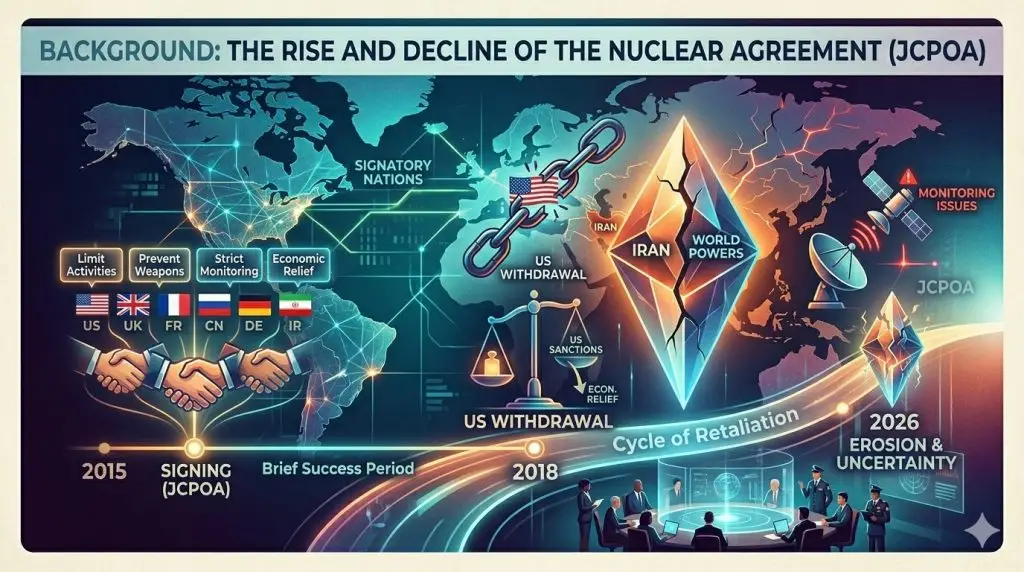
The nuclear agreement, formally called the Joint Comprehensive Plan of Action (JCPOA), was signed in 2015 between Iran and major world powers, including the United States, the United Kingdom, France, Russia, China, and Germany.
The deal was designed to:
- Limit Iran’s nuclear activities
- Prevent the development of nuclear weapons
- Introduce strict international monitoring
- Provide economic relief through the lifting of sanctions
For a brief period, the agreement was seen as a diplomatic success. Iran reduced its uranium enrichment levels and allowed inspections, while sanctions relief helped stabilize its economy.
However, the situation changed dramatically in 2018 when Donald Trump withdrew the United States from the agreement. This move reintroduced harsh sanctions and triggered a cycle of retaliation.
Since then, the deal has been steadily eroding. By 2026, it exists more in principle than in practice.
Reason 1: Intensifying Military Pressure and Regional Conflict
One of the most immediate triggers behind Iran’s withdrawal consideration is the sharp rise in military tension.
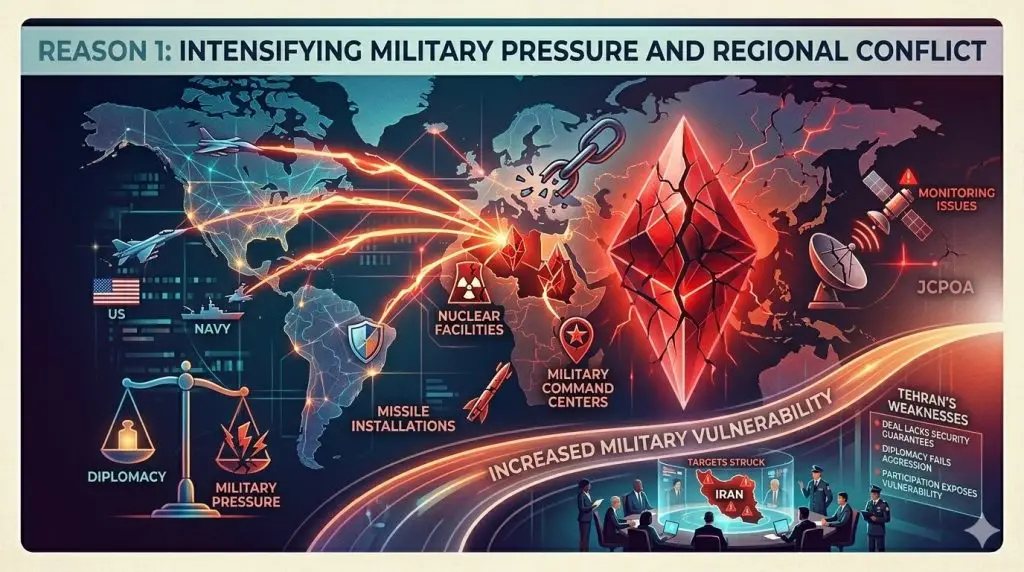
In recent months, Iranian territory and strategic assets have been targeted by coordinated strikes attributed to the United States and Israel. These operations reportedly focused on:
- Nuclear facilities
- Missile installations
- Military command centers
Such actions have had a profound psychological and political impact inside Iran.
From Tehran’s perspective:
- The attacks demonstrate that the nuclear agreement does not guarantee security
- Diplomatic compliance has not prevented military aggression
- Continued participation may expose the country to further vulnerability
This perception has strengthened arguments within Iran that maintaining restrictions under the deal offers little protection while limiting defensive capabilities.
Reason 2: Deepening Distrust Toward the United States
Trust between negotiating parties is essential for any agreement to function. In this case, that trust has been severely damaged.
Iranian leaders frequently point to the U.S. withdrawal in 2018 as proof that commitments can be reversed without warning. Even after changes in leadership in Washington, skepticism remains deeply rooted.
Tehran’s concerns include:
- The possibility of future policy reversals
- Inconsistent implementation of sanctions relief
- Additional demands beyond the original agreement
From Iran’s viewpoint, entering or remaining in a deal with a partner perceived as unreliable is strategically risky.
This erosion of confidence has made it politically difficult for Iranian officials to justify continued compliance, especially in the face of domestic criticism.
Reason 3: Crushing Economic Sanctions and Domestic Strain
Economic pressure is perhaps the most tangible factor influencing Iran’s decision-making.
Years of sanctions have:
- Severely restricted oil exports
- Limited access to international banking systems
- Increased inflation and unemployment
- Reduced purchasing power among citizens
The economic strain has also led to:
- Public dissatisfaction
- Periodic protests
- Growing frustration with government policies
Iran initially agreed to the nuclear deal in part to secure economic relief. However, with sanctions largely back in place, many Iranians believe the agreement has failed to deliver its promised benefits.
As a result, policymakers in Tehran face a difficult reality: continuing to comply with restrictions without receiving economic advantages is increasingly viewed as unsustainable.
Reason 4: Expiration of Key Commitments and Legal Ambiguity
Another important factor is the expiration of several provisions within the original agreement.
Over time, certain restrictions on Iran’s nuclear activities were designed to phase out. As these deadlines pass, the legal framework of the deal becomes less clear.
Iran argues that:
- Some of its obligations are no longer binding
- The agreement has effectively lost its original structure
- Continuing compliance is a voluntary choice rather than a legal requirement
This interpretation provides a basis for Iran to expand its nuclear activities without formally violating the agreement—while also strengthening arguments for a complete withdrawal.
Reason 5: National Security Calculations and Strategic Deterrence
Iran’s nuclear ambitions cannot be separated from its broader security concerns.
Surrounded by regional rivals and facing ongoing military threats, Iran views technological advancement as a form of deterrence. The idea is not necessarily to build a nuclear weapon immediately, but to possess the capability to do so if needed.
Recent developments have reinforced this mindset:
- Military strikes on Iranian soil
- Assassinations of key figures
- Increasing regional instability
Within this context, many Iranian strategists believe:
- Limiting nuclear development weakens national defense
- Strategic ambiguity enhances deterrence
- Withdrawal from the deal could accelerate technological progress
This security-driven perspective plays a central role in shaping Tehran’s decisions.
Reason 6: Internal Political Shifts and the Rise of Hardliners
Domestic politics in Iran have undergone significant changes in recent years.
Hardline factions—who have long criticized the nuclear agreement—are gaining influence. These groups argue that diplomacy with the West has failed and advocate for a more assertive approach.
Their key positions include:
- Rejecting further negotiations under current conditions
- Expanding nuclear capabilities without restrictions
- Prioritizing self-reliance over international cooperation
The decline of moderate voices has shifted the political balance, making it more likely that Iran will adopt a tougher stance.
This internal dynamic is critical because foreign policy decisions in Iran are closely tied to domestic power structures.
Reason 7: Tactical Leverage in High-Stakes Negotiations
While the threat of withdrawal is serious, it may also serve as a strategic bargaining tool.
By signaling a willingness to exit the deal, Iran can:
- Increase pressure on negotiating partners
- Demand immediate and meaningful sanctions relief
- Push for guarantees against future policy reversals
This approach allows Iran to strengthen its negotiating position without necessarily committing to a full withdrawal.
In diplomatic terms, such tactics are not uncommon. However, they carry risks, especially if miscalculations lead to unintended escalation.
Regional and Global Consequences
If Iran decides to withdraw completely, the impact could extend far beyond the Middle East.
1. Increased Risk of Nuclear Proliferation
Other countries in the region may pursue nuclear capabilities, leading to a dangerous arms race.
2. Escalation of Military Conflict
Tensions between Iran, the United States, and Israel could intensify, potentially resulting in a broader war.
3. Disruption of Global Energy Markets
Iran plays a crucial role in global oil supply. Any escalation could affect shipping routes and drive up energy prices.
4. Weakening of International Agreements
The collapse of the deal could undermine confidence in diplomatic solutions to global conflicts.
Possible Future Scenarios (Iran nuclear deal crisis)
Looking ahead, several outcomes are possible:
Scenario 1: Complete Withdrawal
Iran exits the agreement and accelerates its nuclear program without restrictions.
Scenario 2: Gradual Non-Compliance
Iran remains formally in the deal but continues to ignore key limitations.
Scenario 3: Renewed Diplomacy
A revised agreement is negotiated with updated terms and stronger guarantees.
Scenario 4: Escalating Conflict
Diplomatic efforts fail, leading to increased military confrontation.
Each scenario carries significant risks and uncertainties.
Conclusion: A Defining Moment for Global Diplomacy
Iran’s consideration of withdrawing from the nuclear deal reflects a convergence of military, economic, political, and strategic pressures.
From Tehran’s perspective, the agreement no longer provides:
- Security
- Economic relief
- Reliable partnership
At the same time, the international community faces a complex challenge: preventing nuclear escalation while addressing Iran’s grievances.
The decisions made in the coming months will shape not only the future of the nuclear agreement but also the broader trajectory of global security.
In a world already marked by instability, the stakes could not be higher.