
Israel strikes Beirut escalate war tensions fast. Discover 7 shocking developments, rising casualties, and growing risks of a devastating regional conflict.
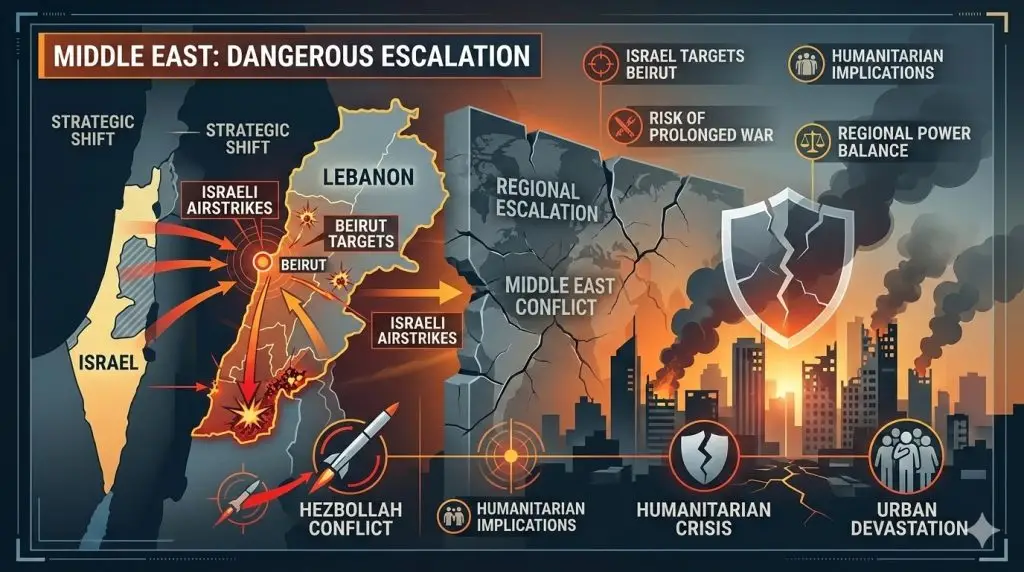
The Middle East has once again been thrust into a dangerous phase of escalation as Israel launched airstrikes targeting central Beirut, marking a significant turning point in the ongoing conflict with Hezbollah. What was once largely confined to border skirmishes between Israel and southern Lebanon has now evolved into a broader confrontation, raising fears of a prolonged regional war with devastating consequences.
This development signals not just a military escalation, but a strategic shift that could reshape the balance of power across the region. As the conflict expands into densely populated urban areas, the humanitarian, political, and economic implications are becoming increasingly severe.
A New Phase of Conflict
For months, tensions between Israel and Hezbollah had been simmering along the southern Lebanese border. Frequent exchanges of rockets, artillery fire, and drone strikes had become almost routine. However, the decision to strike central Beirut represents a dramatic escalation.
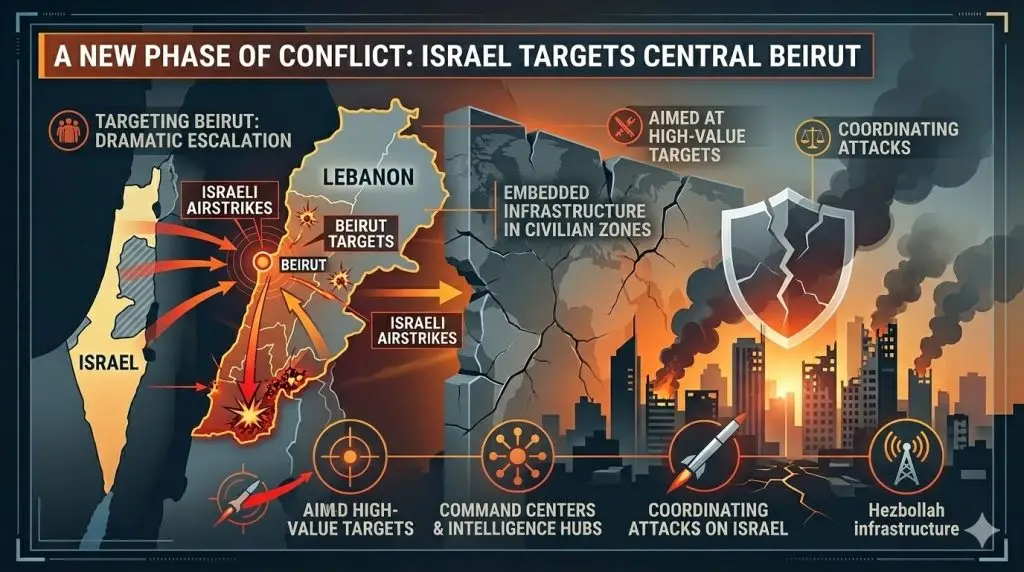
Central Beirut is not just another strategic location—it is the political, economic, and cultural heart of Lebanon. Targeting this area sends a powerful message: Israel is willing to expand the battlefield beyond traditional frontlines to strike at what it perceives as key Hezbollah infrastructure embedded within civilian zones.
Israeli officials have stated that the strikes were aimed at “high-value targets,” including command centers, intelligence hubs, and weapons storage facilities allegedly operated by Hezbollah. According to Israeli military sources, these sites play a critical role in coordinating attacks against Israeli territory.
Why Central Beirut Matters
Unlike southern Lebanon, which has long been a Hezbollah stronghold, central Beirut is a densely populated urban center with a mix of residential buildings, government offices, and commercial hubs. Striking this area introduces a new level of risk, particularly for civilians.
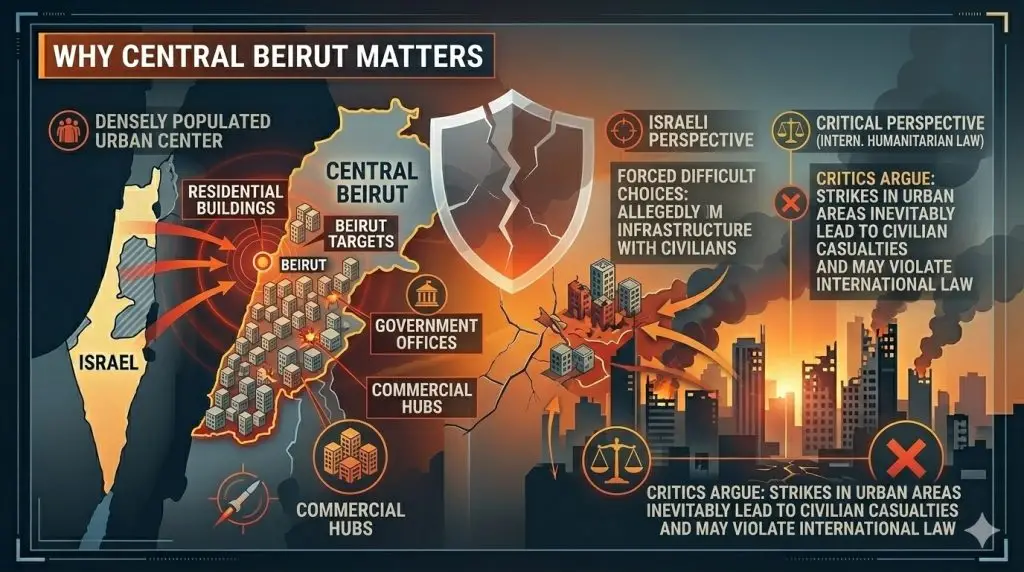
From a strategic perspective, Hezbollah has often been accused by Israel of integrating its military infrastructure within civilian areas, making it difficult to target without causing collateral damage. This tactic, Israel argues, forces difficult choices in military operations.
However, critics—including international human rights organizations—argue that strikes in urban areas like Beirut inevitably lead to civilian casualties and may violate international humanitarian law.
The Immediate Impact on Civilians
Reports emerging from Beirut indicate widespread panic and destruction following the strikes. Several structures were either heavily damaged or completely leveled, while rescue teams faced difficulties accessing impacted zones due to continuing safety risks.
Residents described scenes of chaos—shattered glass, collapsed structures, and families fleeing their homes in fear of further attacks. Hospitals in Beirut were quickly overwhelmed with injured civilians, many of whom had no direct connection to the conflict.
Electricity outages and disrupted communication networks added to the confusion, making it difficult for families to locate loved ones. The psychological impact has been equally severe, as the capital—once considered relatively safer than the south—now faces the reality of direct attack.
Israel’s Strategic Objectives
Israel’s military strategy appears to be evolving in response to the growing capabilities of Hezbollah. Over the years, Hezbollah has developed a sophisticated arsenal that includes long-range rockets, precision-guided missiles, and drones.
Israeli officials argue that allowing Hezbollah to operate freely poses an existential threat. By targeting central Beirut, Israel aims to:
- Disrupt Hezbollah’s command and control systems
- Destroy advanced weapon stockpiles
- Deter further attacks by demonstrating expanded reach
- Pressure Hezbollah politically within Lebanon
From Israel’s perspective, these strikes are part of a broader effort to weaken Hezbollah’s operational capacity before it can launch larger-scale attacks.
Hezbollah’s Response
In response to the strikes, Hezbollah has vowed retaliation. The group has already intensified rocket and drone attacks targeting northern Israel, including civilian areas.
Hezbollah leaders have framed the strikes on Beirut as an attack on all of Lebanon, not just the group itself. This narrative is designed to rally domestic support and justify further escalation.
The risk here is clear: each round of retaliation increases the likelihood of a full-scale war that neither side may be able to control.
The Role of Iran
No discussion of Hezbollah is complete without acknowledging its close ties to Iran. Iran has long supported Hezbollah financially, militarily, and ideologically.
Analysts believe that any significant escalation between Israel and Hezbollah could draw Iran more directly into the conflict. While Iran has so far avoided direct confrontation, it has strongly condemned Israel’s actions and signaled continued support for its allies.
This raises the stakes considerably. A direct confrontation between Israel and Iran could trigger a wider regional war involving multiple countries.
Regional Reactions
The strikes on Beirut have prompted strong reactions across the Middle East and beyond.
Countries in the region have expressed deep concern over the escalating violence. Many fear that the conflict could spread beyond Lebanon and Israel, destabilizing already fragile political environments.
Arab nations have largely condemned the strikes, calling for restraint and an immediate ceasefire. Meanwhile, Western countries have taken a more cautious approach, emphasizing Israel’s right to self-defense while also urging measures to protect civilians.
The United States موقف
The United States has played a critical role in shaping the response to the conflict. As a key ally of Israel, the U.S. has reaffirmed its support for Israel’s security.
At the same time, American officials have expressed concern about the potential for escalation. Diplomatic efforts are reportedly underway to prevent the conflict from spiraling into a broader war.
The U.S. is also working with international partners to ensure humanitarian aid reaches affected areas in Lebanon.
Humanitarian Crisis Deepens
As the conflict intensifies, Lebanon faces the risk of a severe humanitarian crisis. The country was already grappling with economic collapse, political instability, and the aftermath of previous conflicts.
The strikes on Beirut have exacerbated these challenges:
- Thousands of people have been displaced
- Critical infrastructure has been damaged
- Medical facilities are under immense strain
- Access to basic services is increasingly limited
International aid organizations are warning that the situation could deteriorate rapidly if the fighting continues.
Economic Consequences
The economic impact of the strikes is also significant. Beirut is the financial center of Lebanon, and damage to its infrastructure could have long-term consequences for the country’s already fragile economy.
Many companies have had to shut down operations, distribution networks have been interrupted, and investor trust has been significantly weakened. Tourism—once a vital source of revenue—has come to a near standstill.
For a country already in economic crisis, the additional burden of war could prove devastating.
Risk of Regional War
Perhaps the most concerning aspect of the situation is the risk of a broader regional conflict.
Several factors contribute to this خطر:
- Hezbollah’s deep ties to Iran
- Israel’s determination to neutralize threats
- The involvement of other regional actors
- The potential for miscalculation or unintended escalation
If the conflict spreads, it could draw in countries across the Middle East, leading to a war with far-reaching consequences.
Historical Context
The current escalation cannot be understood without considering the long history of conflict between Israel and Hezbollah.
Since the 1980s, Hezbollah has positioned itself as a المقاومة force against Israel. The two sides fought a major war in 2006, which resulted in significant casualties and destruction on both sides.
While there have been periods of relative calm since then, tensions have never fully subsided. The current conflict represents one of the most serious escalations in years.
International Calls for Ceasefire
In response to the escalating violence, international leaders and organizations have called for an immediate ceasefire.
The United Nations has urged both sides to exercise restraint and prioritize the protection of civilians. Human rights groups have also called for investigations into potential violations of international law.
However, achieving a ceasefire may prove difficult. Both Israel and Hezbollah appear determined to pursue their objectives, at least in the short term.
الإعلام and Information Warfare
Another महत्वपूर्ण dimension of the conflict is the battle for narrative control.
Both sides are actively using media and social platforms to shape public perception. Israel emphasizes its right to self-defense and the threat posed by Hezbollah, while Hezbollah portrays itself as defending Lebanon from aggression.
Misinformation and propaganda have further complicated the situation, making it difficult for observers to distinguish between verified facts and exaggerated claims.
What Comes Next?
The situation remains highly fluid, with multiple संभावनाएँ for how the conflict could evolve:
- Escalation into full-scale war – Continued strikes and retaliation could lead to a broader conflict
- Limited confrontation – Both sides may attempt to contain the fighting while maintaining pressure
- Diplomatic resolution – International mediation could lead to a ceasefire agreement
At this stage, predicting the outcome is extremely challenging. Much will depend on the actions of key players, including Israel, Hezbollah, Iran, and the United States.
Conclusion: Israel strikes Beirut
The Israeli strikes on central Beirut mark a critical turning point in the ongoing conflict. What began as localized clashes has now expanded into a more dangerous and व्यापक confrontation.
The humanitarian toll is rising, the risk of regional war is increasing, and the prospects for peace remain uncertain. As the world watches closely, the coming days and weeks will be crucial in determining whether the situation can be de-escalated—or whether it will spiral into a conflict with far-reaching consequences.
In a region already marked by instability, the الأحداث in Beirut serve as a stark reminder of how quickly tensions can escalate—and how difficult it can be to bring them back under control.