
Trump threatens strikes on Kharg Island, escalating Iran tensions and raising fears of a Gulf war that could disrupt global oil supply and energy markets.
Introduction
Tensions in the Middle East have intensified dramatically after Donald Trump, the President of the United States, warned that his country could launch additional military strikes on Iran’s Kharg Island. The warning came during the third week of an escalating conflict involving the United States, Iran, and Israel, which has already caused significant casualties and triggered fears of a broader regional war.
Kharg Island is far more than a typical military objective. It is one of the most important oil export hubs in the world and the central point of Iran’s energy economy. Any military action there could shake global oil markets, affect international shipping routes, and potentially draw multiple countries into a larger conflict.
Trump’s remarks have therefore raised alarm among diplomats, economists, and security experts around the world. They warn that attacks on such a critical energy facility could lead to economic instability and deepen the geopolitical crisis unfolding across the Persian Gulf.
The Recent Escalation
The current confrontation intensified after U.S. and Israeli forces launched a series of strikes against Iranian military targets earlier in the conflict. According to reports, some of these strikes were directed at positions on Kharg Island, which hosts the main terminal used for exporting Iranian crude oil.
In a recent interview, Trump claimed that American forces had already inflicted severe damage on the island’s military infrastructure. However, he warned that further attacks could follow, suggesting the U.S. might strike again if Iran continued its actions against American allies or interfered with maritime traffic in the region.
The U.S. president even hinted that the island could be targeted again “a few more times,” a statement that immediately sparked criticism and concern internationally.
For many observers, this comment reflected the increasingly aggressive rhetoric surrounding the conflict.
Iran’s Response and Rising Hostilities
Iran reacted strongly to the American warning. Iranian officials accused the United States of escalating the war and warned that Tehran would retaliate against any further attacks on its territory.
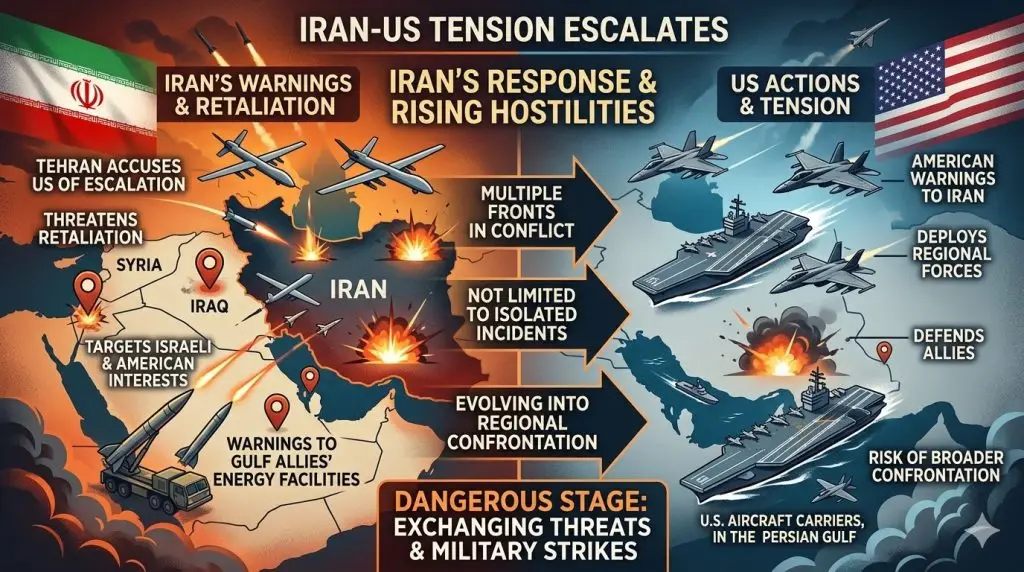
Iran has already launched missile and drone strikes targeting Israeli and American interests in the region. These actions demonstrate that the conflict is no longer limited to isolated incidents but is evolving into a broader confrontation across multiple fronts.
At the same time, Iranian authorities have threatened to target energy facilities belonging to U.S. allies in the Gulf if attacks on Iranian infrastructure continue.
The conflict has therefore reached a dangerous stage, with both sides exchanging threats and military strikes.
Why Kharg Island Is So Important
To understand why the situation is so serious, it is essential to examine the strategic importance of Kharg Island.

Located in the northern part of the Persian Gulf, the island lies just a short distance from Iran’s mainland. Despite its relatively small size, it plays a massive role in the global energy system.
Experts estimate that around 90–95% of Iran’s crude oil exports pass through Kharg Island, making it the backbone of the country’s oil economy.
Large oil tankers arrive at the island to load crude oil that is transported via pipelines from major Iranian oilfields. The island contains:
- Huge oil storage tanks
- Deep-water terminals for supertankers
- Pipeline networks connected to oil fields
- Processing and shipping facilities
Because of these facilities, Kharg Island functions as Iran’s main gateway for oil exports to the world.
The Strait of Hormuz Factor
Another key element in the crisis is the nearby Strait of Hormuz, one of the most important shipping routes on Earth.
Each day, millions of barrels of crude oil move through this narrow sea route linking the Persian Gulf with international energy markets. Analysts estimate that roughly one-fifth of the world’s oil supply travels through this route.
Because tankers leaving Kharg Island must pass through the Strait of Hormuz, any disruption there could impact global energy supplies.
Trump has urged allied nations to send warships to the region to help secure this vital maritime route.
However, several countries have been cautious about becoming directly involved in the conflict.
Calls for International Support
During his statements about Kharg Island, Trump also called on several major nations to help secure shipping lanes in the Gulf.
These countries reportedly include:
- United Kingdom
- France
- Japan
- South Korea
- China
The idea is to create an international naval presence to protect oil tankers and ensure safe passage through the Strait of Hormuz.
However, many governments remain reluctant to escalate tensions further by joining a military coalition.
Impact on Global Oil Markets
One of the biggest concerns about attacks on Kharg Island is the potential impact on global energy markets.
Because Iran exports large amounts of oil through the island, any disruption could immediately reduce global supply.
Energy analysts warn that:
- Oil prices could surge dramatically.
- Shipping insurance costs could increase.
- Global inflation might rise due to higher energy costs.
Some experts say that destroying export facilities on Kharg Island could halt Iran’s oil exports for weeks or even months.
Such a disruption would likely push crude prices significantly higher and create uncertainty in global markets.
Countries that rely heavily on imported oil—especially in Asia—could be severely affected.
Iran’s Economic Dependence on Kharg Island
Iran’s economy is deeply dependent on oil revenue, and Kharg Island sits at the center of that system.
The island handles a vast portion of the country’s petroleum exports each year. Pipelines carry crude oil from offshore fields such as:
- Aboozar
- Dorood
- Forouzan
These pipelines feed into storage tanks and loading terminals on Kharg Island before the oil is shipped overseas.
Because of this infrastructure, experts often describe Kharg Island as the financial lifeline of Iran’s government.
If the island were destroyed or heavily damaged, Iran’s ability to generate revenue from oil exports could collapse.
Military Strategy Behind Targeting the Island
From a strategic perspective, targeting Kharg Island could weaken Iran economically rather than militarily.
Some military analysts believe that destroying the island’s export facilities could pressure Iran to negotiate or reduce its regional activities.
However, others argue that such a strategy could backfire.
If Iran loses its ability to export oil, it might respond by attacking oil infrastructure across the Gulf region.
Possible targets could include facilities in:
- Saudi Arabia
- United Arab Emirates
- Qatar
Such attacks could turn the conflict into a full-scale regional war.
Rising Regional Tensions
The crisis has already affected several countries in the Gulf region.
Reports indicate that missile and drone strikes have targeted locations near major oil infrastructure in neighboring states.
Although some facilities have resumed operations, the attacks have highlighted how vulnerable the region’s energy infrastructure can be.
If the conflict continues to escalate, more countries may become directly involved.
Diplomatic Efforts and Challenges
Despite the growing tensions, diplomatic efforts to reduce the conflict are ongoing.
Several governments have attempted to mediate between the United States and Iran. Efforts to reach an agreement have not advanced much yet.
Trump has indicated that Iran has attempted to discuss possible terms for ending the conflict but said the proposals were not acceptable.
Meanwhile, Iranian leaders insist they will not negotiate while their country remains under military attack.
This deadlock has made a diplomatic solution increasingly difficult.
The Human Cost of the Conflict
While the focus of global attention has been on strategic targets and geopolitical consequences, the conflict has also caused significant human suffering.
Reports suggest that more than 2,000 people have already been killed, many of them in Iran.
Civilian infrastructure has been damaged, and thousands of people have been displaced.
Hospitals and emergency services in several areas have been overwhelmed by casualties.
Humanitarian organizations warn that the situation could worsen if the fighting continues.
International Reactions
The international community has reacted with concern to Trump’s comments about further strikes on Kharg Island.
Some governments have urged restraint and called for immediate negotiations to prevent a larger war.
Others have criticized the rhetoric used by political leaders, warning that inflammatory statements could worsen tensions.
Energy analysts and economists have also expressed concern about the potential economic impact of the conflict.
Risk of a Wider War
One of the biggest fears among experts is that the conflict could expand beyond Iran and Israel.
If oil facilities across the Gulf become targets, multiple countries might be drawn into the war.
Additionally, attacks on shipping routes could disrupt international trade and global energy supplies.
Because the Persian Gulf is one of the world’s most strategically important regions, even a limited conflict there can have global consequences.
What Happens Next?
The situation remains extremely unpredictable.
Several possible scenarios could unfold:
1. Continued Military Escalation
The United States may carry out additional strikes, and Iran could respond with further attacks on regional targets.
2. Diplomatic Negotiations
International pressure could eventually push both sides toward negotiations.
3. Regional War
If energy infrastructure across the Gulf becomes a target, the conflict could expand into a wider regional war.
Conclusion: Trump threatens strikes on Kharg Island
The threat of additional strikes on Kharg Island highlights the growing dangers in the ongoing Middle East conflict.
What began as targeted military operations has quickly evolved into a crisis with global implications.
Because Kharg Island sits at the heart of Iran’s oil export system and lies close to one of the world’s most important shipping routes, any attack there could trigger economic and geopolitical consequences far beyond the region.
As tensions continue to rise, the world is watching closely to see whether diplomacy can prevent further escalation—or whether the conflict will move toward an even more dangerous phase.