
Jamuna River Bangladesh Explore its origin, history, erosion, chars, floods, and economic importance in this clear, engaging guide to its dynamic river system.
Introduction: Jamuna River Bangladesh 2026
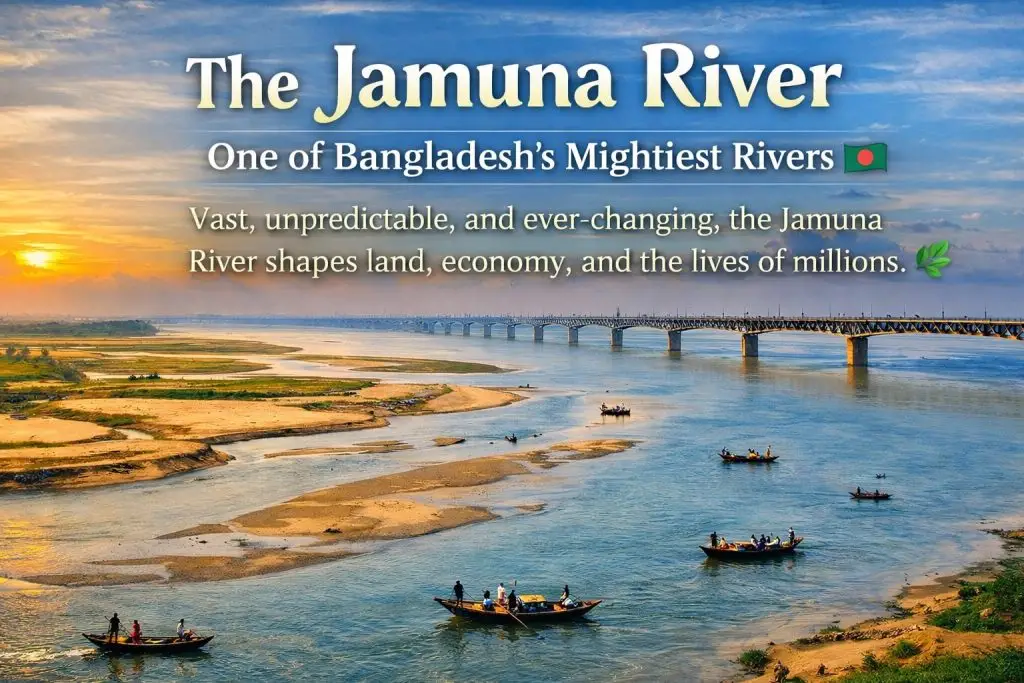
The Jamuna River stands as one of the most powerful, dynamic, and fascinating waterways in Bangladesh. Vast in its scale and completely unpredictable in its behavior, this structural lifeline plays an indispensable role in shaping the country’s geography, driving its agrarian economy, and defining the daily lives of millions of people along its basin.
However, the Jamuna is far more than just a massive body of water cutting southward across the delta. It represents an epic natural force characterized by a continuous cycle of history, power, destruction, and geographical renewal. Renowned for its unique braided channels and shifting sandy islands, known locally as chars, the river constantly redraws the maps of rural districts. While its fierce monsoon currents cause widespread bank erosion, displacing vulnerable riverine communities, its receding waters leave behind incredibly fertile layers of silt. This nutrient-rich soil rejuvenates the plains, allowing local farmers to sustain thriving agricultural yields year after year.
From supporting massive inland trade routes to serving as the foundation for modern engineering marvels like the Jamuna Multi-purpose Bridge, this river is central to the nation’s identity. Let’s dive deeper into the incredible characteristics, ecological mysteries, and cultural impact of this mighty river.
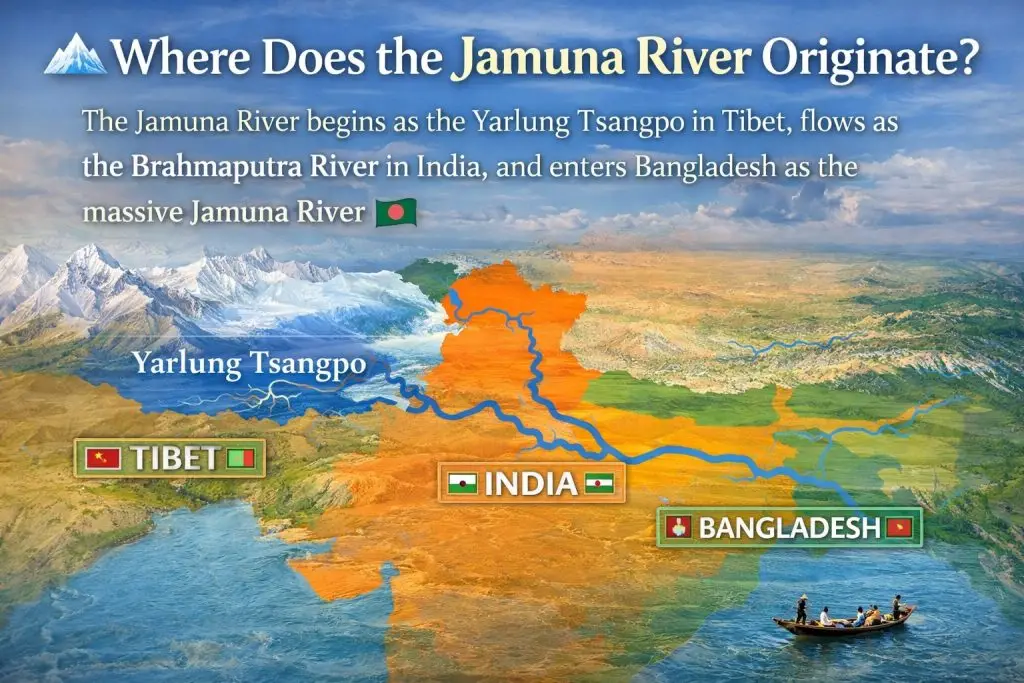
🏔️ Where Does the Jamuna River Originate?
The Jamuna River does not actually begin inside Bangladesh, as many people believe. Its remarkable journey starts thousands of kilometers away on the high-altitude Tibetan Plateau in Tibet.
In this mountainous region, the river is known as the Yarlung Tsangpo. It flows eastward across rugged terrain before making a dramatic turn around the Himalayas, one of the most significant geographic bends in the world.
After descending from the mountains, the river enters India, where it becomes the powerful Brahmaputra River. At this stage, it grows wider and stronger, carrying enormous volumes of water and sediment that shape floodplains and support agriculture.
When the river finally reaches Bangladesh, its main western channel is called the Jamuna River. Technically, the Jamuna is the principal channel of the Brahmaputra within Bangladesh. Although the name changes across borders, it remains one continuous transboundary river system.
This shared river plays a vital role in regional ecology, transportation, fisheries, and rural livelihoods across South Asia 🌏.
📜 Historical Transformation of the Jamuna River
One of the most fascinating geographical stories in South Asia is the historical transformation of the Jamuna River.
Interestingly, the river did not always flow along its present course in Bangladesh. 🌊 Over centuries, powerful natural forces such as earthquakes, floods, and sediment deposition reshaped its direction.
🌍 The Ancient Brahmaputra Course
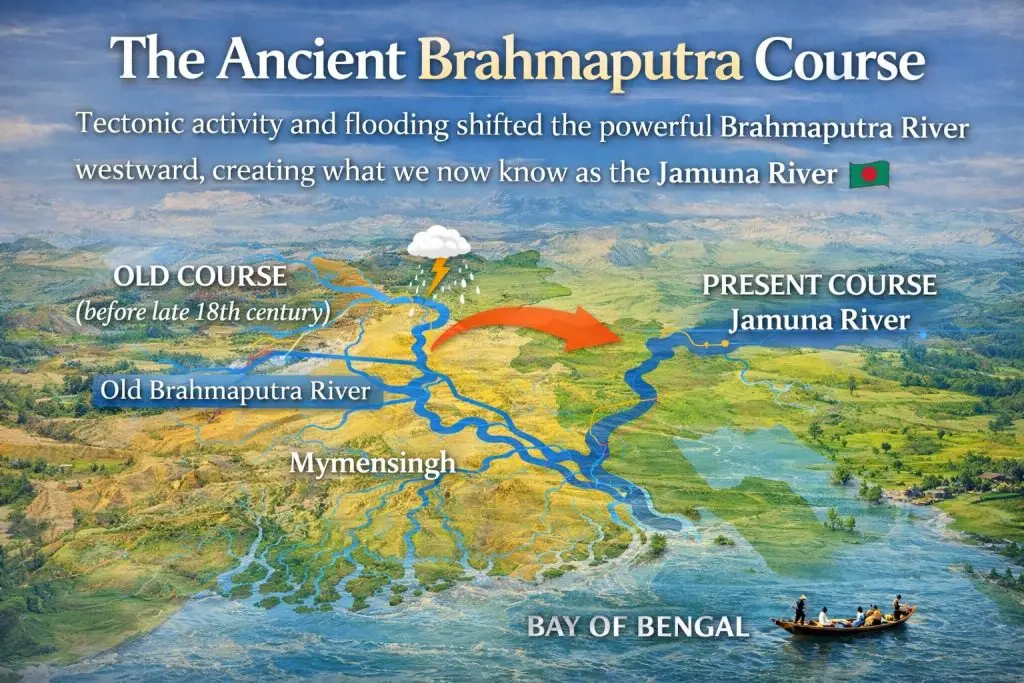
In earlier times, the mighty Brahmaputra River flowed further east, passing through regions near present-day Mymensingh.
This older channel is now called the Old Brahmaputra River. Historical records and geological studies suggest that until the late 18th century, this eastern route carried the main flow of the river.
However, dramatic flooding events and tectonic activity gradually altered the river’s path. 🌪️ Massive water pressure and sediment buildup forced the river westward, creating a new and more powerful channel — what we now recognize as the Jamuna River in Bangladesh.
This natural shift transformed local landscapes, agriculture, trade routes, and human settlements. 🌾🚤 The formation of the Jamuna River demonstrates how dynamic river systems constantly evolve. Today, it stands as one of Bangladesh’s most important waterways, shaped by centuries of environmental change and natural power.
⚡ The Great River Avulsion (18th Century)
During the late 18th century, a powerful natural event permanently changed the course of the Brahmaputra River.
🌊 Intense flooding, combined with tectonic activity and heavy sediment buildup, forced the river to abandon its old eastern channel. Instead of flowing near Mymensingh, the massive water volume suddenly shifted westward. This dramatic river avulsion created a new dominant channel, which later became the modern Jamuna River in Bangladesh. ⚡
This was not a gradual transformation but a rapid hydrological shift that reshaped landscapes, agriculture, settlements, and regional geography for generations.

🌊 Why Is the Jamuna River So Wide?
The Jamuna River becomes incredibly wide, especially during the monsoon season 😲.
Unlike a single-channel river, it is a braided river system, meaning it flows through multiple interconnected channels at the same time. Heavy Himalayan water flow and massive sediment deposits create vast sandbars and temporary islands known as chars. 🌧️🏝️
Because the river constantly shifts its course, its width can expand to several kilometers during peak floods, making it one of the widest rivers in Bangladesh.
🏔️ The Sediment Factor of the Jamuna River
The Jamuna River carries a massive volume of sediment from the Himalayas 🏔️, making it one of the most dynamic rivers in Bangladesh.
Each year, strong currents deposit layers of sand and silt along its banks. These sediments build sandbars, alter river depth, and force channels to shift direction. 🌊
As new land, known as chars, emerges, older land often erodes and disappears. This constant erosion and formation explain why the river never remains stable.
🏝️ Chars: Life on Moving Land in the Jamuna River
One of the most remarkable features of the Jamuna River in Bangladesh is the creation of chars — temporary river islands formed by sediment deposits.
🌊 These shifting lands offer fresh, fertile soil that supports farming and new livelihoods 🌱. However, life here comes with uncertainty ⚠️, as erosion can wash land away overnight. Families rebuild homes repeatedly 🏠, showing incredible strength and resilience 💪. Chars symbolize both opportunity and constant risk.
Economic Significance of the Jamuna River
Despite the constant threats of seasonal flooding and severe bank erosion, the Jamuna River serves as a foundational pillar of Bangladesh’s national economy. The river plays a multi-faceted role in sustaining both localized communities and macro-level industries across the country.
- Agricultural Rejuvenation: During the monsoon, the river deposits massive layers of nutrient-rich alluvial silt across the floodplains. This naturally fertilizes the soil, allowing delta farmers to achieve high-yielding crop cycles without heavy reliance on artificial fertilizers.
- Thriving Fisheries: The vast, braided channels of the Jamuna act as a rich breeding ground for diverse freshwater fish species. This aquatic ecosystem supports a massive fishing industry, providing vital protein and income for thousands of traditional fishing communities.
- Trade and Transport Corridors: As a deep-water commercial artery, the river enables cost-effective cargo transport, connecting remote rural markets with major urban industrial hubs.
Ultimately, this untamed waterway remains an indispensable source of livelihood and economic resilience for millions of citizens.
Agriculture & Fertility
The seasonal flooding of the Jamuna River plays a crucial role in maintaining agricultural productivity across surrounding floodplains 🌊.
Each year, monsoon waters spread nutrient-rich silt over vast areas, naturally replenishing the soil and enhancing its fertility 🌱. This fresh layer of alluvial sediment improves soil structure, boosts organic content, and supports sustainable farming without heavy dependence on chemical fertilizers.
Thanks to this natural renewal process, farmers successfully cultivate staple crops such as rice 🌾, which remains the backbone of rural food security. Jute 🌿, often called the “golden fiber,” thrives in the moist floodplain environment and contributes significantly to the local economy. In addition, a variety of vegetables 🥕 and seasonal crops 🌶️ grow abundantly, ensuring diversified agricultural production.
Although floods can pose risks to homes and infrastructure, they are essential for long-term soil health and farming sustainability, making them both a challenge and a blessing for rural communities 🌾.
🎣 Fisheries & Food Security
The Jamuna River is a lifeline for thousands of fishing families who depend on its waters for their daily income and survival 🎣.
Rich in diverse freshwater species, the river supplies nutritious fish that play a crucial role in meeting local protein needs and improving food security 🐟. Small-scale fishermen, traders, and market vendors all benefit from this vibrant river-based economy 💼.
Fish harvested from the Jamuna strengthen rural livelihoods, reduce poverty, and sustain traditional fishing practices passed down through generations 🌊. As a result, the river remains essential for community stability, economic growth, and sustainable nutrition 🌾.
🚤 Transportation & Trade
For centuries, rivers have served as the natural highways of Bangladesh 🚢, shaping commerce, culture, and communication.
The Jamuna River continues this historic role by supporting vital transportation and trade networks across the country 🌊. Even today, ferries 🚤 carry passengers, vehicles, and goods between riverbanks, ensuring mobility in areas where bridges are limited. Traditional local boats 🛶 remain essential for rural communities, connecting villages to markets, schools, and healthcare services.
The river also functions as an important trade corridor 📦, enabling the movement of agricultural products, fish, and raw materials to regional markets. By enhancing regional connectivity 🌍, the Jamuna strengthens economic integration and sustains livelihoods, making it a lifeline for commerce and transportation.
🌉 Bangabandhu Bridge: Engineering Over a Giant
Crossing the mighty Jamuna River was once a time-consuming and risky journey. Seasonal floods, powerful currents, and an ever-shifting river channel made transportation between eastern and western Bangladesh extremely challenging.
Everything changed with the construction of the Bangabandhu Bridge, a landmark infrastructure project that transformed national connectivity and economic growth.
This iconic multi-purpose bridge connects East and West Bangladesh, creating a direct road and rail link that significantly reduces travel time. It has accelerated trade, improved supply chains, and strengthened economic integration across regions.
Farmers, businesses, and industries now benefit from faster movement of goods, while millions of passengers enjoy safer and more reliable transportation. Beyond infrastructure, the bridge symbolizes national unity and progress 🇧🇩.
However, building this engineering marvel was far from easy. The Jamuna’s strong currents, constantly shifting riverbed 🏝️, and heavy sediment flow ⏳ posed serious technical challenges. Engineers had to design deep, durable foundations capable of withstanding erosion and unpredictable hydrological forces. Advanced construction techniques and international collaboration ensured the bridge could endure the dynamic river environment.
Today, the Bangabandhu Bridge stands not only as a transportation corridor but also as a symbol of Bangladesh’s engineering capability and development vision. It continues to support regional connectivity, economic expansion, and long-term national resilience 🚀.
⚠️ Environmental Challenges of the Jamuna River Bangladesh
While life-giving and economically vital, the Jamuna River also creates significant environmental challenges 🌊.
Severe riverbank erosion destroys homes, farmland, and infrastructure every year, displacing thousands of people 🏚️. Intense seasonal flooding can damage crops and disrupt livelihoods 🌾.
In addition, shifting channels and heavy sediment flow threaten navigation and local ecosystems 🐟. Climate change further increases uncertainty, making flood patterns more unpredictable ⚡ and raising concerns about long-term environmental sustainability.
🏚️ Riverbank Erosion
Riverbank erosion is the most destructive and feared force of the Jamuna River 🌊. Every year, powerful currents and shifting channels swallow entire villages, washing away fertile farmland and vital infrastructure ❌.
Homes, roads, schools, and croplands disappear within weeks, forcing thousands of families to relocate repeatedly 🏠. This ongoing land loss creates economic hardship, food insecurity, and social instability. For many riverside communities, erosion is not a one-time disaster but a recurring tragedy that reshapes lives generation after generation ⚠️.
🌊 Climate Change Pressure
Flooding along the Jamuna River is a natural seasonal process, yet it can quickly turn devastating during intense monsoon rains 🌧️. Rising water levels often submerge croplands, leading to severe crop damage and reduced food production ⚠️.
Homes, roads, and community facilities may be destroyed, causing significant property loss and displacement 🏠. Stagnant floodwaters also increase the risk of waterborne diseases, creating serious public health crises 🦠. In addition, prolonged flooding disrupts local businesses and agricultural income, resulting in widespread economic hardship 💰 for vulnerable riverside communities.
🌍 Climate Change Pressure
Climate change is increasing pressure on the Jamuna River system 🌡️. Shifting rainfall patterns and unpredictable upstream water flow are intensifying flood severity, making seasonal flooding more extreme 🔥.
Higher water volumes and rapid discharge changes also contribute to river instability, altering channels and accelerating bank collapse 🌊. As a result, erosion rates are rising, threatening farmland, homes, and infrastructure ⚠️. These climate-driven impacts demand stronger adaptation strategies and sustainable river management to protect vulnerable communities.
🧭 The Jamuna in Bangladesh’s River Network
The Jamuna River is one of the most powerful and dynamic rivers in Bangladesh, playing a central role in the country’s vast and interconnected river network 🌊.
Originating from the mighty Brahmaputra system, the Jamuna flows southward through northern and central Bangladesh, shaping landscapes, supporting agriculture, and sustaining millions of people along its banks. This river is not isolated — it is part of a much larger hydrological system that defines the geography and economy of the nation.
As it continues its journey, the Jamuna merges with the Padma River, which is the main distributary of the Ganges within Bangladesh. This massive confluence creates a powerful waterway that carries enormous volumes of water and sediment. Further downstream, the combined flow meets the Meghna River, forming one of the widest river channels in the world 🌏. Eventually, these united rivers empty into the Bay of Bengal, completing a remarkable natural cycle.
Together, the Jamuna, Padma, and Meghna rivers form one of the largest and most fertile delta systems on Earth. This delta supports rich biodiversity 🐟, productive farmland 🌾, and vibrant river-based communities. The river network also plays a vital role in transportation, fishing, irrigation, and trade. However, seasonal flooding and riverbank erosion remain ongoing challenges.
The Jamuna River is not just a waterway — it is a lifeline of Bangladesh, connecting regions, cultures, and ecosystems in one of the world’s most extraordinary delta landscapes 🌿.
❤️ Cultural & Human Connection with the Jamuna River
For millions of people in Bangladesh, the Jamuna River is far more than a geographical feature — it is a source of identity, culture, and daily survival 🌊.
Generations of riverbank communities have grown up listening to the rhythm of flowing water, shaping traditions that are deeply connected to nature. The Jamuna has inspired countless folk songs 🎶, poems, and stories 📖 that reflect love, struggle, hope, and resilience. Local festivals, boat races, and seasonal rituals are closely tied to the river’s changing moods.
Beyond art and literature, the Jamuna influences traditional livelihoods 🧡. Fishing, farming, boat-making, and river trade define the way of living for thousands of families 🏠. Despite facing floods and erosion, river communities show remarkable strength and adaptability 💪. Their resilience reflects a powerful human connection with the Jamuna — a river that continues to shape culture, heritage, and everyday life across Bangladesh.
✅ Final Thoughts
The Jamuna River stands as a powerful symbol of both creation and destruction in Bangladesh 🌊.
Its strong currents constantly reshape the landscape, depositing fertile silt that enriches farmland 🌾 while also causing riverbank erosion that challenges nearby communities. This dual nature makes the Jamuna one of the most dynamic and influential rivers in South Asia. Every year, it supports agriculture, fishing, transportation, and trade, directly sustaining millions of livelihoods 🚤🐟.
At the same time, seasonal floods and shifting channels test the resilience of riverbank residents. Families adapt by rebuilding homes, adjusting farming practices, and developing innovative survival strategies 💪. The river’s energy fuels economic growth but also demands respect and careful management.
Understanding the Jamuna River means understanding the heart of Bangladesh 🇧🇩. It shapes the country’s geography, culture, and economy in profound ways. From fertile fields to vibrant river ports, the Jamuna remains a lifeline — a natural force that defines both the challenges and the enduring spirit of the nation 🌿.