
Kharg Island Iran is the center of Iran’s oil exports. Discover why this strategic Persian Gulf hub is vital to Iran’s economy and global energy security.
A Strategic Oil Hub at the Center of Global Energy and Geopolitics
Introduction
In the complex landscape of global energy politics, few places hold as much strategic importance for a single nation as Kharg Island does for Iran. Although the island covers only around 20 square kilometers in the Persian Gulf, it plays a critical role in sustaining Iran’s economy, funding its government, and shaping geopolitical dynamics in the Middle East.
Widely regarded as the backbone of Iran’s petroleum sector, Kharg Island processes and ships most of the nation’s crude oil exports to international markets. Because oil revenue forms the backbone of Iran’s national income, the island has become one of the most strategically significant pieces of energy infrastructure in the world.
Recent geopolitical tensions have pushed Kharg Island back into global headlines. Reports indicate that the island’s military installations were targeted in a U.S. strike during escalating tensions involving Donald Trump, Israel, and Iran, highlighting just how central the island is to regional power struggles.
Understanding why Kharg Island is so crucial requires looking at its geography, infrastructure, economic importance, and strategic role in global oil markets.
The Geography That Made Kharg Island Strategic
Kharg Island sits roughly 25 kilometers off Iran’s southern coast in the northern Persian Gulf, near the Iranian province of Bushehr Province. Despite its relatively small size, its location offers a unique geographic advantage.
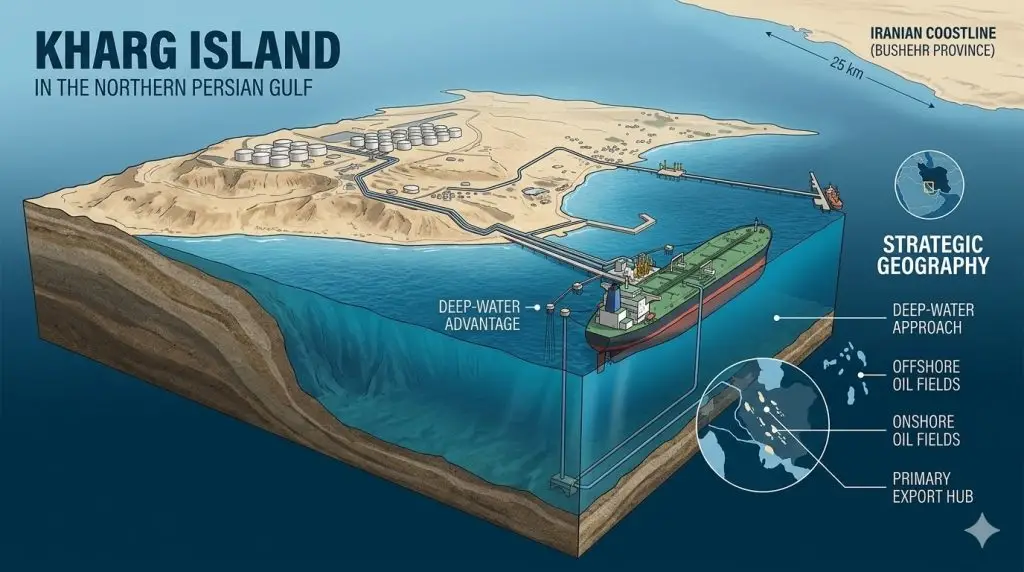
Much of Iran’s coastline is shallow, making it difficult for massive oil tankers to dock safely. However, the waters around Kharg Island are unusually deep. This allows giant supertankers—some of the largest ships in the world—to approach and load oil directly from offshore terminals.
This deep-water advantage is one of the main reasons the island became the center of Iran’s oil export system. Large tankers carrying millions of barrels of crude oil can dock, load their cargo, and depart toward international markets with relative ease.
Additionally, the island lies near major Iranian oil fields both offshore and onshore. This makes it an ideal logistical hub where pipelines, storage tanks, and export terminals can converge.
Because of these geographic advantages, Kharg Island evolved into Iran’s primary oil export terminal and the central artery of its petroleum industry.
The Heart of Iran’s Oil Export System
The most important reason Kharg Island is considered a lifeline for Iran is simple: most of the country’s oil exports pass through it.
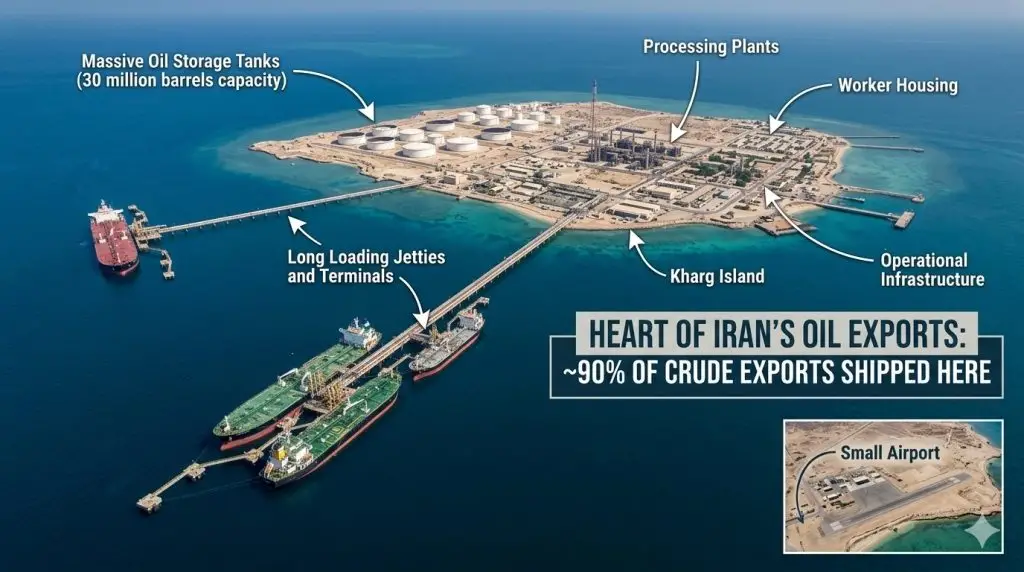
Experts estimate that around 90 percent of Iran’s crude oil exports are shipped from Kharg Island.
That means nearly every barrel of Iranian oil sold to the global market—whether to Asian or other buyers—passes through this single island.
The facilities on the island include:
- Massive oil storage tanks capable of holding about 30 million barrels of crude oil.
- Long loading jetties that extend into deep waters to accommodate supertankers.
- Processing plants and export terminals.
- Worker housing and operational infrastructure.
- A small airport connecting the island to the mainland.
The island can load multiple supertankers simultaneously, enabling Iran to ship millions of barrels of oil per day.
Without these facilities, Iran would struggle to export crude oil at the scale necessary to sustain its economy.
Oil Revenue: The Backbone of Iran’s Economy
For decades, oil has been the foundation of Iran’s national economy. Despite international sanctions and economic restrictions, the country still relies heavily on oil exports to generate government revenue.

Oil income funds:
- Government spending
- Infrastructure development
- Military programs
- Social services
- International trade
Because Kharg Island handles the vast majority of these exports, its operational status directly affects Iran’s economic stability.
Energy specialists often consider the island the core engine powering Iran’s petroleum sector. If the island were shut down or destroyed, Iran’s ability to sell oil internationally would be severely disrupted.
In simple terms, the country’s economy could face massive financial losses within days.
Pipelines Connecting Iran’s Oil Fields
Kharg Island does not produce oil itself. Instead, it acts as the final hub in a vast network of pipelines and offshore infrastructure.
Crude oil from several major Iranian oil fields flows toward the island through subsea pipelines.
These fields include:
- Aboozar oil field
- Forouzan oil field
- Dorood oil field
- Marun oil field
- Ahvaz oil field
Oil extracted from these locations travels through pipelines to Kharg Island, where it is stored, processed, and eventually loaded onto tankers heading for global markets.
This centralized export system makes the island extremely efficient—but also creates a strategic vulnerability.
If the island were damaged or blockaded, much of Iran’s oil export network could be disrupted.
Why Global Markets Watch Kharg Island Closely
Kharg Island is not only important for Iran—it also influences the global oil market.
Iran is one of the world’s largest oil producers and a member of Organization of the Petroleum Exporting Countries.
Even under sanctions, the country exports significant volumes of crude oil to international buyers, particularly in Asia.
China has emerged as one of the biggest purchasers of Iranian crude in recent years.
Because of this, disruptions at Kharg Island can have ripple effects across the global energy system.
For example:
- Reduced exports from Iran could tighten global oil supplies.
- Oil prices could rise sharply in response.
- Shipping routes in the Persian Gulf could become unstable.
Analysts warn that if Kharg Island were disabled, up to 2 million barrels of oil per day could disappear from global markets, potentially pushing oil prices dramatically higher.
This is why traders, governments, and energy companies around the world monitor developments around the island closely.
Kharg Island’s Role in Regional Military Strategy
Because of its economic importance, Kharg Island is also a critical military asset.
Iran heavily protects the island through the Islamic Revolutionary Guard Corps, which maintains a strong presence there.
Defensive systems reportedly include:
- Radar installations
- Surface-to-air missile systems
- Coastal defense missiles
- Naval patrols in surrounding waters
These defenses are designed to protect the island from air strikes, naval attacks, or sabotage.
However, despite these protections, Kharg Island remains a vulnerable target in any regional conflict.
Its oil facilities, pipelines, and storage tanks are concentrated in a relatively small area, making them potentially easy to target.
Military analysts have long argued that disabling the island would be one of the fastest ways to damage Iran’s economic capacity.
A History of Conflict: Kharg Island in War
Kharg Island has been targeted during previous conflicts.
During the Iran–Iraq War, Iraqi forces repeatedly attacked the island in an attempt to cripple Iran’s oil exports.
Bombings damaged many of the island’s facilities, but Iran managed to repair them and maintain exports despite the attacks.
This experience led Iran to heavily reinforce the island’s defenses and infrastructure.
Over the years, Tehran has invested billions of dollars to strengthen export facilities, expand storage capacity, and modernize the terminal.
Recent Escalation and Global Concerns
Tensions surrounding Kharg Island intensified in 2026 amid growing conflict between the United States, Israel, and Iran.
Reports indicate that U.S. forces carried out strikes targeting military sites on the island, though oil infrastructure was reportedly left intact.
Political leaders warned that attacks on the island’s oil facilities could trigger severe retaliation and destabilize global energy markets.
Iranian officials have repeatedly stated that the island is a “red line” for the country’s security.
Because of its central role in Iran’s economy, any attack on Kharg Island risks escalating regional tensions dramatically.
A Strategic Weak Point in Iran’s Economy
Ironically, the same factors that make Kharg Island powerful also make it vulnerable.
Because such a large percentage of Iran’s oil exports pass through one location, the country depends heavily on the island’s continued operation.
This creates a strategic bottleneck.
If the island were seriously damaged, blocked, or captured during a conflict, Iran’s oil exports could collapse.
Energy analysts often describe Kharg Island as both:
- Iran’s economic lifeline
- Its biggest strategic weakness
Protecting the island is therefore one of Tehran’s top national security priorities.
The Future of Kharg Island
Looking ahead, Kharg Island will likely remain central to Iran’s economic and geopolitical strategy.
Iran continues investing in upgrading its oil export infrastructure, expanding storage facilities, and improving tanker loading capacity.
At the same time, rising geopolitical tensions in the Middle East mean the island will remain under intense international scrutiny.
Whether in times of peace or conflict, Kharg Island will continue to play a crucial role in:
- Iran’s economy
- Global energy markets
- Regional military strategy
Conclusion: Kharg Island Iran
Kharg Island may appear small on the map, but its influence stretches across global energy markets and geopolitical power struggles.
Handling roughly 90 percent of Iran’s oil exports, the island serves as the primary gateway through which Iranian crude reaches international buyers. Its deep-water access, massive storage facilities, and extensive pipeline network make it the core of the country’s oil export system.
Because oil revenue supports much of Iran’s economy, the island has become a national lifeline—one that Tehran protects heavily and its rivals watch closely.
In an era of rising geopolitical tension and shifting energy dynamics, Kharg Island stands as one of the most strategically important energy hubs in the world.