
Discover Mahasthangarh, the oldest archaeological site in Bangladesh. Explore ancient ruins, history, travel tips, nearby attractions, hotels, and food.
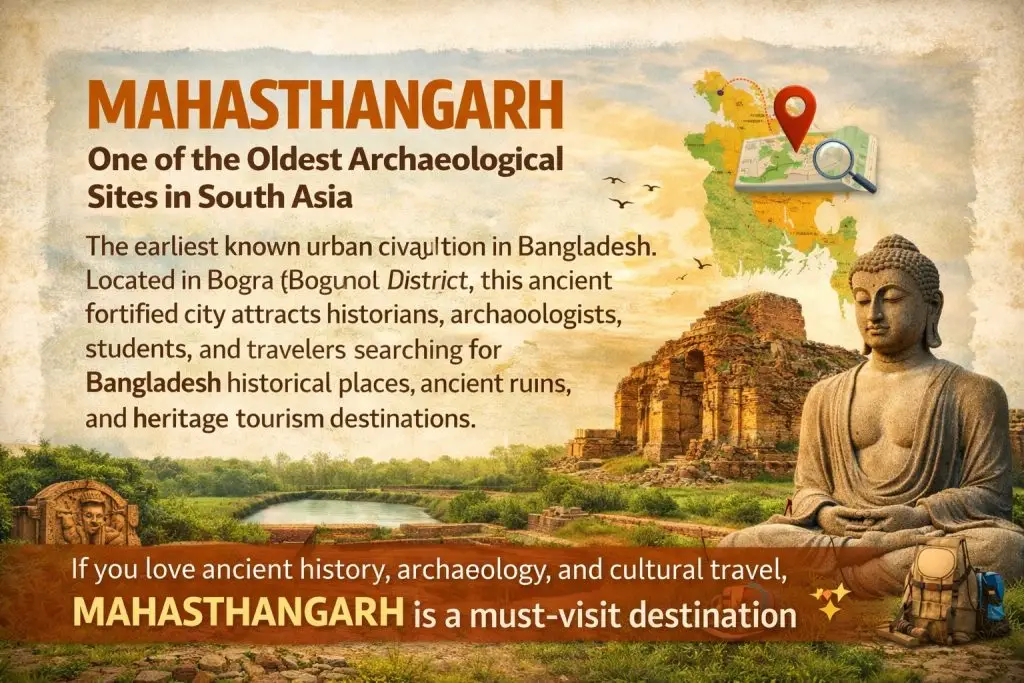
Mahasthangarh is one of the oldest archaeological sites in South Asia and the earliest known urban civilization in Bangladesh. Located in Bogra (Bogura) District, this ancient fortified city attracts historians, archaeologists, students, and travelers who are searching for Bangladesh historical places, ancient ruins, and heritage tourism destinations.

If you love ancient history, archaeology, and cultural travel, Mahasthangarh is a must-visit destination ✨
📍 Where is Mahasthangarh Located?
Mahasthangarh is located in Shibganj Upazila of Bogra (Bogura) District, in the Rajshahi Division of northern Bangladesh 🇧🇩. It lies approximately 13 kilometers north of Bogra town, making it an easy day trip for travelers staying in the city. Because of its accessible location and historical importance, Mahasthangarh is one of the most visited archaeological sites in Bangladesh.

Geographically, the ancient city is positioned on the western bank of the Karatoya River 🌊. In ancient times, the Karatoya was a large and powerful river, serving as an important trade and transportation route across Bengal. Historians believe the river played a key role in the rise of Pundranagara, the ancient capital city that once thrived at Mahasthangarh. Today, although the river has become much smaller, the surrounding fertile plains and rural landscape still reflect why this location was ideal for an early urban settlement.

The area around Mahasthangarh is mostly flat agricultural land 🌾, dotted with villages, ponds, and greenery, offering visitors a peaceful countryside atmosphere. Its strategic location near an ancient river route and fertile land made Mahasthangarh a major political, cultural, and commercial center in early Bengal history.
📜 Full History of Mahasthangarh
Mahasthangarh is believed to be over 2,300 years old, making it the oldest city civilization in Bangladesh.
🏛️ Ancient Name – Pundranagara
Before it became known as Mahasthangarh, this ancient settlement was called Pundranagara or Paundravardhanapura, which served as the capital of the powerful Pundra Kingdom in ancient Bengal. The name Pundranagara literally means “the city of the Pundras,” an early ethnic and cultural group that inhabited northern Bengal thousands of years ago. This ancient name highlights the city’s deep historical roots and its importance long before the medieval period.
Evidence of the name Pundranagara appears in ancient Sanskrit literature, Gupta-era inscriptions, and various early historical records of Bengal, confirming its authenticity and significance 🔎. These sources describe the city as a well-organized administrative and commercial center. Its strategic location near river routes helped it grow into a major political authority, cultural hub, and trade center.
The repeated mention of Pundranagara in historical texts proves that Mahasthangarh was not a small settlement, but a thriving capital that played a crucial role in shaping ancient Bengal’s civilization.angarh was once a major political, cultural, and trade center of ancient Bengal.
🧱 Mauryan Period (3rd Century BCE)
One of the most important archaeological discoveries at Mahasthangarh is a limestone inscription written in Brahmi script, dating back to the 3rd century BCE, during the reign of Emperor Ashoka 👑 of the Mauryan Empire. This inscription is among the earliest written records ever found in Bangladesh, proving that Mahasthangarh was already a significant urban center more than two thousand years ago.
The presence of Mauryan-era writing indicates that the city had an organized administrative system, where official orders, governance, and communication were recorded. It also suggests strong religious and cultural activity, as the Mauryan period is closely associated with the spread of Buddhism and state-supported religious institutions. Furthermore, Mahasthangarh’s connection to the Mauryan Empire shows it was linked to a vast South Asian trade and political network, making it an important regional hub rather than an isolated settlement.
🛕 Gupta & Post-Gupta Period
During the Gupta Empire (4th–6th century CE), Mahasthangarh experienced a new phase of prosperity and cultural richness. This era is often called the “Golden Age” of ancient India, and its influence clearly reached this historic city of Bengal. Mahasthangarh developed as both a religious center and an economic hub, supported by agriculture, craftsmanship, and regional trade routes.
Archaeological excavations from this period have uncovered beautiful terracotta plaques 🧩 that once decorated temples and religious structures. Researchers have also found stone sculptures of Hindu and Buddhist deities 🕉️, showing that multiple faiths were practiced side by side. Additionally, ancient coins, pottery, and household items 🪙 reveal an active urban lifestyle and a thriving local economy.
The Gupta and Post-Gupta period highlights a remarkable peaceful coexistence of Hinduism, Buddhism, and later Jain influences, making Mahasthangarh an important symbol of cultural harmony in early Bengal history. later Jain influences.
🕌 Pala & Sena Period (8th–12th Century)
During the Pala Dynasty (8th–12th century), Mahasthangarh entered a significant phase as a center of Buddhist learning and culture 🧘♂️. The Palas were strong patrons of Buddhism, especially the Mahayana tradition, and they supported the construction of monasteries, temples, and educational institutions across Bengal. Archaeological remains in and around Mahasthangarh suggest the presence of Buddhist viharas (monasteries) and religious establishments that attracted monks, scholars, and students from different regions.
This period also saw active trade and cultural exchange, as routes linked Bengal with northern India, Nepal, and parts of Southeast Asia. Later, under the Sena Dynasty, which followed the Palas, Hindu influence grew stronger again. Temples dedicated to Hindu deities were built, reflecting a gradual religious transition while maintaining Mahasthangarh’s importance as a spiritual and cultural center.
🌿 Medieval Decline
After the 12th century, the city slowly declined due to:
- River course changes 🌊
- Political shifts
- Economic movement to other regions
The once-great city was gradually buried under soil and forgotten for centuries.
🏺 Rediscovery by Archaeologists
In the 19th century, British archaeologists identified Mahasthangarh as an ancient fortified city. Excavations began, revealing:
✔ City walls
✔ Temples
✔ Roads
✔ Residential buildings
✔ Religious structures
Today, Mahasthangarh is one of the most important archaeological heritage sites in Bangladesh.
🧱 Main Attractions Inside Mahasthangarh
Visiting Mahasthangarh truly feels like stepping into a vast open-air ancient museum 🌤️, where layers of history unfold with every step. As the oldest known archaeological site in Bangladesh, Mahasthangarh preserves the remains of a powerful and well-organized civilization that flourished over two thousand years ago.
🏰 1. The Fortified Citadel
At the heart of Mahasthangarh lies its fortified citadel, the main urban center of the ancient city. The entire area is enclosed by massive mud and brick walls, showcasing impressive early engineering skills.
Stretching approximately 1.5 kilometers in length and 1.3 kilometers in width, with walls rising up to 15 meters high, the citadel clearly demonstrates that Mahasthangarh was a carefully planned and heavily protected settlement. These strong defenses suggest the city held great political, administrative, and military importance in ancient Bengal.
🛕 2. Govinda Bhita Temple
Located within the citadel, Govinda Bhita is one of the oldest Hindu temple remains discovered in Bangladesh.
Archaeological excavations revealed temple foundations, beautifully crafted terracotta plaques, and various religious artifacts. These findings indicate the presence of organized Hindu worship and reflect the artistic excellence of the period. The temple stands as strong evidence of early religious diversity and architectural sophistication.
💧 3. Mankalir Kunda
Mankalir Kunda is an ancient water reservoir shrouded in mystery and local legends 🌊.
Believed to hold religious and ritual significance, locals claim that its water never dries up, even during harsh dry seasons. This sacred pond highlights the importance of water management and spiritual beliefs in ancient urban life.
🔥 4. Parasuramer Bedi
This site is associated with the legendary Hindu warrior sage Parashurama.
Rich in mythology and folklore, Parasuramer Bedi remains an important cultural landmark, blending history with mythological traditions that are still remembered today.
🧘 5. Buddhist Vihara Ruins
Scattered throughout Mahasthangarh are ruins of Buddhist viharas, confirming that the city was once a prominent center of Buddhist learning and monastic life.
These remains reflect a time when Mahasthangarh thrived as a spiritual and educational hub, welcoming scholars and monks from far regions.
Together, these attractions make Mahasthangarh a remarkable destination where history, religion, and legend merge into one unforgettable journey through time ✨.
🏛️ Mahasthangarh Museum
Just beside the ruins, the Mahasthangarh Archaeological Museum displays:
🪔 Stone sculptures
🧱 Terracotta plaques
🪙 Ancient coins
🍶 Pottery and tools
This museum helps visitors understand the daily life of ancient Bengal civilization.
🌄 Tourist Spots Near Mahasthangarh
A visit to Mahasthangarh becomes even more rewarding when you explore the fascinating tourist spots located nearby. These attractions add depth to your journey by blending archaeology, folklore, and natural beauty into one unforgettable experience.
🧱 Gokul Medh (Behula Lakhindar Basor Ghor)
Gokul Medh is one of the most intriguing ancient mounds in northern Bangladesh. Popularly linked to the famous Bengali folklore of Behula and Lakhindar, the site carries strong cultural and emotional significance. Archaeological studies suggest that Gokul Medh may have originally been a Buddhist stupa or religious structure dating back to ancient times. Its layered earthwork and elevated form offer valuable insights into early construction techniques and spiritual practices.
🌊 Karatoya River
Once known as a mighty and powerful river in ancient Bengal, the Karatoya River played a crucial role in trade, transportation, and settlement development. Today, it flows calmly, offering visitors a peaceful escape into rural life 🌾. The riverbanks are perfect for quiet walks, photography, and enjoying the scenic beauty of traditional villages.
🛕 Vasu Vihara
Located close to Mahasthangarh, Vasu Vihara is another significant Buddhist monastery site. The ruins indicate that this area was an important center of Buddhist learning and meditation, further highlighting the region’s rich religious and historical heritage.
🚗 Travel Guide to Mahasthangarh
🗓️ Best Time to Visit
🌤️ October to March – Cool and comfortable weather
Avoid heavy monsoon ☔
🚌 How to Go to Mahasthangarh
From Dhaka:
- By Bus 🚌 → 5–6 hours to Bogra
- By Train 🚆 → Train to Bogra station
From Bogra town:
- CNG/Auto rickshaw 🚖 (30 minutes)
🎟️ Entry Information
💰 Small entry fee for locals & foreigners
📷 Photography allowed
🕘 Open during daylight hours
🏨 Best 10 Hotels Near Mahasthangarh (Bogra)
Here are top hotels in Bogra for a comfortable stay:
1️⃣ Momo Inn Park & Resort – A luxury 5-star resort hotel with pool, spa, fitness centre and scenic surroundings. Ideal for couples and families.
🌍 Location: Rangpur Road, Nawdapara, Bogura 5800, Bangladesh
🔗 Website: https://www.momoinn.com/
📌 Booking available on major platforms like Booking.com, Agoda and MakeMyTrip.
2️⃣ Hotel Naz Garden – Popular upscale hotel with free breakfast and Wi-Fi, outdoor pool and garden settings.
🌍 Location: Bogra City Bypass, Bogura 5800, Bangladesh
🔗 Website: http://www.hotelnazgarden.com/
📌 Book via hotel website or hotel booking sites like Agoda/Booking.com.
3️⃣ Hotel La Villa – Comfortable mid-range hotel with good guest reviews and easy access to city attractions.
🌍 Location: Altafunnessa Lane, Bogura 5800, Bangladesh
🔗 Website: https://www.facebook.com/hotellavillabogra
📌 Booking available through Facebook contact or travel sites.
4️⃣ Hotel Lynn Valley – Modern hotel with highly rated services and facilities. Great choice for business or leisure stays.
🌍 Location: Shahid Abdul Jabbar Road, Bogura 5800, Bangladesh
🔗 Website: https://www.hotellynnvalley.com/
📌 Book via website or hotel booking portals.
5️⃣ Annex Suites – Stylish hotel with free Wi-Fi and breakfast. Comfortable choice near central Bogra.
🌍 Location: 174 Shahid Abdul Jabbar Road, Bogura 5800, Bangladesh
📌 Can be booked through travel booking sites.
6️⃣ The Asteria Hotel – Well-reviewed hotel with convenient location near Sherpur Road.
🌍 Location: Sherpur Rd, Bogura, Bangladesh
📌 Book through sites like Booking.com or Agoda.
7️⃣ Hotel Siesta – Affordable hotel on Bogra City Bypass, suitable for budget travellers.
🌍 Location: Bogra City Bypass, Bogura 5800, Bangladesh
📌 Available on budget booking platforms.
8️⃣ Parjatan Motel Bogura – A publicly operated lodging facility featuring tidy rooms and essential guest services.
🌍 Location: Sherpur Rd, Bogura 5800, Bangladesh
🔗 Website: http://www.parjatan.gov.bd/
📌 Can be booked via Parjatan official site or local travel agents.
9️⃣ Hotel Castle Soad – Well-liked hotel with good service and reviews, great for travellers seeking friendly staff and decent rates.
🌍 Location: Bogura 5800, Bangladesh
📌 Booking available on travel platforms and direct contact.
🔟 Hotel Metro Inn – Comfortable hotel on Kazi Nazrul Islam Road with reliable services and good ratings.
🌍Location details: MM Tower, located on Kazi Nazrul Islam Road in Bogura, Bangladesh
📌 Available through hotel booking services.
Bogra offers lodging options for every type of traveler, from high-end resorts like Momo Inn Park & Resort to economical hotels including Hotel Siesta and Parjatan Motel, providing comfort and ease throughout your visit.
🍽️ Top 10 Restaurants Near Mahasthangarh
After exploring ruins, enjoy delicious food 😋
1️⃣ Akboria Grand Hotel Restaurant 🍛 Famous for traditional meals
2️⃣ Tandoor Restaurant Bogra 🔥 BBQ & Indian food
3️⃣ Casuarina (Naz Garden) 🍽️ Fine dining
4️⃣ Shyamoly Restaurant
5️⃣ Red Chillies Restaurant 🌶️
6️⃣ Quality Sweets & Restaurant 🍮
7️⃣ The BreakRoom Café ☕
8️⃣ Helium Restaurant
9️⃣ Bogra Food Garden
🔟 Zahmon Chinese Restaurant 🍜
Don’t miss local snacks like Khotkoti and Bogra Doi 🥣
🎒 Travel Tips for Visitors
✔ Wear comfortable shoes 👟
✔ Carry water & sun protection ☀️
✔ Respect the heritage site – don’t climb fragile ruins 🚫
✔ Hire a local guide for better historical understanding 🎤
🌟 Why Mahasthangarh is Important for Bangladesh Tourism
Mahasthangarh is:
🏺 The oldest archaeological city in Bangladesh
📚 A key site for ancient Bengal history
🌍 An emerging heritage tourism destination
🎓 A learning center for students of archaeology and history
✨ Conclusion
Mahasthangarh is more than just ruins — it is the living memory of ancient Bangladesh civilization. Walking through its walls, temples, and mounds feels like traveling back over two thousand years ⏳
If you are searching for:
🔎 Ancient places in Bangladesh
🏺 Historical tourist spots
📜 Heritage travel destinations
Then Mahasthangarh should be at the top of your travel list ❤️🇧🇩