
Shocking rumors claim Benjamin Netanyahu died during the Iran conflict, but the Israeli leader released a video denying the viral claims.
Introduction

In the midst of escalating geopolitical tensions between Israel and Iran, a wave of viral rumors spread across social media claiming that Israeli Prime Minister Benjamin Netanyahu had been killed in an Iranian attack. The speculation quickly gained traction online, fueling confusion and conspiracy theories worldwide.
However, Netanyahu directly addressed the claims by posting a video of himself online, appearing relaxed and joking about the rumors while drinking coffee. The short clip, shared through his official channels, was widely interpreted as a clear message: the Israeli leader is alive and continuing to lead his country during one of a highly unstable phase in contemporary Middle Eastern history.
The incident highlights how misinformation can rapidly spread during wartime and how political leaders are increasingly using social media to respond quickly to viral claims.create image
Rumors Spread Rapidly Online
The controversy began when several social media accounts — many linked to pro-Iranian narratives — began sharing unverified posts claiming that Netanyahu had been killed or seriously injured in an Iranian missile strike.

These posts circulated across platforms such as X (formerly Twitter), Telegram, and other messaging apps, often accompanied by dramatic captions, manipulated images, or unrelated video clips. Some posts even claimed that Netanyahu’s residence had been struck by missiles or that Israeli officials were hiding his death from the public.
Within hours, the claims were shared thousands of times, creating confusion among internet users who were unsure whether the reports were legitimate.
The rumors appeared at a time when tensions between Israel and Iran were already extremely high, making the claims more believable to some observers.
According to multiple international media reports, the speculation was largely based on misinformation and unverified sources rather than confirmed intelligence or official statements.
Netanyahu Releases Video to Address Claims
Rather than issuing a traditional written statement, Netanyahu chose a more direct approach.
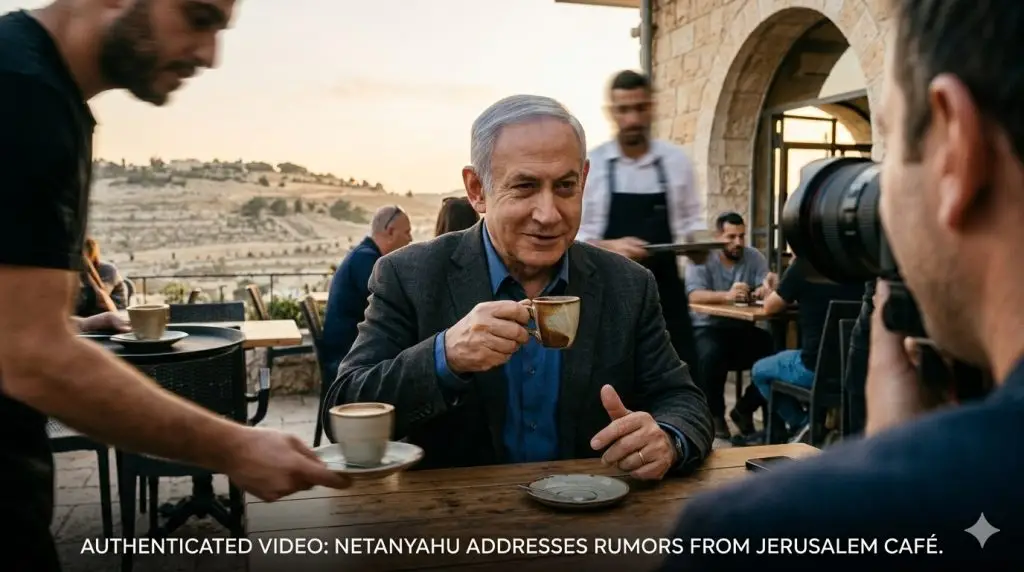
The Israeli prime minister posted a short video showing himself sitting at a café near Jerusalem while ordering and drinking coffee. In the clip, he appeared calm and relaxed, speaking casually with an aide and joking about the rumors circulating online.
At one point in the video, Netanyahu humorously responded to the claims about his death, making a playful remark about being “dead for coffee,” implying he was simply craving caffeine rather than actually deceased.
The video quickly went viral and was widely shared by journalists and political commentators.
Analysts said the casual setting of the video appeared intentional. By filming the clip in a normal public environment rather than an official office, Netanyahu seemed to signal confidence and normalcy despite the ongoing conflict.
Reuters later confirmed the authenticity of the video and verified that it had been filmed recently at a café near Jerusalem.
Context: Rising Israel–Iran Conflict
The rumors about Netanyahu’s death emerged during a period of intense confrontation between Israel and Iran.
The crisis escalated dramatically after joint military strikes conducted by Israel and the United States targeted Iranian military infrastructure in late February. These attacks were reportedly aimed at weakening Iran’s nuclear program and missile capabilities.
Following those strikes, Iran launched retaliatory missile and drone attacks targeting Israeli territory and military assets.
Air raid sirens sounded across multiple Israeli cities, including Tel Aviv and areas surrounding Jerusalem. Israeli authorities responded by imposing emergency security measures, including temporary school closures and restrictions on public gatherings.
The exchange of strikes marked one of the most serious direct confrontations between Israel and Iran in recent years.
Amid such high-stakes conflict, misinformation has become increasingly common, with both sides accusing each other of spreading propaganda.
Disinformation During Wartime
Experts say the rapid spread of rumors about Netanyahu’s death is a clear example of how digital misinformation thrives during conflicts.
When tensions rise, information gaps often appear because governments limit public communication for security reasons. These gaps create opportunities for false narratives to spread quickly online.
In this case, several misleading posts claimed that Iranian missile strikes had killed high-ranking Israeli officials, including Netanyahu and members of his family.
Some viral videos were later proven to be unrelated footage from other countries or older incidents that had nothing to do with the current conflict.
Fact-checkers found that one widely circulated clip supposedly showing damage to a Netanyahu family home actually came from a house fire in the United States, not Israel.
Despite being debunked, the video continued to circulate widely on social media.
Israeli Government Denies Rumors
Soon after the rumors began spreading, officials from the Israeli government publicly denied the claims.
A spokesperson for Netanyahu’s office stated that reports of the prime minister’s death were completely false and described them as “fake news.”
Government officials urged the public to rely on verified news sources and official statements rather than unconfirmed social media posts.
The Israeli leadership also emphasized that Netanyahu continued to hold meetings with military and political advisers as the conflict with Iran unfolded.
Netanyahu’s Strategy: Humor and Visibility
Political analysts believe Netanyahu’s decision to respond with humor rather than anger was a deliberate communication strategy.
By joking about the rumors and showing himself calmly drinking coffee, Netanyahu aimed to undermine the credibility of the false reports while projecting confidence.
Such a response also allowed him to connect with ordinary citizens who were seeing the rumors online.
Experts note that modern political leaders increasingly rely on informal videos and social media posts to communicate directly with the public during crises.
In contrast to traditional press conferences, short videos can spread quickly online and reach millions of viewers within minutes.
Social Media Reaction
The footage rapidly drew attention and reactions across social networks.
Supporters of Netanyahu shared the clip as proof that the rumors were false, praising the prime minister’s calm demeanor.
Critics, however, questioned the authenticity of the footage, with some claiming the video might have been edited or artificially generated. These claims were largely dismissed by mainstream news organizations and fact-checkers.
Despite the debates, the video effectively slowed the spread of the death rumors and shifted attention back to the broader geopolitical situation.
Broader Impact on Public Perception
The incident highlights a growing challenge faced by governments around the world: the battle against misinformation during crises.
In the age of social media, rumors can travel faster than official statements.
Even when false claims are eventually debunked, the initial misinformation can still shape public perceptions and create confusion.
Political leaders now find themselves needing to respond quickly to viral rumors to prevent panic or diplomatic misunderstandings.
Netanyahu’s video response demonstrates how direct communication can sometimes be the fastest way to counter false narratives.
Historical Examples of Similar Rumors
Rumors about the death of world leaders are not new.
Throughout history, misinformation about political figures has spread during wars, revolutions, and major crises.
In the digital era, however, such rumors spread much faster due to social media algorithms and instant global communication.
Similar rumors have previously targeted leaders in several countries, often during periods of political instability or military conflict.
In many cases, these rumors were later proven to be deliberate propaganda designed to influence public opinion.
Regional and Global Reactions
International observers closely watched the situation as the rumors spread.
Diplomats and analysts emphasized that misinformation during conflicts can increase tensions between rival states.
If widely believed, false reports about the death of a national leader could potentially trigger political or military reactions.
For this reason, global media organizations quickly worked to verify the facts and clarify that Netanyahu was alive.
Several international outlets published fact-checks explaining how the rumors originated and why they were false.
Netanyahu Continues Leadership During Crisis
Despite the rumors, Netanyahu remains actively involved in Israel’s wartime decision-making.
Reports indicate that he continues to coordinate with military commanders and political allies regarding Israel’s security strategy.
The Israeli government has also maintained close communication with the United States and other international partners during the conflict.
The situation remains fluid, with ongoing diplomatic efforts aimed at preventing further escalation in the region.
Conclusion: Netanyahu died
The viral rumors claiming that Israeli Prime Minister Benjamin Netanyahu had been killed illustrate how quickly misinformation can spread during times of geopolitical tension. In today’s hyperconnected digital world, a single unverified claim posted online can travel across continents within minutes, reaching millions of people before official sources have time to respond. This situation demonstrates how modern conflicts are fought not only on the battlefield but also in the information space.
By releasing a simple video showing himself calmly drinking coffee and joking about the false claims, Netanyahu effectively shut down the speculation and reassured the public that he remains alive and actively leading his government. The informal nature of the video also helped humanize the response, making it easier for viewers to trust the message and dismiss the rumors circulating online.
The incident highlights the growing importance of rapid communication in political leadership. Governments now face the challenge of responding quickly to misinformation while maintaining transparency and public confidence. Social media platforms, while powerful tools for communication, can also amplify rumors and propaganda if information is not verified.
As tensions between Israel and Iran continue, the struggle over information and public perception may become nearly as critical as military actions. In modern geopolitics, controlling the narrative can influence public opinion, international diplomacy, and the overall stability of a region.