
Looking for Online Marriage Registration in BD? Follow our 2026 complete guide for a fast, step-by-step digital process and safe certification.
Introduction: Online Marriage Registration in BD 2026
Marriage is one of the most significant events in a person’s life, symbolizing a legal and social commitment between two individuals. While the occasion itself is joyful, the process of completing the required legal formalities has traditionally been challenging for many couples in Bangladesh. In the past, marriage registration often involved multiple visits to a Nikah Registrar (Kazi) or government registration office, lengthy paperwork, and considerable waiting times.
With Bangladesh rapidly advancing toward its vision of a “Smart Bangladesh,” many public services have been modernized through digital transformation. Marital registry systems are heavily adopting these digital upgrades, empowering couples to review essential rules, authenticate credentials, and handle key administrative steps via central web portals. This shift has made the process more efficient, transparent, and convenient for citizens both at home and abroad.
Whether you are a Muslim couple seeking official registration and a valid Kabinnama, an interfaith couple registering under applicable civil laws, or a Non-Resident Bangladeshi (NRB) planning a marriage from overseas, understanding the latest procedures is essential. This comprehensive 2026 guide to Online Marriage Registration in Bangladesh explains the legal framework, eligibility requirements, necessary documents, registration steps, applicable fees, and verification methods. By following this guide, couples can navigate the registration process with confidence and ensure their marriage is legally recognized without unnecessary complications.
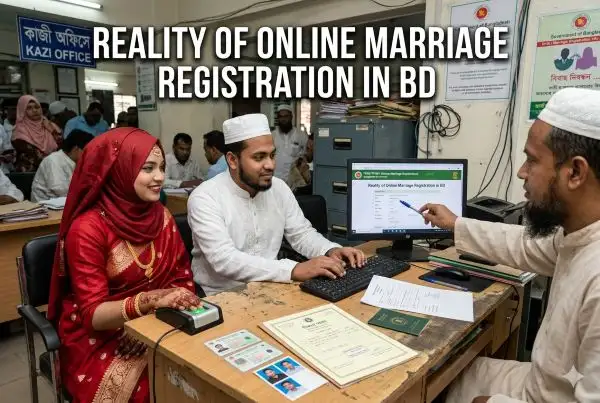
The Reality of Online Marriage Registration in BD (2026 Update)
Before diving into the steps, it is critical to understand exactly how “online registration” operates under current Bangladeshi law.
Important Clarification: Under the Ministry of Law, Justice and Parliamentary Affairs, an “Online Marriage Registration” does not mean a completely virtual zoom wedding where no one meets in person. By law, physical signatures or thumbprints of the bride, groom, and witnesses are still mandatory on the official registry book (Bahi).
The digital upgrade introduced by the government allows couples to:
- Initiate and Apply Online: Fill out essential background information, verify National Identity Cards (NID) or passports, and submit application profiles through integrated government portals like myGov.bd.
- Book Authorized Registrars: Find and schedule appointments with verified, licensed Nikah Registrars (Kazis) or Civil Marriage Officers within specific jurisdictions.
- Automate Record Keeping: Store marriage records securely within the central government database, preventing fraudulent marriages and making the issuance of certified copies or trackable tracking numbers incredibly fast.
- Post-Registration Digital Integration: Seamlessly transition your registered marriage profile into secondary portals like Prottoyon.gov.bd for citizenship certificates or myGov for Ministry attestation.
By blending mandatory physical solemnization with cloud-based tracking, this system preserves strict legal authenticity while delivering the efficiency of modern digital government platforms.
Legal Requirements for Marriage Registration in Bangladesh
To use the Online Marriage Registration system, both parties must strictly fulfill the baseline criteria established by Bangladeshi family law. Failing to meet these conditions renders the marriage legally void and can lead to criminal prosecution.
1. Legal Age Requirements
The legal age of marriage remains strict and non-negotiable under the Child Marriage Restraint Act:
- Bride (Female): Must be at least 18 years old.
- Groom (Male): Must be at least 21 years old.
During the online initiation phase, the system cross-references the inputted date of birth with the national BDRIS (Birth and Death Registration Information System) and EC (Election Commission) databases. If either party is underage, the portal automatically blocks the application.
2. Free Consent
Both the bride and groom must give their voluntary, uncoerced consent to the union. In the online intake form, an electronic declaration of free will must be checked before proceeding to schedule the physical signing ceremony.
3. Marital Status and Prohibited Relationships
- Monogamy/Polygamy Rules: The groom must declare his current marital status. If he is already married, he must submit certified digital proof of legal permission from the Arbitration Council under the Muslim Family Laws Ordinance, 1961.
- Consanguinity: The parties must not fall under prohibited degrees of relationship (e.g., direct siblings, ascendants, or certain close relatives as defined by religious personal law).
Step-by-Step Online Marriage Registration Process
Once you have gathered all the necessary documents and information, it is important to follow the registration process in the correct order. Completing each step systematically helps prevent errors, reduces processing delays, and ensures that your application is properly reviewed by both the government’s digital verification system and the local registration authorities. A well-organized submission can significantly improve processing efficiency and minimize the likelihood of additional document requests. By adhering to the required procedure, applicants can achieve a smoother and faster registration experience from start to finish.
- 1.Create and Verify Your myGov.bd Account (10-15 Minutes): Visit the official myGov Bangladesh platform (myGov.bd). Register using an active mobile number or email address. To access the judicial and municipal registry options, you must complete your Profile Verification by uploading or fetching your National ID (NID) details. The platform uses API bridges to match your face and details instantly with the EC database.
- 2.Fill Out the Marriage Intention & Profile Form (20 Minutes): Navigate to the service directory and locate the Marriage Registration section. Here, enter the personal details of both the bride and groom: full legal names, accurate dates of birth, current addresses, permanent addresses, and religious backgrounds. You will also insert the details of at least two adult witnesses.
- 3.Select an Authorized Jurisdiction and Local Registrar (5 Minutes): The digital system will prompt you to choose the exact geographical area (Division, District, Upazila/Thana, and Ward/Union) where the solemnization will occur. Based on this choice, the system displays a list of verified, government-licensed Nikah Registrars (Kazis) or Civil Marriage Officers. Select your preferred officer to link your application tracking number directly to their office dashboard.
- 4.Pay the Base Processing Fee Online (5 Minutes):Pay the regulatory portal processing fee through integrated digital financial services (Mobile Financial Services like bKash, Nagad, Rocket, or internet banking/Ekpay). Keep the digital receipt download file safely; its transaction ID will be attached to your tracking slip.
- 5.Solemnize and Execute Physical Registries (Scheduled Day): On your scheduled date, visit the chosen local Registrar’s office or have the authorized Registrar attend your wedding venue. The Registrar will open your digital application on their institutional portal, verify your physical documents against the online record, conduct the religious or civil vows, and collect manual signatures/thumbprints on Form No. 160 (Kabinnama Book).
- 6.Download & Collect Your Certified Copy (Within a Week):As soon as the registrar syncs your marriage details into the government network, your portal status changes to “Registered.” At this stage, you are free to log back in and save a digital copy of your provisional certificate. To get the permanent paper certificate featuring a trackable QR code, simply drop by the registrar’s office or select the courier delivery option to receive it by mail.
Document Checklist for Online Initiation
To ensure a smooth online marriage registration process, it is important to prepare all required documents in advance. Make sure you have clear, high-quality scanned copies or photographs of each document before starting your application. Poor image quality, incomplete information, or unreadable files can lead to verification delays, additional review requests, or even application rejection. By organizing accurate and legible documents beforehand, you can minimize processing issues, speed up approval, and improve the chances of your registration being successfully verified through the government database system.
For the Bride and Groom:
- National Identity Card (NID): The primary document for identity verification.
- Valid Passport: Highly recommended if either party is an NRB, a foreign national, or plans to apply for dependent/spouse visas immediately after marriage.
- Digital Birth Registration Certificate: Must be verifiable via the online BDRIS portal (
everify.bdris.gov.bd) if NID is unavailable. - Passport-Sized Photographs: Recent studio-quality color photos with a white or blue background (JPEG format, maximum size 2MB per upload).
- Affidavit of Marital Status: Essential for single individuals marrying foreign nationals or for special civil marriages, confirming that neither party is currently bound by an existing legal marriage.
For Witnesses and the Legal Guardian (Vakil):
- NID Copies of Two Adult Witnesses: Must be present at the time of manual signature. Under Muslim personal law, these must be two adult males or one male and two females.
- NID Copy of the Vakil (Guardian/Representative): If a proxy representative is designated to formalize the consent structure under traditional rites.
Official Government Fee Structure in 2026
One of the greatest benefits of the Online Marriage Registration framework is financial transparency. Historically, couples faced arbitrary pricing from local agents. The current government schedule sets uniform fees based strictly on the financial volume of the Mahr (dower money) for Muslim marriages, or flat rates for civil registries.
Muslim Marriage Registration Fee Scale
The registration fee is proportional to the Mahr agreed upon by the families:
| Mahr Range (BDT) | Official Registration Fee Calculation Structure |
| Up to 4,00,000 BDT | 1,250 BDT for every 1,00,000 BDT (or a fraction thereof). |
| Above 4,00,000 BDT | A base fee of 5,000 BDT for the first 4,00,000 BDT, plus an additional 100 BDT for every 1,00,000 BDT exceeding that amount. |
| Provisional/Copy Fee | A flat rate of 100 BDT to 500 BDT for certified true copies or secondary digital prints. |
Hindu and Special Marriages Flat Fees
- Hindu Marriage Registration Act, 2012: Governed by flat base fees ranging between BDT 500 to BDT 1,500 depending on municipal area boundaries.
- Special Marriage Act, 1872 (Interfaith/Civil): Requires a statutory notice fee of BDT 200, a base registration fee of approximately BDT 1,000 to BDT 2,000, and standard operational fees for the 30-day mandatory public filing tracking.
Special Marriages & Interfaith Couples: Navigating the 1872 Act
If you or your spouse belong to different religions (e.g., a union between a Muslim and a Christian, or a Hindu and a Buddhist) or prefer a completely secular, non-religious legal structure, your path involves the Special Marriage Act of 1872.
The digital pathway accommodates special marriages, but with a unique variation in the timeline:
[Fill Special Marriage Form Online]
[System Dispatches 30-Day Public Notice]
[Waiting Period for Legal Objections]
[Execute Civil Marriage Signatures]
- The 30-Day Notice Rule: When you submit your application through the portal under the Special Marriage track, the system publishes a digital notice to the local Marriage Registrar’s notice board. This notice must remain public for exactly 30 days.
- Objection Period: This window allows any party to file a legal objection if there are pre-existing marriages, identity fraud, or age discrepancies.
- Registry Execution: If no valid legal objections are sustained within 30 days, the portal unlocks the final scheduling step, allowing the couple and three witnesses to sign the civil registry book before the Marriage Registrar.
Post-Registration: Ministry Attestation for Abroad and Visas
Registering your marriage online is only the first half of the journey if your ultimate goal involves relocation, joint bank accounts, or immigration visas. A raw Kabinnama or a local certificate is often rejected by foreign embassies unless it goes through a formal verification chain.
The Attestation Sequence via myGov
- Notary Public Attestation: Obtain a certified English translation of your Kabinnama and have it attested by a registered Notary Public.
- Law Ministry Verification: Submit your verified digital marriage tracking code to the Ministry of Law, Justice and Parliamentary Affairs division via myGov.bd to authenticate the Kazi’s signature.
- Ministry of Foreign Affairs (MoFA) Consular Attestation: Finally, submit the document package to the MoFA Consular Section (or via the online Apostille system if applicable) to get the final official government stamp.
This entire process ensures that your marriage document holds absolute legal validity across global borders.
Common Pitfalls to Avoid in Online Processing
Even with standard automation, small mistakes can pause or ruin your application. Keep an eye out for these frequent mistakes:
- Name Discrepancies: Ensure that the names entered into the fields match your NID and Passport letter-for-letter. If your NID says “Mohammad” but your passport says “Md.”, edit your profiles to establish uniformity before clicking submit.
- Using Unlicensed Kazis: Do not rely on unauthorized religious clerks who claim they can do “online registration” off-the-grid. Always check their registration license number against the active registry directory on the RD.gov.bd (Registration Directorate) or myGov lists.
- Ignoring the 30-Day Window: Under typical family law statutes, a marriage should ideally be registered within 30 days of the actual physical social ceremony if the solemnization happened earlier. Letting this window slip can lead to administrative fines or extra legal delay affidavits.
Frequently Asked Questions (FAQ)
Can we complete the entire marriage registration completely from home without going anywhere?
No. While you can fill out the application forms, upload IDs, pay fees, and track your processing status entirely online from home, you must still meet your chosen Registrar in person (either at their office or a wedding venue) alongside your witnesses to manually sign the official, permanent paper ledger.
What happens if our marriage certificate is lost or damaged?
Because your record is now saved in the integrated central database, recovering it is simple. Log into your myGov portal dashboard, enter your original application reference tracking code or NID number, select “Apply for Certified Copy,” pay the minimal re-issuance fee online, and download a fresh digital copy or request a stamped printout.
Is online registration legally mandatory in Bangladesh?
Yes. Under the Muslim Marriages and Divorces (Registration) Act 1974 and subsequent amendments, registering your marriage legally is a strict statutory requirement. Skipping the official registration process can result in strict legal penalties, including fines and imprisonment. Even worse, an unregistered marriage leaves you completely unprotected, making it incredibly difficult to legally resolve issues like inheritance distribution, child custody disputes, or dower rights.
Can non-resident Bangladeshis (NRBs) use this online framework?
Absolutely. NRBs can initiate the registration profile creation, upload passport scans, and handle portal payments online from anywhere in the world. However, they must plan their travel to Bangladesh to complete the physical registry book signature step, or execute appropriate legal powers-of-attorney via the Bangladesh Embassy if permitted under specific marital exceptions.
Conclusion: Embracing the Future of Marital Legalities
Securing your legal union in Bangladesh no longer requires battling tedious manual bureaucracy or hidden processing fees. As highlighted throughout this 2026 guide, utilizing the unified Online Marriage Registration framework is the most reliable way to protect your spousal, financial, and family rights. By transitioning key identity verification steps, portal profiling, and fee structures to digital systems like myGov, the government has created a highly transparent environment for modern couples.
While the fundamental legal requirement of physically signing the marriage ledger under an authorized registrar or Kazi remains unchanged, the digital backbone makes tracking, archiving, and retrieving your official documents incredibly seamless. Failing to register your marriage can cause severe vulnerabilities regarding future immigration, property inheritance, or dower rights.
Whether you are coordinating a traditional local ceremony or planning an international relocation, taking advantage of the automated platform ensures that your legal paperwork matches the speed of the modern world. Prioritize your peace of mind by following these updated steps, checking your background criteria beforehand, and securing a fully verifiable, QR-coded marriage record that stands strong across all global jurisdictions.
For an in-depth breakdown of processing your final certificates for international visas, this guide on Marriage Certificate Ministry Attestation Rules explains the necessary steps for navigating the myGov system and securing Foreign Ministry approval.