
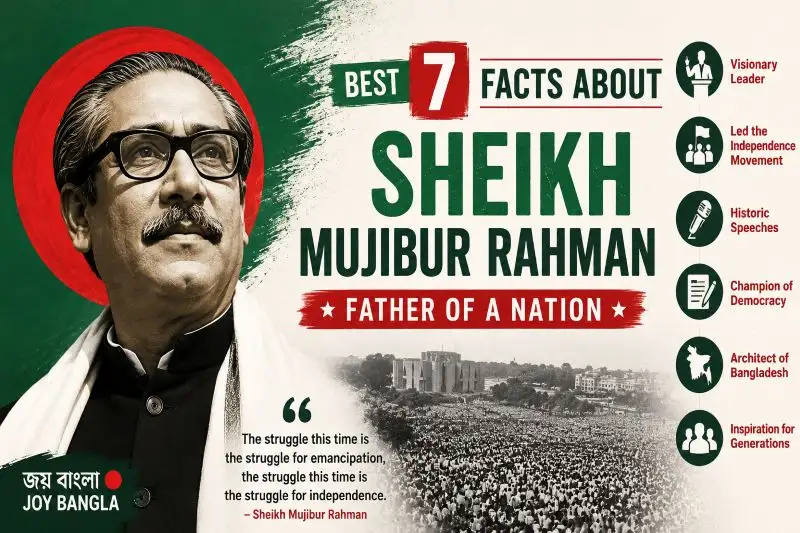
Discover the best 7 facts about Sheikh Mujibur Rahman, the Father of the Nation, and learn about his leadership and legacy.
Introduction: 7 Facts About Sheikh Mujibur Rahman
Sheikh Mujibur Rahman is remembered as one of the most influential and respected leaders in the history of Bangladesh. Popularly known as the “Father of the Nation,” he played a vital role in leading the Bengali people toward independence and national identity. Through his strong leadership, inspiring speeches, and dedication to justice, he became a symbol of courage and patriotism for millions of people.
Throughout his political career, Sheikh Mujibur Rahman consistently spoke for the rights of ordinary citizens and worked to protect the cultural and political identity of the Bengali population. His contributions to democracy, language rights, and the independence movement helped shape the foundation of modern Bangladesh. Even today, his vision and leadership continue to influence the country’s politics, culture, and national spirit.
People across the world admire Sheikh Mujibur Rahman for his determination, resilience, and commitment to freedom. His historic speeches and political actions inspired generations during difficult times. This article explores seven remarkable facts about Sheikh Mujibur Rahman, focusing on his leadership, achievements, and lasting influence on the history of Bangladesh.
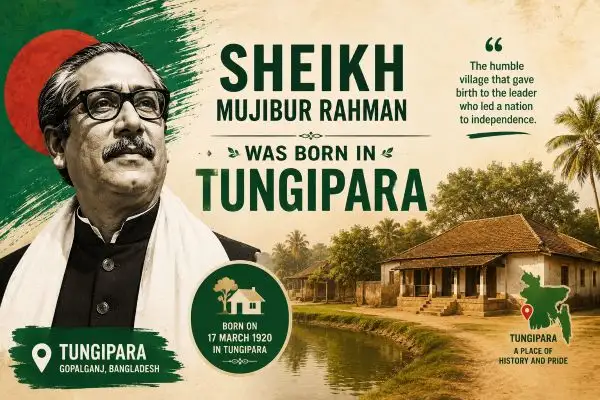
1. Tungipara: The Birthplace of Sheikh Mujibur Rahman
Nestled along the banks of the Madhumati River in Gopalganj, Tungipara is the historic village where Sheikh Mujibur Rahman was born on March 17, 1920. This serene, rural setting shaped his early life, fostering a deep empathy for the struggles of ordinary citizens. Today, Tungipara stands as a sacred landmark of national heritage. It houses the Bangabandhu Mausoleum Complex, where the Father of the Nation is laid to rest. The site serves as a timeless symbol of inspiration, drawing millions who wish to honor his memory.
- Humble Beginnings in Rural Bengal: One of the most notable facts about Sheikh Mujibur Rahman is his simple and modest upbringing. He was born on March 17, 1920, in Tungipara, a peaceful village in Gopalganj District of present-day Bangladesh. His father, Sheikh Lutfur Rahman, worked as a government official, while his mother, Sayera Khatun, played an important role in shaping his values and character.
- Early Signs of Leadership:From childhood, Sheikh Mujibur Rahman displayed confidence, kindness, and leadership qualities. During his school years, he became involved in various social and political activities. He showed deep concern for fairness, equality, and the well-being of ordinary people from a very young age.
- Understanding the Struggles of Common People: Growing up in rural Bengal allowed him to witness poverty and social inequality closely. These experiences helped him develop strong compassion for the people of Bengal. His connection with ordinary citizens later became one of the strongest foundations of his political career and leadership philosophy.
- Tungipara as a Historic Landmark:Today, Tungipara is recognized as an important historical place in Bangladesh. Thousands of visitors travel there every year to pay tribute to Sheikh Mujibur Rahman and learn more about his life and legacy.
2. Sheikh Mujibur Rahman’s Role in the Language Movement
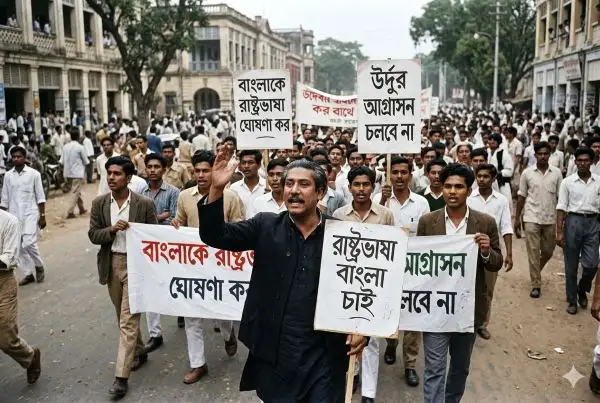
During the late 1940s and early 1950s, Sheikh Mujibur Rahman emerged as a fierce defender of linguistic rights when the Pakistani ruling elite tried to impose Urdu as the sole state language. Recognizing that language is the bedrock of cultural survival, Mujib actively organized student strikes and political coalitions to champion the Bengali-speaking majority. Despite facing multiple arrests and prolonged imprisonment for his activism, his unwavering defiance galvanized early nationalist sentiment, laying the foundational groundwork for the country’s eventual pursuit of complete political sovereignty.
- Political Ascent: This crucial struggle did more than just protect the mother tongue; it firmly established Sheikh Mujibur Rahman as a major, rising political force capable of leading East Pakistan.
- Defending Linguistic Identity: During the late 1940s and early 1950s, the Pakistani administration attempted to declare Urdu as the sole national language. This decision completely ignored the majority Bengali population in East Pakistan. Sheikh Mujibur Rahman fiercely opposed this policy, viewing language as the bedrock of cultural identity and fundamental human rights.
- Mobilizing Resistance: Actively organizing student strikes and political rallies, Mujib became a driving force behind the resistance. He was imprisoned multiple times for his activism, yet his dedication to establishing Bengali as an official state language never wavered.
- Igniting Nationalism: The Language Movement served as a historical turning point for the region. It catalyzed a distinct sense of Bengali nationalism and united a fragmented population against systematic political and cultural discrimination.
- A Lasting Legacy: The ultimate sacrifices of this movement are globally commemorated every February 21st as International Mother Language Day. Mujib’s early advocacy for linguistic rights solidified his devotion to preserving his people’s heritage.
3. Sheikh Mujibur Rahman Delivered the Historic 7th March Speech
- A Turning Point in History: On March 7, 1971, Sheikh Mujibur Rahman delivered a monumental address at Dhaka’s Racecourse Ground. Speaking to a massive crowd of millions, he addressed a population deeply desperate for political rights and sovereign freedom.
- A Strategic Call to Action: While avoiding an overt, premature declaration of independence that could trigger immediate military retaliation, Mujib masterfully outlined clear strategies for civil disobedience. He urged citizens to convert every home into a fortress and prepare for potential armed resistance.
- Galvanizing the Masses: The speech was a masterclass in political communication, instantly sparking intense patriotism, unity, and courage. It motivated ordinary laborers, students, and everyday citizens to transform into determined freedom fighters ready to challenge oppression.
- Global and Historical Recognition: Renowned worldwide for its emotional resonance and tactical brilliance, the address stands as one of history’s greatest political speeches. Recognizing its profound impact, UNESCO officially inducted it into the Memory of the World Register as a vital piece of global documentary heritage.
- An Enduring Symbol: This historic moment perfectly demonstrated Mujib’s unparalleled ability to unite a fractured nation during a time of extreme crisis. Decades later, the speech remains an everlasting symbol of Bangladeshi national pride and a source of inspiration for future generations.

4. Sheikh Mujibur Rahman Led Bangladesh Toward Independence
- Challenging Decades of Inequality: For a generation, East Pakistan endured severe economic deprivation and cultural marginalization. Sheikh Mujibur Rahman emerged as the primary champion against this inequality, introducing the historic Six-Point Movement—a definitive roadmap aimed at securing self-governance, political autonomy, and financial equity for the Bengali population.
- A Denied Democratic Mandate: The turning point arrived with the 1970 general elections, where Mujib’s political party secured a historic, absolute majority. Rather than allowing a peaceful democratic transition, the ruling military junta refused to transfer power fairly, triggering immense civil unrest and a brutal, state-sponsored military crackdown.
- The Struggle for Liberation: This political impasse erupted into the 1971 Bangladesh Liberation War. Even though Mujib was arrested and detained in West Pakistan at the very onset of the conflict, his ideas and political stature served as the ultimate unifying beacon that kept the resistance motivated.
- Birth of Bangladesh: Following nine months of intense struggle and profound human sacrifice, Bangladesh achieved official victory on December 16, 1971. For transforming the dream of a free nation into reality through collective courage, Sheikh Mujibur Rahman was permanently honored as the “Father of the Nation.”
5. Sheikh Mujibur Rahman Became the First President of Bangladesh
- Assuming Supreme Leadership: Following the liberation of Bangladesh, Sheikh Mujibur Rahman returned home to a heroes’ welcome and immediately shouldered the massive burden of governance. He initially served as the newborn country’s first President, later transitioning into the role of Prime Minister to directly spearhead state operations.
- Confronting Post-War Devastation: The infant nation faced overwhelming crises, including widespread poverty, destroyed infrastructure, acute food shortages, and an unstable economy. Mujib focused heavily on rebuilding core public sectors, prioritizing progressive advancements in public education, healthcare, and agricultural rehabilitation to feed the population.
- Constitutional and Diplomatic Framework: Under his guidance, Bangladesh adopted a progressive constitution anchored on four core pillars: nationalism, democracy, socialism, and secularism. Concurrently, he launched a major diplomatic offensive, successfully securing global recognition and establishing vital foreign relations with major international powers.
- The Foundation of a Modern State: Although his administration faced intense economic hardships and mounting domestic criticism during these turbulent post-war years, his institutional groundwork was indispensable. His visionary efforts ultimately laid the structural, legal, and political foundations upon which the modern state of Bangladesh stands today.
6. Sheikh Mujibur Rahman’s Powerful Leadership and Charismatic Personality
- A Leader with Extraordinary Influence: Sheikh Mujibur Rahman was widely admired not only as a political figure but also as an inspiring speaker and influential national leader. His strong personality and commanding presence helped him gain the trust and respect of millions of people across Bangladesh.
- Inspiring People Through Powerful Speeches: One of his greatest strengths was his ability to connect emotionally with ordinary citizens. His speeches encouraged hope, unity, and courage during challenging political periods. People felt motivated by his words because he spoke with honesty, passion, and deep concern for the nation.
- Deep Concern for Common Citizens:Sheikh Mujibur Rahman consistently spoke for the rights of poor and marginalized communities. He openly criticized injustice, inequality, and political discrimination. His dedication to improving the lives of ordinary people made him highly respected among the masses.
- Leadership Built on Determination and Trust: His leadership style combined emotional connection with strong political determination. Even political opponents acknowledged his popularity and influence among the Bengali population.
- Lasting Impact on South Asian Politics: Historians often describe him as one of the most influential leaders in South Asian history. Students, workers, farmers, and young activists viewed him as the true voice of the Bengali people.
7. Sheikh Mujibur Rahman’s Legacy Continues Today
- A Leader Remembered Across Generations: One of the most remarkable aspects of Sheikh Mujibur Rahman is the lasting influence of his legacy. Even many years after his passing, he continues to be honored as one of the most respected and influential figures in Bangladesh’s history.
- Continued Influence on National Identity: His speeches, political ideals, and leadership philosophy still shape the country’s culture, politics, and national consciousness. Many people consider him a symbol of freedom, unity, and patriotism.
- National Recognition and Honors: Numerous schools, universities, roads, museums, and public institutions have been named in his memory. His birthday on March 17 is celebrated nationwide, and students across Bangladesh learn about his contributions to the country’s independence and development.
- Inspiration for Future Leaders:Young political leaders and students often study his leadership style and speeches to understand courage, resilience, and public service. His ability to inspire people during difficult times remains highly admired.
- Global Recognition of His Leadership:Internationally, Sheikh Mujibur Rahman is respected for his role in the fight for self-determination and independence. His vision of a strong, independent, and prosperous Bangladesh continues to inspire discussions about democracy, justice, and human rights around the world.
The Historical Significance of Sheikh Mujibur Rahman
The historical importance of Sheikh Mujibur Rahman transcends conventional political leadership, cementing him as the definitive symbol of sovereignty and cultural pride for millions. His enduring crusade for social justice, linguistic preservation, democratic governance, and territorial autonomy fundamentally reshaped the geopolitical landscape of modern South Asia. Without his unparalleled ability to mobilize the masses and articulate their collective grievances, the emergence of an independent Bangladesh could not have materialized in the manner it did.
Historians consistently characterize Mujib as an exceptionally fearless statesman who steadfastly refused to compromise on the fundamental rights of his citizens. He maintained this fierce defiance despite enduring years of grueling imprisonment, immense geopolitical pressure, and constant threats to his own life. His unwavering resolve in the face of autocracy established a template for regional resistance movements.
Ultimately, his legacy is not confined by national borders. His powerful oratory achievements and visionary stewardship continue to resonate globally, serving as an enduring source of inspiration for marginalized populations everywhere. For anyone advocating for the universal values of liberty, human equality, and right to self-determination, his life remains a timeless testament to the power of courage.
Leadership Lessons from Sheikh Mujibur Rahman
There are several valuable leadership lessons people can learn from Sheikh Mujibur Rahman:
- A Defined, Strategic Vision: True leadership requires an unwavering long-term objective. Mujib possessed a crystal-clear, uncompromising dream of a sovereign and self-reliant Bangladesh, allowing him to guide his people through decades of uncertainty with absolute clarity and purpose.
- Resilience Under Extreme Adversity: He demonstrated remarkable fortitude when facing systemic oppression. Despite enduring prolonged imprisonments, severe political intimidation, and constant death threats, he refused to abandon his principles, proving that true leaders remain steadfast during immense crises.
- Empathetic and Powerful Oratory: Exceptional communication is vital for mass mobilization. His historic speeches resonated deeply because they perfectly articulated the pain and aspirations of the public, successfully uniting millions of diverse individuals around a single, shared goal.
- Uncompromising Pursuit of Equity: A legitimate leader must be anchored in ethics. Mujib dedicated his entire life to challenging systemic discrimination, consistently advocating for democratic representation, constitutional rights, and social justice for marginalized populations.
- Unfaltering People-Centric Focus: He genuinely prioritized the welfare of ordinary citizens over elite political interests. This deep empathy and grassroots connection earned him the absolute trust of his nation, transforming him into an enduring symbol of authentic leadership.
Conclusion
Sheikh Mujibur Rahman stands as a monumental figure whose leadership fundamentally redefined the geopolitical landscape of South Asia and birthed the nation of Bangladesh. His political journey—stretching from the foundational days of the Language Movement to his definitive role as the architect of independence—underscores a lifelong commitment to state-building and cultural identity. He was not merely a politician; he was the unifying voice of a populace yearning for sovereignty, transforming localized grievances into a global movement for self-determination.
The core truths of his biography highlight a rare combination of raw courage, strategic defiance, and an unbreakable bond with his citizens. Through his seminal oratory achievements, most notably the historic 7th March speech, and his willingness to endure immense personal sacrifice, he galvanized millions to resist oppression. This vision of a democratic, exploitation-free society remains the ethical compass guiding the nation today.
Ultimately, exploring the narrative of Sheikh Mujibur Rahman is indispensable for anyone seeking to understand modern South Asian dynamics, the psychology of transformational leadership, and the enduring human struggle against systemic injustice. His legacy serves as a timeless case study in how unwavering determination can successfully challenge established empires to secure a people’s freedom.
Frequently Asked Questions: Sheikh Mujibur Rahman
Who was Sheikh Mujibur Rahman?
He was a visionary statesman and the foundational leader of Bangladesh. Revered permanently as the “Father of the Nation,” he served as the country’s initial President and later as its Prime Minister, guiding the territory from a neglected province to an independent state.
What does the honorific title “Bangabandhu” signify?
Conferred upon him by the public in 1969, “Bangabandhu” translates literally to “Friend of Bengal.” It symbolizes the deep affection, trust, and emotional bond the Bengali population shared with him throughout his decades of political struggle.
What was his role in the 1971 Liberation War?
Mujib was the central inspiration behind the independence movement. His iconic 7th March speech mobilized millions to resist oppression. Although arrested by Pakistani forces at the conflict’s onset, his political mandate and ideology united the freedom fighters until victory was achieved.
Why is his 7th March speech considered historically unique?
Delivered without a script, the address masterfully blended tactical guidelines with a passionate call for liberty. Because of its profound global impact and artistic power, UNESCO officially inducted it into the Memory of the World Register as part of humanity’s documentary heritage.