
Discover Teesta Barrage 2026 complete history, origin, benefits, water management, irrigation impact, and powerful role in Bangladesh’s growth.
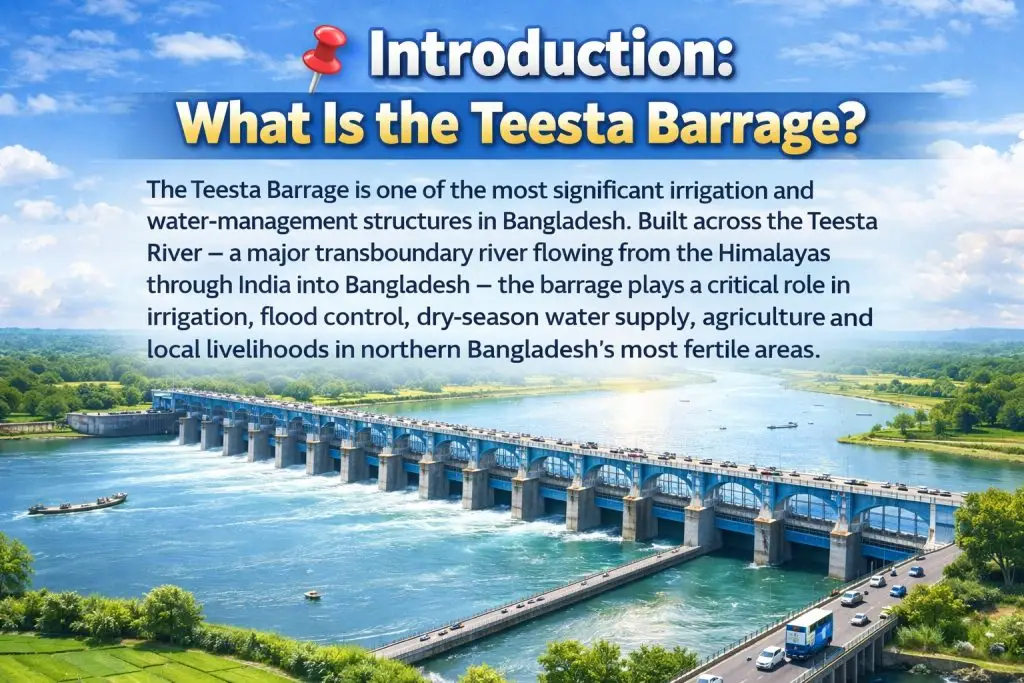
📌 Introduction: What Is the Teesta Barrage?
The Teesta Barrage is one of the most significant irrigation and water-management structures in Bangladesh. Built across the Teesta River — a major transboundary river flowing from the Himalayas through India into Bangladesh — the barrage plays a critical role in irrigation, flood control, dry-season water supply, agriculture and local livelihoods in northern Bangladesh’s most fertile areas.
🏞️ 1. Origin & Background of the Teesta Barrage Project
The idea of using the waters of the Teesta River for irrigation in northern Bangladesh dates back many decades, influenced by both pre-independence and post-independence development goals.
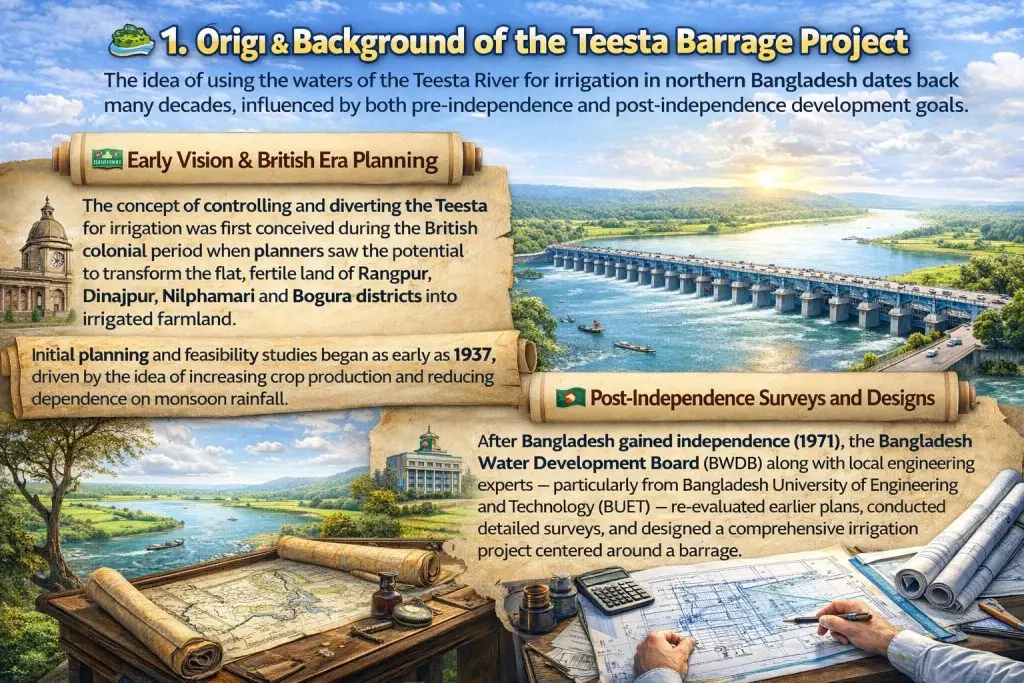
🏛️ Early Vision & British Era Planning
- The concept of controlling and diverting the Teesta for irrigation was first conceived during the British colonial period when planners saw the potential to transform the flat, fertile land of Rangpur, Dinajpur, Nilphamari and Bogura districts into irrigated farmland.
- Initial planning and feasibility studies began as early as 1937, driven by the idea of increasing crop production and reducing dependence on monsoon rainfall.
📈 Post-Independence Surveys and Designs
After Bangladesh gained independence (1971), the Bangladesh Water Development Board (BWDB) along with local engineering experts — particularly from Bangladesh University of Engineering and Technology (BUET) — re-evaluated earlier plans, conducted detailed surveys, and designed a comprehensive irrigation project centered around a barrage.
🏗️ 2. Construction History & Timeline
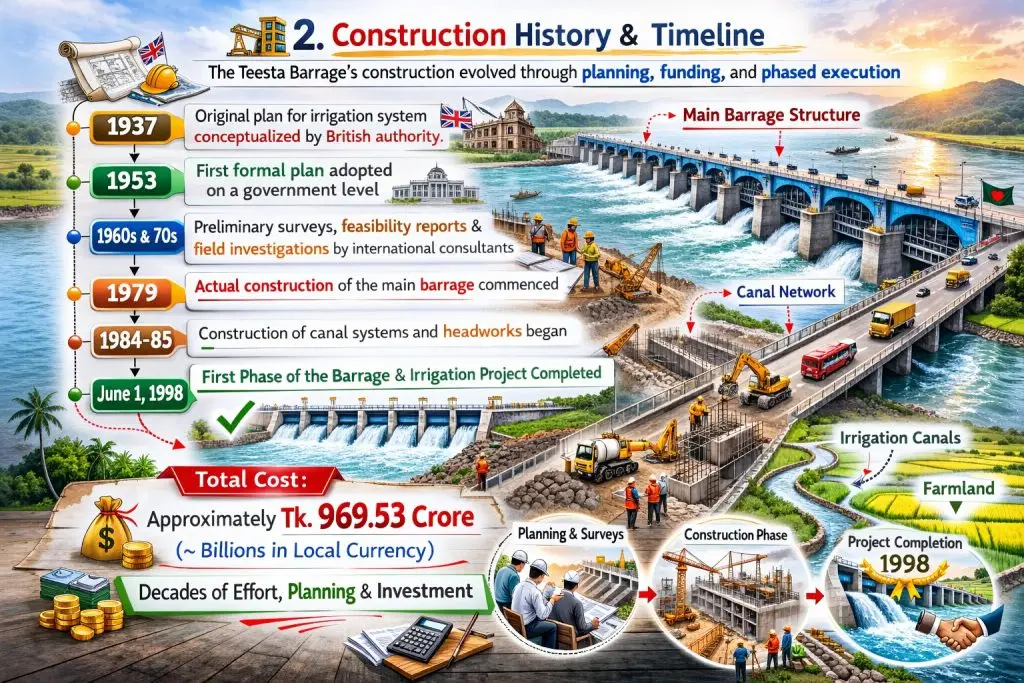
The Teesta Barrage’s construction did not happen in a single year — it evolved through planning, redesign, funding negotiations, phased construction and project execution.
📅 Major Milestones
| Year / Period | Key Event |
|---|---|
| 1937 | Original plan for irrigation system conceptualized by British authority. |
| 1953 | First formal plan adopted on a government level for a barrage. |
| 1960s & 70s | Preliminary surveys, feasibility reports and field investigations carried out by international consultants. |
| 1979 | Actual construction of the main barrage commenced. |
| 1984-85 | Construction of canal systems and headworks began. |
| June 1, 1998 | First phase of the barrage and irrigation project completed. |
💰 Total cost: Approximately Tk. 969.53 crore (~ billions in local currency), reflecting decades of effort, planning and investment.
🏞️ 3. Where Is Teesta Barrage Located? Geographical Details
The Teesta Barrage is strategically located on the Teesta River at Doani village in Hatibandha Upazila, under Lalmonirhat District, in the northern part of Bangladesh.
It lies very close to the boundary of Nilphamari District, making it an important regional water control point.

The barrage is positioned just downstream of the India–Bangladesh international border, where the Teesta River enters Bangladesh from India.
Its geographic setting allows Bangladesh to regulate river flow immediately after the river crosses the border.
The structure is built on a wide, flat floodplain, which is ideal for constructing large irrigation canals.
This flat terrain helps in smooth diversion of water into the Teesta Main Canal system.
The surrounding region is part of the fertile Rangpur Division, known for agriculture and crop production.
Because of its northern location, the barrage directly supports irrigation in drought-prone districts.
The area experiences both monsoon flooding and dry season water shortages, increasing the importance of its location.
Nearby rural communities depend heavily on the barrage for irrigation and livelihood support.
The site was carefully selected after hydrological and soil surveys confirmed its suitability.
Its proximity to the border also makes it geopolitically significant in transboundary water management.
The barrage stands as a gateway structure controlling Teesta’s downstream flow in Bangladesh.
Road connections around the barrage have improved transportation and local trade.
Overall, the geographical location of Teesta Barrage makes it a vital water management hub in northern Bangladesh. 🌊
🧱 4. Structure & Technical Specifications
The Teesta Barrage is a modern hydraulic engineering structure built to regulate and distribute Teesta River water efficiently.
The total length of the main barrage is approximately 615 meters, spanning the river’s wide channel.
It is equipped with 44 radial gates, which control the volume and speed of water flow during both dry and monsoon seasons.
These gates can be raised or lowered to manage irrigation supply and reduce flood risks.
The canal head regulator, measuring around 110 meters, includes 8 additional gates to direct water into irrigation canals.
In total, the barrage system contains about 52 gates, ensuring precise water management.
A 610-meter flood bypass channel is integrated into the structure to safely release excess monsoon water.
The project also features a silt trap system that prevents sediment from entering and blocking irrigation canals
.
A massive 2,470-meter closure dam helps divert river flow toward the controlled barrage section.
Additionally, nearly 80 kilometers of protective embankments safeguard surrounding agricultural lands and communities from flooding. 🌊
🚜 5. Irrigation Command Area & Canal Network
The Teesta Barrage was primarily constructed to boost irrigation and increase agricultural productivity in northern Bangladesh.
It serves as the backbone of the Teesta Irrigation Project, one of the largest irrigation systems in the country.
The total command area of the project is approximately 750,000 hectares, covering vast fertile plains.
Out of this, around 540,000 hectares are classified as net irrigable land, directly benefiting farmers.
The irrigation network spans several northern districts under Rangpur Division, including Lalmonirhat, Nilphamari, Rangpur, and Dinajpur.
Water from the barrage is diverted into a well-planned system of main canals and branch canals.
These canals further connect to secondary and minor channels, ensuring water reaches remote villages.
An integrated drainage canal system prevents waterlogging and protects crops during heavy rainfall.
The project supports year-round cultivation of rice, wheat, maize, and vegetables.
Overall, the Teesta Barrage canal network plays a transformative role in strengthening food security and rural livelihoods in northern Bangladesh. 🌾🌊
🌧️ 6. Hydrology: How the Barrage Controls Water
The Teesta Barrage plays a crucial role in regulating the seasonal flow of the Teesta River through advanced gate and canal management systems.
💧 Dry Season Water Management:
During the winter and pre-monsoon months, when natural river discharge becomes very low, the barrage stores and diverts available water into irrigation canals to support agriculture. This controlled distribution ensures crops receive essential moisture despite reduced upstream flow. However, dry-season shortages remain a concern due to upstream water withdrawals and changing climate patterns that reduce overall river discharge.
🌊 Flood Moderation:
In the monsoon season, the barrage gates, embankments, and flood bypass channels help release excess water gradually. This reduces sudden flooding, protects farmland, and safeguards nearby villages from severe erosion and damage.
📜 7. Historical & Economic Importance of Teesta Barrage
The Teesta Barrage represents one of the most significant irrigation achievements in northern Bangladesh. Historically, farmers in this region depended heavily on unpredictable monsoon rainfall, which often led to drought, crop failure, and food shortages. With the completion of the barrage and canal network, vast areas of previously rain-fed land were converted into controlled irrigated farmland.
📊 Agriculture & Food Security
The irrigation potential unlocked by the project now supports year-round cultivation. Farmers grow rice, wheat, maize, potatoes, vegetables, and other cash crops, significantly increasing crop yields and farm income. Reliable water supply has reduced seasonal risks, strengthened food production, and improved regional food security.
🚜 Employment & Economic Growth
Beyond agriculture, the barrage has stimulated economic development by creating employment in farming, canal maintenance, irrigation management, construction, and local trade. Increased agricultural output has boosted rural markets, improved livelihoods, and contributed positively to the northern economy of Bangladesh. 🌾🌊
🤝 8. Cross-Border Water Sharing & Controversies
The Teesta River is a major transboundary river shared between India and Bangladesh, making water management a sensitive diplomatic issue. Because the river originates in the Indian Himalayas and flows into Bangladesh, both countries depend on its water for irrigation, agriculture, and livelihoods. This shared status has led to decades of discussions, negotiations, and political debates over fair water distribution.
🇮🇳🇧🇩 Water Allocation Talks
Bangladesh has consistently requested a long-term, legally binding agreement to ensure predictable dry-season water flow. Although multiple rounds of bilateral talks have taken place since the 1980s, a comprehensive and permanent treaty has yet to be finalized. Seasonal agreements and proposed formulas have been discussed, but consensus remains incomplete.
📉 Downstream Water Decrease
Critics in Bangladesh argue that upstream water diversion structures in India, including the Gajoldoba Barrage, reduce dry-season flow. Lower downstream discharge affects irrigation reliability, crop production, and livelihoods in northern Bangladesh. 🌊
📉 9. Challenges & Environmental Issues
Despite its major irrigation benefits, the Teesta Barrage faces ongoing environmental and operational challenges that affect its long-term sustainability.
🔹 Reduced Flow & Sedimentation
During the dry season, river discharge often drops significantly, limiting the volume of water available for irrigation. At the same time, the Teesta carries heavy sediment from the Himalayan region. This sediment gradually accumulates in canals and riverbeds, causing siltation. As a result, water-carrying capacity decreases, irrigation efficiency declines, and regular dredging becomes necessary to maintain proper flow.
💦 Flood Erosion
In the monsoon season, intense rainfall and high upstream discharge increase water pressure. Even with protective embankments, strong currents and silt-laden water can erode riverbanks, damage canals, and displace nearby communities.
🌍 Climate Change Impacts
Changing monsoon patterns, rising temperatures, and glacier melt variations are altering river flow behavior. These climate shifts threaten long-term water reliability and create uncertainty for agriculture and water management planning. 🌊
🚀 10. The Teesta Comprehensive Management & Restoration Project (Future Plan)
To ensure long-term sustainability, the government has introduced the Teesta Comprehensive Management and Restoration Project (TCMRP) as a large-scale future development initiative. The plan focuses on restoring the river’s natural flow capacity, improving irrigation efficiency, and reducing flood vulnerability in northern Bangladesh.
Key proposed activities include river dredging to remove excessive sediment build-up, embankment strengthening and repairs to protect nearby communities, and floodplain restoration to improve natural water retention. The project also aims for land reclamation, creating usable land from silted areas, and modernizing irrigation infrastructure connected to the Teesta Barrage.
A memorandum of understanding (MoU) has been signed between Bangladesh authorities and POWERCHINA to explore technical cooperation and investment support. If fully implemented, this mega river management plan could significantly improve dry-season water availability, flood control capacity, agricultural productivity, and regional economic stability in the coming decades. 🌊
📘 11. Social & Cultural Impact
The Teesta Barrage is more than a hydraulic structure—it plays a powerful role in shaping the social and cultural fabric of northern Bangladesh. Over the decades, the barrage has influenced settlement patterns, livelihoods, and community development across irrigated regions.
👩🌾 Livelihood Support
Millions of people directly and indirectly depend on water supplied through the barrage’s canal network. Farmers rely on irrigation for year-round crop production, while local fishermen benefit from controlled water bodies and canal fisheries. Seasonal labor opportunities in farming, maintenance, and small trade have also expanded. Reliable water access has reduced migration during dry seasons and strengthened rural household income stability.
🏘️ Community Development
As irrigation expanded, villages along the canals gradually developed into vibrant market centers and small towns. Improved agricultural income supported better housing, education access, healthcare services, and transportation links. Local markets flourished due to increased crop production and trade activities. Over time, the barrage has contributed not only to economic upliftment but also to stronger rural communities and improved quality of life. 🌾🌊
🤔 12. Frequently Asked Questions (FAQs)
❓ Where exactly is the Teesta Barrage?
➡️ It’s located on the Teesta River at Doani (Hatibandha upazila) in Lalmonirhat district, Bangladesh, near the Nilphamari border.
❓ When was the Teesta Barrage completed?
➡️ The first phase was completed in June 1998 after years of construction and planning.
❓ What is the main purpose of the Barrage?
➡️ To provide irrigation, manage seasonal water flow, and support agriculture and flood control in northern Bangladesh.
❓ Why is water sharing an issue?
➡️ Because Bangladesh and India share the Teesta River, negotiations differ over how much water should flow downstream, especially during the dry season.
❓ Are there plans to expand Teesta Barrage?
➡️ Yes — large-scale restoration, dredging and management projects are proposed to improve water delivery, flood control and environmental sustainability.
🏁 13. Conclusion: Why Teesta Barrage Matters
The Teesta Barrage remains one of Bangladesh’s most significant achievements in irrigation and water resource management.
Designed to regulate the mighty Teesta River, this large-scale project has played a transformative role in boosting agricultural productivity across the country’s northern districts. Since its completion in 1998, the barrage has helped farmers cultivate multiple crops annually, strengthened rural livelihoods, and supported regional food security. 🌾💧
Beyond irrigation, the Teesta Barrage is also strategically important for flood control, dry-season water distribution, and regional development planning. Over the years, it has become a key focus in Bangladesh–India water-sharing discussions, highlighting its geopolitical and environmental importance. As climate change and water demand continue to rise, the barrage’s modernization and future expansion plans are expected to play an even greater role in sustainable water management. 🌍
Whether you are researching Teesta Barrage history, exploring its engineering features, assessing its environmental impact, or looking into future prospects, understanding this landmark project offers valuable insight into Bangladesh’s ongoing journey toward agricultural resilience and smart water governance.