
Airstrikes on Tehran presidential complex spark devastation as reported fatalities climb to 787, raising fears of wider regional war and humanitarian collapse.
Date: March 3, 2026
By: News Desk
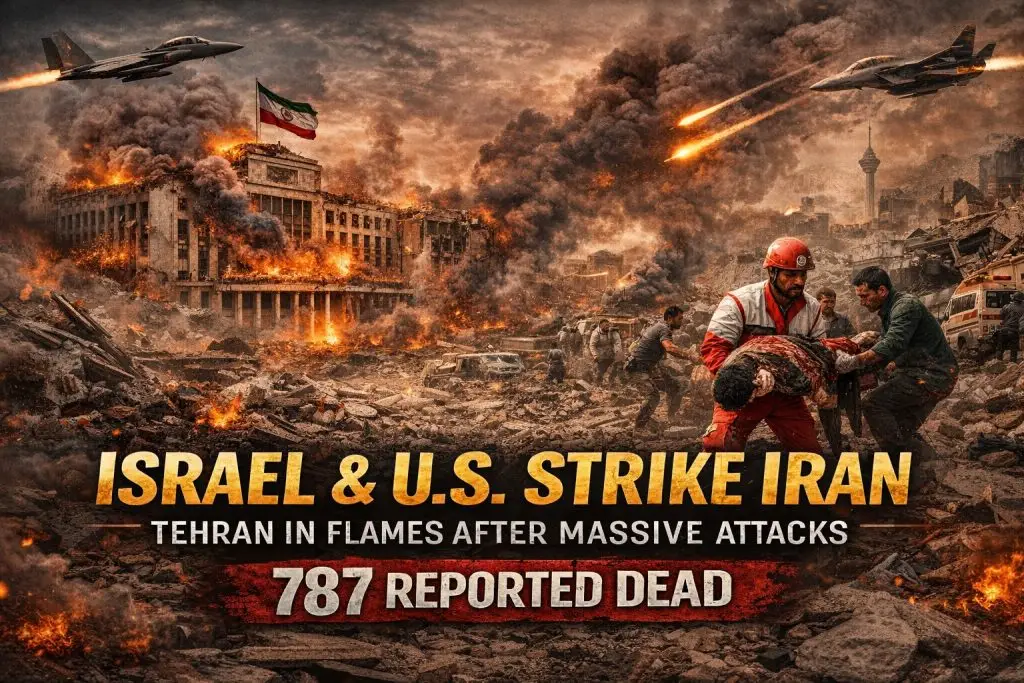
TEHRAN & GLOBAL — The Middle East has entered a phase of intense warfare following large-scale military operations carried out by Israel and the United States against the Islamic Republic of Iran. The attacks, which intensified over the weekend, reportedly included a strike on the Tehran Presidential Office, a symbolically and strategically significant target in the Iranian capital. Meanwhile, the Iranian Red Crescent has announced that the death toll from the strikes has risen to 787 people across the country, a grim indication of both the scale and human cost of the assault.
This conflict represents one of the most severe escalations between Israel and Iran in decades, with implications that extend far beyond the borders of the two countries. In this in-depth report, we examine the facts on the ground, the sequence of events, the strategic motivations behind the attacks, the regional reactions, and the broader geopolitical stakes.
I. The Escalation: From Tensions to Full-Blown Conflict
A. Origins of the Strikes
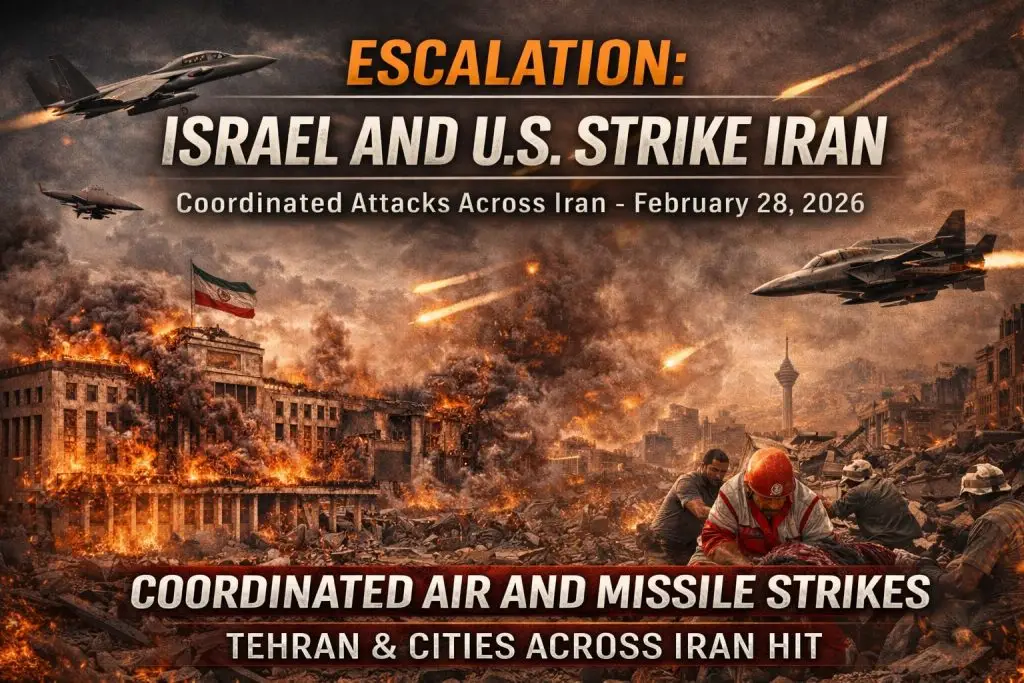
The current wave of hostilities began in earnest on Saturday, February 28, 2026, when coordinated military operations launched by Israel — with support from the United States — targeted numerous locations across Iran, including Tehran. According to multiple reports, military aircraft, drones, and missile systems were used to strike political and military facilities deep inside Iranian territory, marking a dramatic escalation from prior tensions.
Among the foremost targets was the Tehran Presidential Office, located in the heart of the capital, signaling that the attackers sought to undermine Iran’s political infrastructure, not just its military capabilities. Additional strikes reportedly hit key command and control centers, military installations, and sites associated with Iran’s nuclear and ballistic missile programs.
B. Targeting of Leadership and Infrastructure
One of the most consequential developments during the initial phases of the conflict was the confirmed death of Iran’s Supreme Leader, Ayatollah Ali Khamenei. Iranian state media announced that Khamenei, who had led the country since 1989, was killed in the opening wave of strikes, a development that has shaken Iran’s political structure.
Senior Iranian military and political figures are also reported to have been killed in the attacks, amplifying concerns that Iran’s leadership and national security apparatus have been severely disrupted by the offensive.
C. Iran’s Retaliation
In response to the strikes, Iran has launched its own wave of retaliatory ballistic missile and drone attacks. These have reportedly targeted Israeli cities and strategic sites, as well as U.S. Military installations and jointly managed strategic facilities within the Gulf region. Both sides have thus far escalated in a manner that suggests the conflict is far from contained.
II. The Human Cost: 787 Lives Lost and Counting
A. Rising Casualty Figures
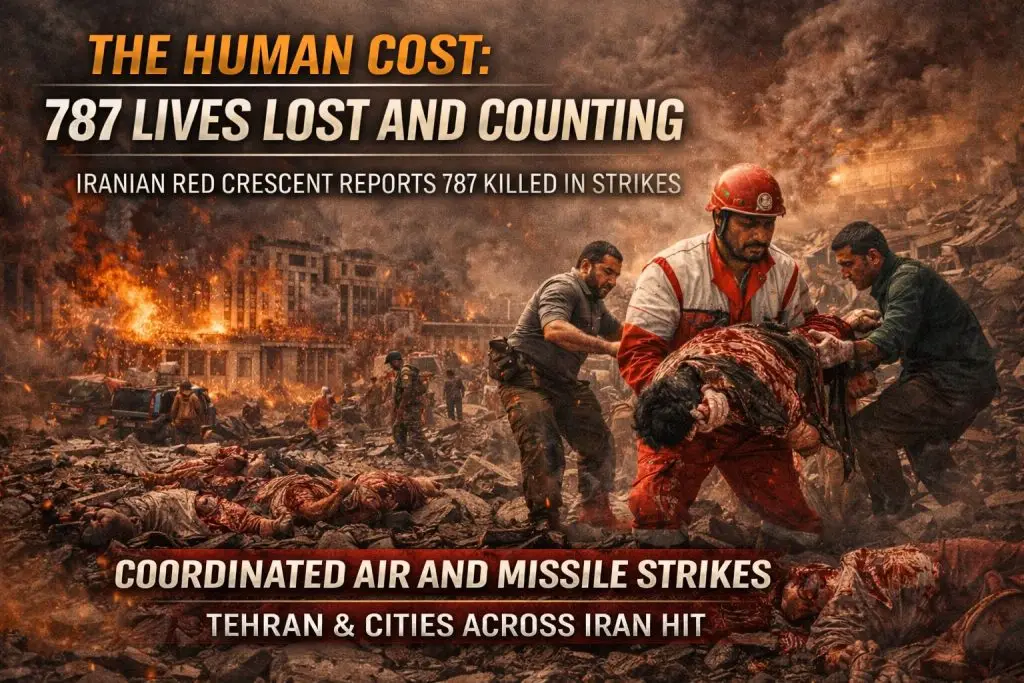
The ongoing strikes have had a devastating impact on civilians and military personnel alike. As of the latest update, the Iranian Red Crescent Society has reported a nationwide death toll of 787, encompassing fatalities resulting directly from air and missile strikes across 153 towns and cities. Hospitals, residential buildings, schools, and other civilian areas have all been affected.
The casualty count is likely to change as rescue efforts continue and additional information becomes available, particularly from hard-hit urban centers such as Tehran, where communications have been severely disrupted.
B. Civilian Impact and Infrastructure Damage
In cities across Iran, the effects of bombardment have been catastrophic. Entire residential blocks have been leveled by explosions, devastating families and displacing thousands. Hospitals have been overwhelmed by the influx of wounded, while power outages and communication blackouts have made coordination of rescue operations extremely difficult.
One of the most tragic incidents occurred in the southern province of Hormozgan, where a girls’ elementary school was struck, resulting in the deaths of at least 148 schoolchildren and teachers, according to local authorities.
Such attacks have drawn condemnation from human rights groups and raised serious questions about compliance with international humanitarian law, which prohibits indiscriminate targeting in conflict.
C. Iranian Security and Rescue Efforts
The Iranian Red Crescent and local civil defense teams have been at the forefront of rescue and recovery operations. These teams are working under extraordinarily difficult conditions amid ongoing bombings, widespread infrastructure damage, and limited resources.
Volunteers and emergency workers continue to search through rubble for survivors while authorities attempt to establish emergency shelters and provide medical care to the injured.
III. Regional Spillovers and Global Reverberations
A. Wider Middle East Engagement
The conflict has quickly spilled beyond Iranian and Israeli borders. Iran’s retaliatory strikes have reportedly reached cities in Israel, including strikes in Beit Shemesh, which resulted in civilian casualties. In addition, missiles and drones fired from Iranian territory have hit U.S. military installations and diplomatic premises in the region, leading to casualties among American troops.
Neighboring countries, especially those hosting U.S. forces, have increased security alerts and evacuation procedures in response to the spillover violence.
B. Role of Non-State Actors
Militant groups backed by Iran, such as Hezbollah in Lebanon, have also joined the conflict by launching rocket barrages into northern Israel. In response, Israeli forces have carried out strikes in southern Lebanon.
Other regional actors are bracing for potential escalation, with Gulf states expressing concern about their own security and the possibility of direct involvement.
C. Disruptions to Global Trade and Energy Markets
The strategic geography of the conflict — including the proximity to the Strait of Hormuz, through which a significant portion of the world’s oil supply passes — has sparked immediate concerns among international energy markets. Disruptions to shipping routes and increased insurance costs have already contributed to volatility in global oil prices.
Airspace closures and heightened military activity have likewise caused cancellations and rerouting of flights across the Middle East.
IV. Political Responses and Diplomatic Reactions
A. United StatesPosition
U.S. President Donald Trump has publicly defended the military campaign, asserting that the United States has the capacity to sustain operations beyond the initially projected 4-to-5-week timeframe. The president has framed the strikes as necessary actions to neutralize threats emanating from Iran’s nuclear ambitions and regional proxies.
However, Trump’s rhetoric has also underscored the uncertainty about how long the conflict will last, suggesting that a quick resolution is unlikely given current dynamics.
B. International Community’s Response
Reactions from the international community have been mixed, with Western allies largely echoing support for Israel’s right to self-defense while calling for restraint to prevent further civilian casualties.
European leaders have also emphasized the need for a ceasefire and renewed diplomatic efforts to de-escalate tensions.
Countries such as China and Russia have urged immediate negotiations, warning that prolonged warfare would destabilize global security. United Nations bodies have held emergency sessions, but remain divided on how to formulate a resolution acceptable to all major stakeholders.
C. Regional Leaders Speak Out
Regional leaders, including those from Turkey and Saudi Arabia, have expressed deep concern over the human toll and potential long-term effects of the war. Discussions in Ankara focused on scenario planning and civil defense readiness in the face of worsening instability.
Diplomatic contacts between Middle Eastern powers and global actors continue behind the scenes, with special envoys reportedly engaged in shuttle diplomacy to prevent further escalation.
V. Military Analysis: Strategies, Targets, and Tactics
A. Israel’s Strategic Calculus
Israel’s decision to conduct deep strikes into Iranian territory represents a dramatic shift from its historical preference for proxy engagements and limited engagements through third parties. The targeting of political infrastructure such as the Tehran Presidential Office and alleged leadership compounds suggests a strategy aimed at decapitating Iran’s governance capabilities and disrupting command hierarchies.
B. Iran’s Military Response
Iran’s military apparatus has responded with an aggressive missile and drone campaign, focusing on Israeli cities and U.S. military assets in the Gulf. The use of ballistic missiles and drones, including those aimed at civilian areas, has further heightened tensions and raised questions about the conflict’s trajectory.
C. Proxy Warfare and Asymmetric Tactics
Beyond conventional forces, the conflict has also unfolded through proxies and irregular networks. Hezbollah’s involvement, alongside militias in Iraq and Yemen aligned with Tehran, underscores the multi-vector nature of the fight. These groups have launched cross-border attacks and contributed to widening the geographical scope of the conflict.
VI. Humanitarian and International Law Concerns
A. Civilian Protection under Threat
The bombing of residential areas, hospitals, schools, and other non-military targets has prompted widespread concern from humanitarian organizations. International legal experts have criticized the use of force in densely populated urban centers, warning that such operations could amount to violations of international humanitarian law if precautions to protect civilians are not strictly observed.
B. Aid and Support Efforts
Global humanitarian agencies are calling for access to affected regions to provide food, water, and medical assistance. However, security conditions remain highly volatile, and attempts to deliver aid have been limited by ongoing hostilities.
C. Displacement and Refugees
Large numbers of civilians have fled conflict zones, especially around Tehran and other urban areas heavily bombarded in recent days. Neighboring countries are preparing emergency reception plans for potential refugees, even as regional tensions continue to rise.
VII. Looking Ahead: Possible Paths Forward
Scenario 1: Prolonged Attrition Warfare
In this scenario, the conflict could continue for weeks or months, with periodic escalatory cycles of strikes and counter-strikes. This would likely deepen regional instability and exacerbate the humanitarian crisis.
Scenario 2: Regional Expansion
Should Iran’s allies and proxies intensify their involvement, the war could expand beyond Iranian and Israeli territory, drawing in additional regional actors such as Saudi Arabia, Turkey, and the Gulf Cooperation Council states.
Scenario 3: Diplomatic Breakthrough
Although currently distant, there remains the possibility of renewed diplomatic engagement leading to a ceasefire agreement. This would require a significant shift in political will among the belligerents and their global partners.
Conclusion
The ongoing Israel–Iran conflict, marked by targeted strikes on Tehran’s political heart and a rising death toll now reported at 787, constitutes one of the most significant escalations in Middle Eastern warfare in recent history. Both the human cost and geopolitical stakes are immense, involving civilian suffering, military confrontation, and far-reaching effects on international security and the global economy.
As the world watches closely, the priority for mediators and international leaders must be to contain the conflict, protect civilians, and create avenues for negotiation before further loss of life and regional destabilization occurs.