
Live updates on US-Israel strikes on Iran, reports on Khamenei, Trump says operations continue as Middle East tensions escalate worldwide with global reaction.
Date: March 2, 2026
Location: International / Middle East Conflict Zone
Topic: US-Israeli military offensive against Iran, death of Supreme Leader Ayatollah Ali Khamenei, Trump declares ongoing strikes
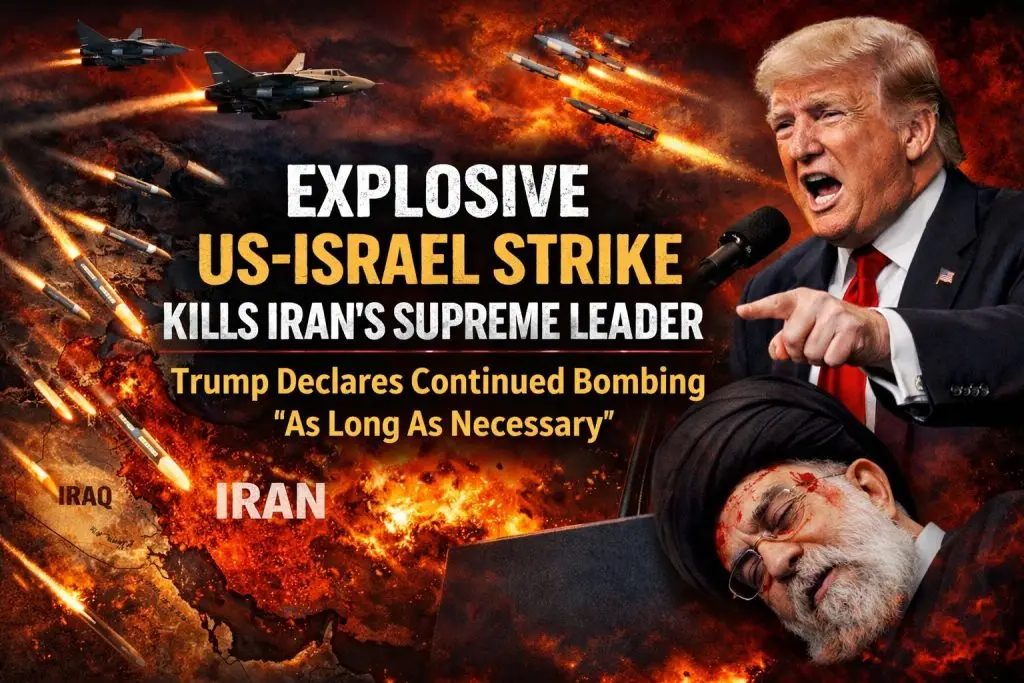
In a dramatic escalation of military conflict in the Middle East, the United States and Israel launched a joint attack on Iran that has swept across global headlines, triggered sharp international reactions, and shifted geopolitical balance. U.S. President Donald Trump announced that Iran’s Supreme Leader Ayatollah Ali Khamenei has been killed in the strikes — a claim that Iran and other sources initially contested — and asserted that bombing operations will continue “as long as necessary.”
1. Historic Attack: US-Israel Military Strikes on Iran
On February 28, 2026, the United States and Israel initiated a coordinated assault on Iran, described by military officials as Operation Epic Fury — a large-scale aerial and missile campaign targeting Iranian military infrastructure, missile launch sites, Revolutionary Guard command centers, and leadership compounds.
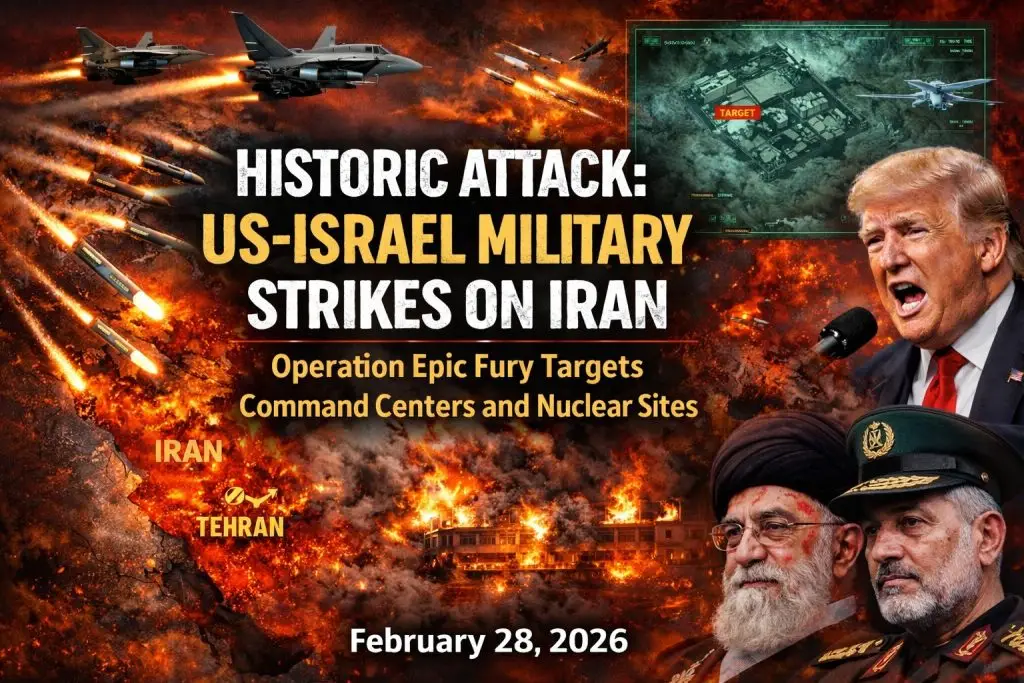
The offensive was executed with sophisticated weaponry and intelligence, including joint surveillance efforts by U.S. and Israeli forces. Israeli officials acknowledged that the compound of Ayatollah Ali Khamenei in Tehran was heavily damaged, and top Iranian commanders and nuclear program officials were struck in the assault.
Targeted Objectives of the Strikes
According to defense analysts and regional security experts, the military offensive was designed with multiple strategic objectives in mind. A primary goal was the neutralization of Iran’s nuclear infrastructure and ballistic missile capabilities, which U.S. and Israeli officials have long described as a direct threat to regional stability.
By targeting suspected enrichment facilities, missile launch systems, and weapons storage sites, the operation aimed to significantly degrade Iran’s capacity to project military power beyond its borders.
Another central objective involved dismantling leadership infrastructure and command-and-control networks. Precision strikes reportedly focused on military headquarters, communications hubs, and facilities linked to senior security officials. Disrupting these systems was intended to limit coordination among Iranian forces and reduce the effectiveness of any immediate retaliation.
The offensive was also framed as a response to alleged regional threats against U.S. allies, particularly in the Gulf and Israel. Officials argued that preemptive action was necessary to deter further escalation.
Additionally, some policy statements hinted at a broader long-term vision of encouraging political transformation within Iran. President Trump and senior officials maintained that the strikes were designed to eliminate imminent dangers and prevent future weapons development that could destabilize the Middle East.
2.Reported Death of Ayatollah Ali Khamenei
In a dramatic announcement posted on Truth Social, U.S. President Donald Trump declared that Iran’s Supreme Leader, Ayatollah Ali Khamenei, had been killed during the joint U.S.–Israel strikes.
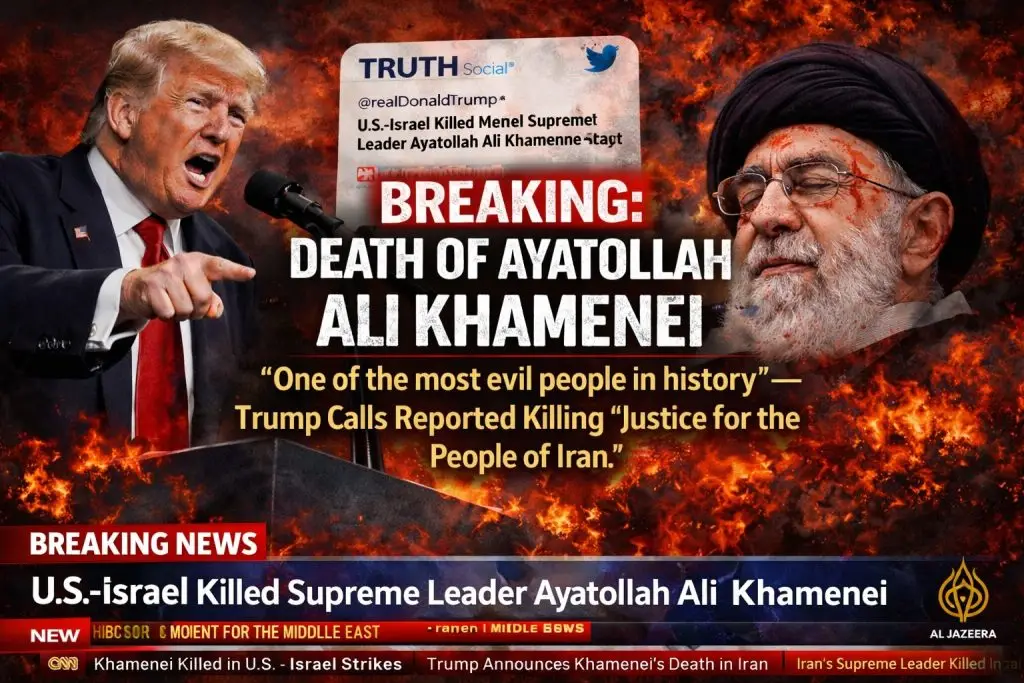
Trump described Khamenei as “one of the most evil people in history” and characterized the reported death as “justice for the people of Iran.” He further framed the development as a transformational moment for the Middle East, suggesting it could reshape the region’s political and security landscape for years to come. The announcement quickly spread across global media platforms, intensifying both uncertainty and geopolitical tension.
Conflicting Early Reports
Initial reports regarding Khamenei’s status were inconsistent. Senior Iranian officials publicly denied the claim, insisting that both the Supreme Leader and President Masoud Pezeshkian were safe. However, hours later, Iranian state media issued statements confirming Khamenei’s death, declaring a period of national mourning and stating that he was killed when his fortified compound in Tehran was struck during the air campaign.
If verified, this would mark the first confirmed killing of a sitting Iranian head of state by foreign military action in modern history, representing a profound geopolitical shift with far-reaching political, religious, and strategic consequences.
3. Trump’s Statement: “Strikes Won’t Stop”
President Trumpmade it clear that the U.S. military campaign alongside Israel is not a limited or symbolic action but an ongoing operation designed to achieve long-term strategic goals.
In his remarks, he emphasized that “heavy and pinpoint bombing will continue, uninterrupted… for as long as necessary to achieve our objective,” signaling a sustained military posture rather than a short, targeted strike. Trump framed the offensive as a decisive move to eliminate threats, weaken hostile capabilities, and restore what he described as stability in the Middle East.
According to his statements, the operation is intended not only to neutralize military targets but also to reshape the broader regional security environment.
Strategic Rationale
In explaining the reasoning behind the continued strikes, Trump pointed to what he described as a breakdown of Iran’s deterrence capacity, arguing that Tehran’s regional actions required a forceful response.
He also suggested that divisions within Iran’s political and military establishment could create openings for change, including the possibility that some internal factions might distance themselves from hardline leadership.
Additionally, Trump portrayed the reported death of Ayatollah Ali Khamenei as a turning point, describing it as an opportunity for Iranian citizens to reclaim political direction and push for systemic transformation supported by domestic resistance movements.
4.Iran’s Response and Retaliation
In the immediate aftermath of the joint U.S.–Israel strikes, Iranian leaders responded with strong warnings and promises of retaliation. The Islamic Revolutionary Guard Corps (IRGC) condemned the operation as a “barbaric attack” and declared that those responsible would face serious consequences. Iranian state media broadcast statements emphasizing national unity and resistance, while military officials signaled that retaliation would be measured but forceful.
Reports indicated that Iranian forces launched ballistic missiles and armed drones toward U.S. and allied installations across parts of the Persian Gulf region. Potential targets included strategic bases and defense facilities in countries such as Kuwait, Bahrain, Qatar, and the United Arab Emirates. Air defense systems were reportedly activated in multiple locations as regional militaries worked to intercept incoming threats.
Beyond direct exchanges, tensions spilled into neighboring conflict zones. Explosions and clashes were reported in parts of Iraq and Syria, areas where regional proxy groups have historically operated. The widening instability raised concerns about civilian safety, with early casualty figures suggesting both military and non-combatant losses. Meanwhile, global energy markets reacted sharply. Instability around the Strait of Hormuz—a critical shipping route for oil exports—contributed to rising oil prices and renewed fears of supply disruptions, underscoring the broader economic risks of prolonged escalation.
5. Global Reactions and International Context
United Nations and Global Leaders
The United Nations Security Council held emergency deliberations to address the growing crisis. While the U.S. justified the military actions under self-defense and counter-terrorism rationales, many global leaders urged restraint, emphasizing de-escalation to avoid broader war.
European governments, gulf states, and global economic hubs voiced concern about potential repercussions on international security and energy supplies. Calls for ceasefires and diplomatic negotiations were echoed in capitals around the world.
Domestic U.S. Political Debate
President Trump’s opponents criticized the decision as an aggressive military gamble lacking full congressional authorization, warning of prolonged conflict and human cost. Supporters, however, framed it as decisive leadership aimed at weakening a longstanding adversary.
6. Geopolitical Implications
The death of Ayatollah Ali Khamenei — a towering figure in Iranian politics since 1989 — has created political uncertainty in Tehran and surrounding nations. Analysts suggest that Iran’s power vacuum may ignite internal struggles, alter alliances, and reshape Middle Eastern political structures for years to come.
There is also intense speculation about how this development may affect:
- Iran’s nuclear negotiations and non-proliferation dynamics
- U.S. military engagement strategies in Southwest Asia
- Israel’s defense policy and national security
- Proxy conflicts with entities like Hezbollah and militia groups
- Fractured U.S.–Iran diplomatic channels
The long-term outcome remains uncertain, but global security experts agree that this conflict has permanently altered regional calculus.
7. Looking Ahead: Future Developments to Watch
As the crisis deepens, several critical developments will shape the direction of the U.S.–Israel conflict with Iran in the coming days and weeks. One of the most urgent issues is leadership stability inside Tehran. If reports surrounding the death of Ayatollah Ali Khamenei are confirmed, attention will quickly turn to succession plans, internal political unity, and the role of the Islamic Revolutionary Guard Corps (IRGC) in maintaining order.
Another major factor is the scale and intensity of continued military operations. President Trump’s pledge that strikes will not stop suggests prolonged engagement, raising concerns about broader regional escalation. Iran’s potential retaliation—whether through direct missile attacks or proxy groups operating in Iraq, Syria, Lebanon, or the Persian Gulf—could significantly widen the conflict.
Global diplomatic efforts will also be crucial. Emergency United Nations discussions, backchannel negotiations, and pressure from European and Gulf states may influence whether tensions cool or spiral further. Additionally, energy markets, oil supply routes, and international shipping lanes remain at risk, making economic stability another key area to watch closely.
Conclusion
The U.S.-Israel military attack on Iran and the death of Supreme Leader Ayatollah Ali Khamenei mark a pivotal moment in modern geopolitics. With President Trump pledging continued strikes and Iran vowing fierce retaliation, the conflict has entered a volatile phase with global implications in security, diplomacy, and economics. This breaking development continues to unfold, and world attention remains sharply focused on the aftermath of this historic escalation.