
Yemens Houthis Strike Israel as Iran attacks surge, fueling 7 alarming escalations, regional chaos, and growing fears of a wider Middle East war.
Introduction
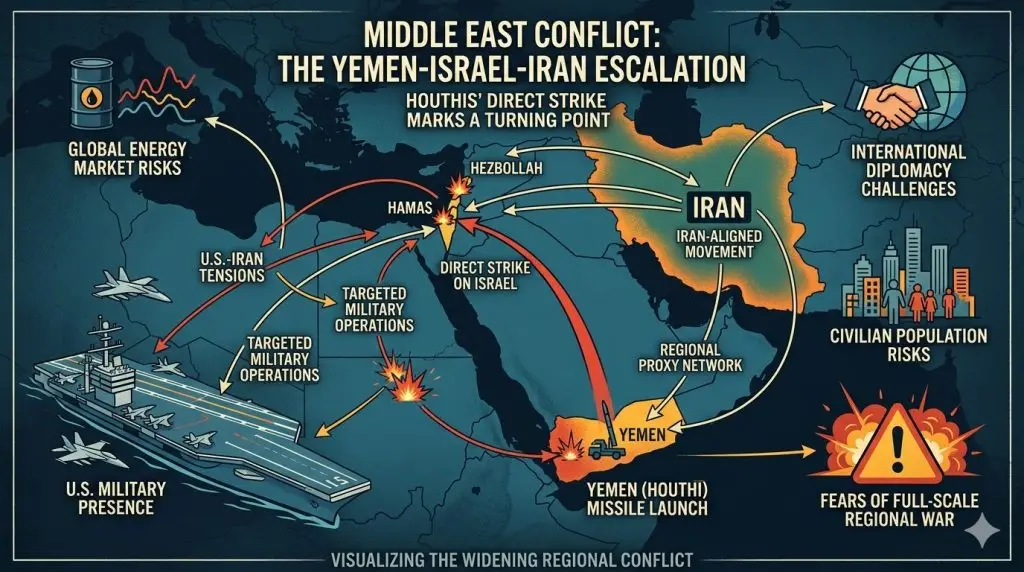
The Middle East has entered a dangerously volatile phase as Yemen’s Iran-aligned Houthi movement launches its first direct strike on Israel in the ongoing war involving the United States, Israel, and Iran. What initially began as a series of targeted military operations has now evolved into a widening regional conflict, drawing in multiple actors and threatening global stability.
The Houthis’ entry into the conflict marks a critical turning point. Their missile attack on Israel signals not only solidarity with Iran but also a broader alignment of regional forces against U.S. and Israeli military actions. As attacks on Iran continue and retaliatory strikes multiply, fears of a full-scale regional war are growing rapidly.
This developing crisis has far-reaching consequences—affecting global energy markets, international diplomacy, and civilian populations across multiple countries. With tensions escalating on multiple fronts, the world watches closely as events unfold.
Houthis Enter the War
Yemen’s Houthi movement officially confirmed that it launched a missile attack targeting Israel—its first such action since the outbreak of the current conflict. According to reports, Israel successfully intercepted the incoming missile, preventing casualties or significant damage.
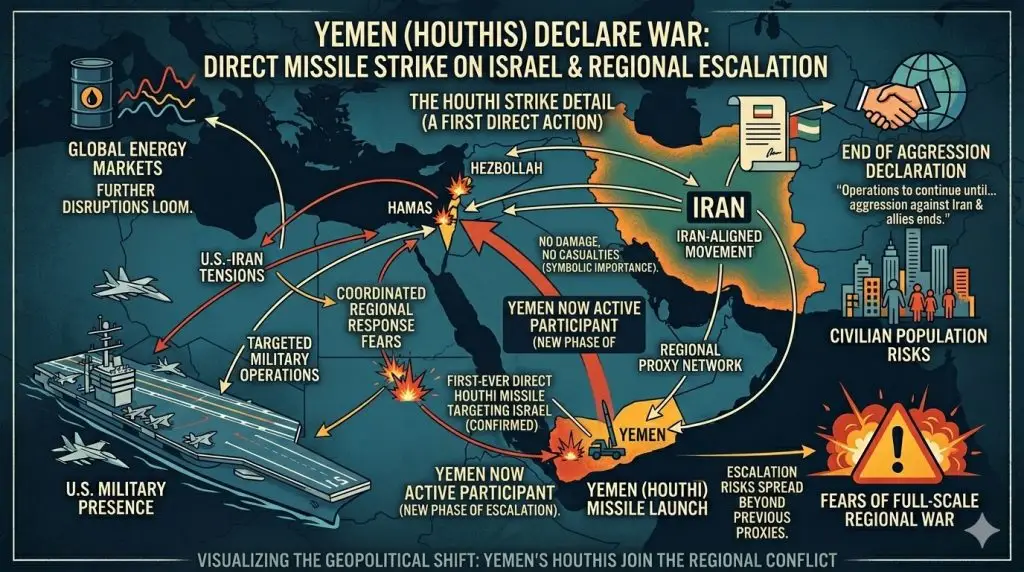
Despite the interception, the symbolic importance of the strike cannot be overstated. The Houthis have long been aligned with Iran, but their direct involvement in this war marks a new phase of escalation.
In a statement, Houthi leaders declared that their operations would continue until what they describe as “aggression” against Iran and its allies comes to an end.
This declaration effectively positions Yemen as an active participant in a conflict that already spans multiple countries, raising fears of a coordinated regional response against Israel and its allies.
A Coordinated Axis of Resistance
The Houthis are part of a broader network often referred to as the “axis of resistance,” which includes Iran and allied groups across the Middle East. Their entry into the conflict suggests increasing coordination among these actors.
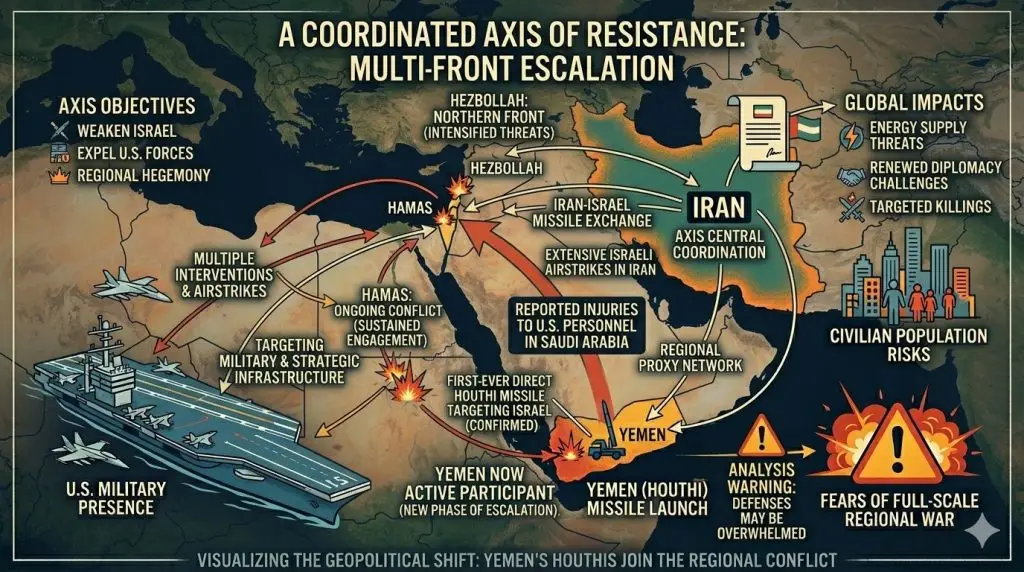
Iran has already launched missile strikes against Israel and other regional targets, including attacks that reportedly injured U.S. personnel in Saudi Arabia.
Meanwhile, Israel and the United States continue to conduct extensive airstrikes inside Iran, targeting military infrastructure and strategic facilities. These operations aim to weaken Iran’s capabilities but have also triggered widespread retaliation.
The Houthis’ involvement adds a southern front to the conflict, complicating defense strategies for Israel and its allies. Analysts warn that this multi-front dynamic could overwhelm existing defense systems and increase the likelihood of escalation.
Why the Houthis Joined Now
For weeks after the conflict began, the Houthis had remained largely on the sidelines, issuing warnings but refraining from direct action. Their sudden entry raises important questions about timing and strategy.
Several factors likely contributed to their decision:
1. Continued Attacks on Iran
The ongoing bombardment of Iranian targets by U.S. and Israeli forces appears to have been a key trigger. The Houthis have framed their attack as a response to these actions.
2. Regional Solidarity
The group has consistently positioned itself as part of a broader resistance movement. By joining the conflict, they reinforce their alignment with Iran and other allies.
3. Strategic Pressure
Opening a new front against Israel increases pressure on its military resources, forcing it to divide attention across multiple threats.
4. Messaging and Influence
The attack sends a strong political message, demonstrating that the conflict is no longer confined to a single geographic area.
Israel’s Response and Military Preparedness
Israel has responded swiftly to the new threat. Its advanced missile defense systems successfully intercepted the Houthi projectile, highlighting its preparedness for multi-directional attacks.
However, the addition of a southern front presents new challenges. Israel must now defend against threats originating from Yemen, Iran, and potentially other regions simultaneously.
The Israeli military has also intensified its operations inside Iran, targeting key installations and infrastructure. These strikes are part of a broader strategy aimed at reducing Iran’s ability to sustain prolonged conflict.
Despite these efforts, the expanding scope of the war raises concerns about the limits of even the most advanced defense systems.
U.S. Involvement and Strategic Goals
The United States remains deeply involved in the conflict, supporting Israel while conducting its own military operations against Iran.
U.S. Secretary of State Marco Rubio stated that the ongoing military campaign could conclude within weeks, suggesting confidence in achieving strategic objectives.
However, the situation on the ground tells a more complex story. The entry of the Houthis and continued Iranian resistance indicate that the conflict may be far from over.
President Donald Trump has also signaled a willingness to pursue negotiations but has warned of further strikes if key demands—such as reopening critical shipping routes—are not met.
This dual approach of military pressure and diplomatic signaling reflects the high stakes involved.
Humanitarian Impact Inside Iran
While military developments dominate headlines, the human cost of the conflict is rapidly increasing.
Reports indicate that over a thousand civilians have been killed in strikes across Iran, including women and children. Critical infrastructure such as hospitals and schools has also been affected.
Human rights organizations have raised serious concerns about targeting practices and the adequacy of civilian protections. They argue that the scale of destruction risks creating a humanitarian crisis with long-term consequences.
The situation is further complicated by restricted access to information, making it difficult to fully assess the extent of the damage.
Threat to Global Energy and Trade
One of the most significant global implications of the conflict is its impact on energy supplies and international trade.
The Middle East is home to some of the world’s most critical shipping routes, including the Strait of Hormuz and the Bab al-Mandab Strait. The Houthis have previously demonstrated their ability to disrupt shipping in the Red Sea, and their renewed involvement raises concerns about maritime security.
Any disruption to these routes could have immediate effects on global oil prices and supply chains, potentially leading to economic instability worldwide.
Markets have already shown signs of volatility, reflecting uncertainty about the conflict’s trajectory.
Risk of Wider Regional War
The involvement of the Houthis increases the risk of a broader regional war involving multiple countries and non-state actors.
Key concerns include:
- Expansion of conflict zones: Additional countries may become involved, either directly or indirectly.
- Escalation of missile exchanges: Increased frequency and intensity of attacks.
- Strain on defense systems: Multi-front attacks could overwhelm existing capabilities.
- Breakdown of diplomacy: Ongoing hostilities may hinder efforts to negotiate a ceasefire.
The situation remains highly unpredictable, with each new development carrying the potential to escalate tensions further.
Diplomatic Efforts and Challenges
Despite the ongoing violence, diplomatic efforts are underway to de-escalate the conflict.
However, progress has been limited. Iran has denied engaging in direct negotiations, while the United States continues to apply military pressure.
The involvement of additional actors like the Houthis complicates diplomatic efforts, as any agreement must now address a wider range of interests and grievances.
International mediators face significant challenges in bringing all parties to the table.
The Road Ahead : Yemen’s Houthis strike Israel
The entry of Yemen’s Houthis into the conflict represents a significant escalation with far-reaching implications.
Key questions moving forward include:
- Will other regional actors join the conflict?
- Can diplomatic efforts succeed in preventing further escalation?
- How will global markets respond to ongoing instability?
- What steps can be implemented to ensure civilian safety?
As the situation continues to evolve, the stakes remain extraordinarily high.
Conclusion: Yemens Houthis strike Israel
The missile strike by Yemen’s Houthis against Israel marks a pivotal moment in an already volatile conflict. It underscores the interconnected nature of regional tensions and highlights the risk of a broader war.
With attacks on Iran continuing and new fronts opening, the Middle East stands at a critical crossroads. The actions taken in the coming days and weeks will likely determine whether the conflict escalates further or moves toward resolution.
For now, the world watches with growing concern as a regional crisis edges closer to becoming a global one.