
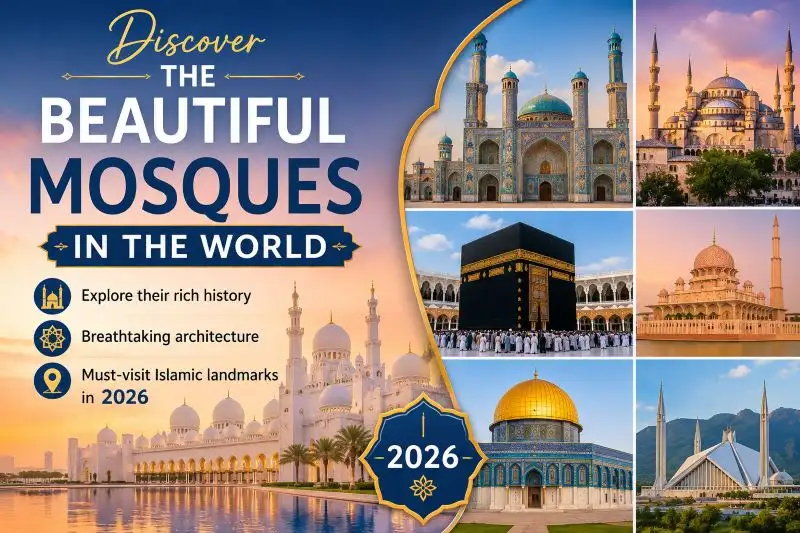
Discover the beautiful mosques in the world, explore their rich history, breathtaking architecture, and must-visit Islamic landmarks in 2026.
Beautiful Mosques in the World: A Journey Through History, Faith, and Timeless Architecture
Mosques are among the most inspiring landmarks ever created by human hands. They are not simply places of worship but also centers of learning, culture, community, and artistic expression. From ancient stone structures that have stood for more than a thousand years to modern architectural masterpieces built with cutting-edge engineering, beautiful mosques in the world reflect the rich history and diversity of Islamic civilization.
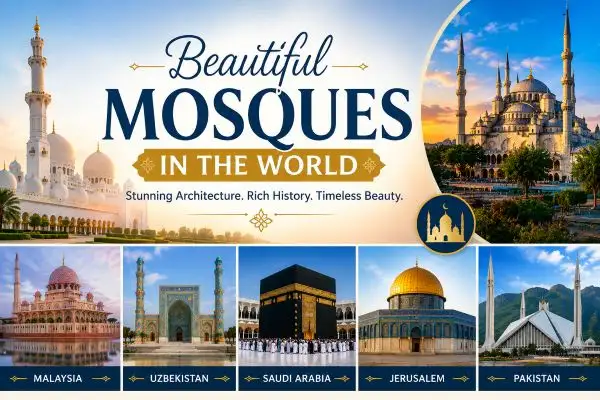
Every mosque has its own unique story. Some were built by powerful emperors, while others were constructed through the dedication of local communities. Their elegant domes, towering minarets, intricate geometric patterns, and breathtaking calligraphy continue to attract millions of visitors each year. Whether you are passionate about architecture, history, photography, or religious heritage, exploring these magnificent mosques offers a memorable experience.
In this guide, you’ll discover the history of mosque architecture, learn what makes these sacred buildings so remarkable, and explore some of the most beautiful mosques in the world that deserve a place on every travel enthusiast’s bucket list.
The Rich History of Mosques
The history of mosques dates back to the 7th century during the early years of Islam. The very first mosque was established by Prophet Muhammad (peace be upon him) after his migration to Madinah. Known for its simplicity, it served as much more than a prayer space. It became a gathering place where people learned about faith, settled community matters, welcomed travelers, and strengthened social bonds.
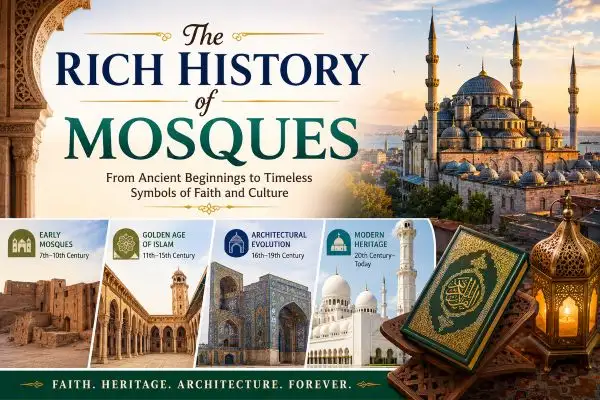
As Islam spread across Asia, Africa, Europe, and the Middle East, mosque architecture evolved alongside different cultures and civilizations. Skilled craftsmen blended local building traditions with Islamic artistic principles, creating architectural styles that remain admired around the world today.
During the Islamic Golden Age, many mosques became centers of education and scientific discovery. Scholars gathered inside mosque libraries to study mathematics, astronomy, medicine, literature, and philosophy. This educational role helped preserve knowledge and encouraged innovation that influenced societies far beyond the Islamic world.
Today, historic mosques continue to stand as symbols of peace, faith, and cultural heritage. Many have been carefully restored to preserve their beauty for future generations while continuing to serve their local communities.
What Makes a Mosque Beautiful?
The beauty of a mosque is about much more than its size or appearance. Every architectural detail has both artistic and spiritual significance.
Some of the most recognizable features include:
- Grand central domes that create spacious prayer halls.
- Elegant minarets from which the call to prayer is traditionally announced.
- Intricate Arabic calligraphy featuring verses from the Holy Quran.
- Detailed geometric patterns symbolizing harmony and balance.
- Colorful mosaics and handcrafted tile work.
- White marble courtyards that reflect natural light.
- Ornate chandeliers that illuminate large interiors.
- Peaceful gardens, fountains, and reflecting pools that create a calming atmosphere.
Unlike many historic religious buildings, traditional Islamic art avoids depicting people or animals inside mosques. Instead, artists focus on beautiful patterns, floral designs, and calligraphy that celebrate the beauty of creation while directing attention toward worship.
1. Masjid al-Haram, Saudi Arabia
Located in the holy city of Makkah, Masjid al-Haram is the largest and most sacred mosque in Islam. At its center stands the Holy Kaaba, toward which Muslims around the world face during their daily prayers.

Every year, millions of pilgrims travel here to perform Hajj and Umrah, making it one of the most visited religious sites on Earth. Over the centuries, the mosque has expanded significantly to accommodate the growing number of worshippers while preserving its profound spiritual significance.
Its vast marble courtyards, illuminated walkways, and remarkable architectural design create a peaceful environment despite welcoming millions of visitors annually. For Muslims, visiting Masjid al-Haram is the fulfillment of a lifelong dream and one of the most meaningful spiritual experiences.
2. Sheikh Zayed Grand Mosque, United Arab Emirates
The Sheikh Zayed Grand Mosque in Abu Dhabi is widely regarded as one of the finest examples of modern Islamic architecture. Completed in 2007, it beautifully combines traditional craftsmanship with contemporary engineering.
The mosque is famous for its brilliant white marble exterior, more than 80 graceful domes, towering minarets, and one of the world’s largest hand-knotted carpets. Massive crystal chandeliers decorated with gold leaf add even more elegance to its breathtaking prayer halls.
Reflecting pools surrounding the mosque enhance its beauty, especially during sunset when the changing light creates stunning reflections across the white marble surfaces. Visitors from around the world admire not only its architectural brilliance but also its message of peace, tolerance, and cultural understanding.
3. Sultan Ahmed Mosque (Blue Mosque), Türkiye
Standing proudly in the heart of Istanbul, the Sultan Ahmed Mosque, commonly known as the Blue Mosque, has been one of the city’s defining landmarks since the early 17th century.
The mosque earned its famous nickname from the more than 20,000 handmade blue İznik tiles that decorate its interior walls. Sunlight filtering through hundreds of stained-glass windows fills the prayer hall with a peaceful glow, creating an unforgettable atmosphere.
Its impressive central dome is surrounded by smaller cascading domes, while six elegant minarets rise high above Istanbul’s skyline. The mosque continues to serve as an active place of worship while welcoming millions of visitors who come to admire one of the greatest achievements of Ottoman architecture.
4. Hassan II Mosque, Morocco
Perched dramatically along the Atlantic coastline in Casablanca, the Hassan II Mosque is one of the most spectacular modern mosques ever constructed. Completed in 1993, it showcases the extraordinary craftsmanship of thousands of Moroccan artisans.
Its soaring minaret is among the tallest in the world, while the interior features hand-carved cedar wood ceilings, intricate mosaic tile work, polished marble floors, and beautifully crafted stone columns.
One of its most remarkable features is its location above the ocean, symbolizing the connection between humanity, nature, and faith. During high tide, waves gently crash against the mosque’s foundation, creating breathtaking views that make it one of the world’s most photographed Islamic landmarks.
5. Badshahi Mosque, Pakistan
Located in the historic city of Lahore, the Badshahi Mosque is one of the greatest masterpieces of Mughal architecture. Built in 1673 during the reign of Emperor Aurangzeb, this magnificent mosque has remained one of Pakistan’s most treasured landmarks for centuries.
Constructed primarily from red sandstone with elegant white marble domes, the mosque can accommodate tens of thousands of worshippers. Its vast courtyard, towering gateways, and beautifully decorated prayer hall showcase the remarkable craftsmanship of the Mughal era.
Visitors admire the mosque not only for its impressive size but also for its peaceful atmosphere and rich historical significance. Standing within its courtyard offers a glimpse into one of South Asia’s finest examples of Islamic architecture.
6. Putra Mosque, Malaysia
Situated beside the scenic Putrajaya Lake, the Putra Mosque is one of Malaysia’s most recognizable religious landmarks. Often called the Pink Mosque, it is famous for its distinctive rose-colored granite exterior and graceful pink dome.
Completed in 1999, the mosque blends Persian, Middle Eastern, and traditional Malaysian architectural styles. Its elegant arches, spacious prayer hall, and beautifully landscaped surroundings make it a favorite destination for both worshippers and tourists.
As the sunlight changes throughout the day, the mosque’s pink tones create stunning reflections across the lake, offering photographers unforgettable views.
7. Faisal Mosque, Pakistan
Unlike many traditional mosques, the Faisal Mosque in Islamabad features a bold and modern design. Completed in 1986, it was designed by Turkish architect Vedat Dalokay and was inspired by the shape of a Bedouin desert tent.
Instead of a large central dome, the mosque features a unique triangular roof supported by four towering minarets. Nestled against the beautiful Margalla Hills, the white marble structure appears both simple and majestic.
Its spacious prayer hall and surrounding landscape create a calm environment that attracts visitors from around the world. Today, Faisal Mosque is considered one of the largest and most recognizable mosques in South Asia.
8. Nasir al-Mulk Mosque, Iran
Known worldwide as the Pink Mosque, the Nasir al-Mulk Mosque in Shiraz is celebrated for its breathtaking stained-glass windows.
Built during the late 19th century, the mosque transforms every morning as sunlight streams through the colorful glass, filling the prayer hall with vibrant shades of red, blue, green, and yellow.
Its intricate Persian tilework, elegant arches, and delicate floral patterns make it one of the most photographed mosques in the world. Visitors often describe stepping inside as walking into a living work of art.
9. Jameh Mosque of Isfahan, Iran
The Jameh Mosque of Isfahan is one of the oldest and most historically significant mosques in the world. Located in the heart of Isfahan, this remarkable mosque reflects over 1,200 years of Islamic architectural evolution. Instead of being built all at once, it gradually expanded under different dynasties, making it a living record of Persian history.
One of its most distinctive features is the four-iwan courtyard design, which later became a model for many mosques throughout Central Asia and the Middle East. The mosque is adorned with turquoise-blue tiles, elegant brickwork, beautifully carved stucco, and intricate Quranic inscriptions.
Each area highlights the exceptional craftsmanship and artistic styles developed across various eras of history, creating a remarkable journey through Islamic architectural evolution.
Today, the Jameh Mosque of Isfahan is recognized as a UNESCO World Heritage Site and continues to attract historians, architects, and travelers from around the globe. Its timeless beauty and cultural importance make it one of the most beautiful mosques in the world.
10. Al-Aqsa Mosque, Jerusalem
The Al-Aqsa Mosque is one of the most sacred sites in Islam and holds immense religious and historical significance. Situated within the Al-Haram Al-Sharif compound in Jerusalem, it is regarded as the third holiest mosque in Islam after Masjid al-Haram in Makkah and Al-Masjid an-Nabawi in Madinah.
The mosque has witnessed centuries of history, including various periods of construction, restoration, and preservation. Its silver-colored dome, elegant arches, spacious courtyards, and ancient stone walls reflect a blend of Umayyad, Abbasid, Ayyubid, Mamluk, and Ottoman architectural influences.
Visitors are deeply moved by the peaceful atmosphere surrounding the mosque and its connection to Islamic history. Beyond its architectural beauty, Al-Aqsa Mosque remains a powerful symbol of faith, resilience, and spiritual devotion for millions of Muslims worldwide.
11. Sultan Qaboos Grand Mosque, Oman
Completed in 2001, the Sultan Qaboos Grand Mosque in Muscat is one of the finest examples of contemporary Islamic architecture in the Middle East. Built using high-quality sandstone and marble, the mosque combines traditional Islamic design with modern engineering and meticulous craftsmanship.
The mosque features a magnificent central dome, five elegant minarets representing the Five Pillars of Islam, beautifully landscaped gardens, and a vast prayer hall illuminated by natural light. Inside, visitors can admire one of the world’s largest handcrafted Persian carpets and an enormous crystal chandelier that enhances the mosque’s luxurious interior.
Its peaceful surroundings, symmetrical design, and attention to detail make it one of Oman’s most visited landmarks. The mosque welcomes visitors from different cultures, promoting understanding and appreciation of Islamic art and heritage.
12. Baiturrahman Grand Mosque, Indonesia
Located in Banda Aceh, the Baiturrahman Grand Mosque is one of Indonesia’s most iconic religious landmarks. Originally built during the 17th century and later reconstructed in the late 19th century, the mosque combines Mughal, Indonesian, and European architectural influences into a truly unique design.
The mosque is instantly recognizable for its striking black domes, brilliant white walls, graceful minarets, and expansive reflecting pool. Its elegant arches, detailed carvings, and spacious courtyard create an atmosphere of peace and serenity.
Baiturrahman Grand Mosque gained international recognition after surviving the devastating 2004 Indian Ocean tsunami. While much of the surrounding city was destroyed, the mosque remained standing and became a powerful symbol of hope, resilience, and unity for the people of Aceh.
Today, it welcomes thousands of worshippers and visitors every year, offering not only a place for prayer but also a reminder of the strength of faith during times of hardship.
Why Beautiful Mosques Matter
Mosques have always been much more than places of worship. Throughout Islamic history, they have served as centers of education, charity, community gatherings, and cultural exchange.
Many historic mosques included:
- Libraries filled with valuable manuscripts
- Schools where scholars taught science and religion
- Community meeting halls
- Public kitchens serving those in need
- Courtyards where travelers could rest
These institutions helped preserve knowledge during the Islamic Golden Age and contributed to remarkable advancements in astronomy, mathematics, medicine, engineering, and literature.
Even today, mosques continue to strengthen communities by providing educational programs, charitable services, and spaces for spiritual reflection.
Tips for Visiting Beautiful Mosques
Whether you are visiting for worship or sightseeing, showing respect for local customs is essential.
Here are a few simple guidelines:
- Respect local traditions by wearing clothing that covers your shoulders and knees. Some mosques also request female guests to use a headscarf during their visit.
- Remove your shoes before entering prayer areas.
- Keep your voice low and avoid disturbing worshippers.
- Follow photography rules, as some mosques restrict photos inside prayer halls.
- Visit outside peak prayer times if you are touring the mosque.
- Respect all cultural and religious traditions during your visit.
Being respectful helps create a positive experience for both visitors and local communities.
Why These Mosques Continue to Inspire the World
Every mosque reflects centuries of artistic skill, engineering excellence, and spiritual devotion. From the sacred courtyards of Masjid al-Haram to the modern elegance of the Sheikh Zayed Grand Mosque, these remarkable landmarks demonstrate how architecture can inspire peace, unity, and admiration.
Their graceful domes, towering minarets, detailed calligraphy, and carefully crafted interiors continue to influence architects and artists across the globe. Many of these buildings are not only places of worship but also treasured cultural landmarks that preserve the history of Islamic civilization.
Exploring these magnificent mosques allows visitors to appreciate the diversity of Islamic art while gaining a deeper understanding of the cultures that built them.
Conclusion
The beautiful mosques in the world are among humanity’s most remarkable architectural and cultural achievements. They stand as lasting symbols of faith, creativity, and community, reflecting centuries of history and craftsmanship. From the spiritual significance of Masjid al-Haram to the breathtaking elegance of the Sheikh Zayed Grand Mosque, each mosque offers a unique glimpse into the rich heritage of Islamic civilization.
Whether you’re passionate about history, architecture, photography, or cultural travel, visiting these magnificent mosques is an unforgettable experience. Their timeless beauty, peaceful atmosphere, and extraordinary designs continue to inspire millions of people every year.
As you explore these iconic landmarks, you’ll discover that they are more than impressive buildings—they are living expressions of faith, art, and the enduring legacy of cultures that have shaped our world.
Frequently Asked Questions About Beautiful Mosques in the World
1. What makes a mosque beautiful?
A beautiful mosque combines meaningful architecture, detailed craftsmanship, peaceful surroundings, and spiritual importance. Features such as elegant domes, tall minarets, intricate calligraphy, and decorative tilework make each mosque unique.
2. Which is the most famous mosque in the world?
Masjid al-Haram in Makkah is the most well-known mosque. It is the holiest site in Islam and welcomes millions of pilgrims every year.
3. Can tourists visit famous mosques?
Many renowned mosques allow visitors outside prayer times. Guests should wear modest clothing, remove their shoes before entering prayer areas, and respect local customs during their visit.
4. Why are historic mosques important?
Historic mosques preserve centuries of religious, cultural, and architectural heritage. They also reflect the artistic traditions and craftsmanship of different civilizations.
5. Which countries have the most beautiful mosques?
Saudi Arabia, Türkiye, the United Arab Emirates, Morocco, Iran, Pakistan, Malaysia, Indonesia, and Egypt are home to many of the world’s most admired mosques.
6. Why do travelers visit beautiful mosques in the world?
People visit these remarkable landmarks to admire their architecture, learn about Islamic history, experience local culture, capture stunning photographs, and enjoy the peaceful atmosphere that makes each mosque a memorable destination.