
Discover the powerful history of Iran Prime Minister, why the role was abolished in 1989, and who truly controls Iran’s government today.
Introduction
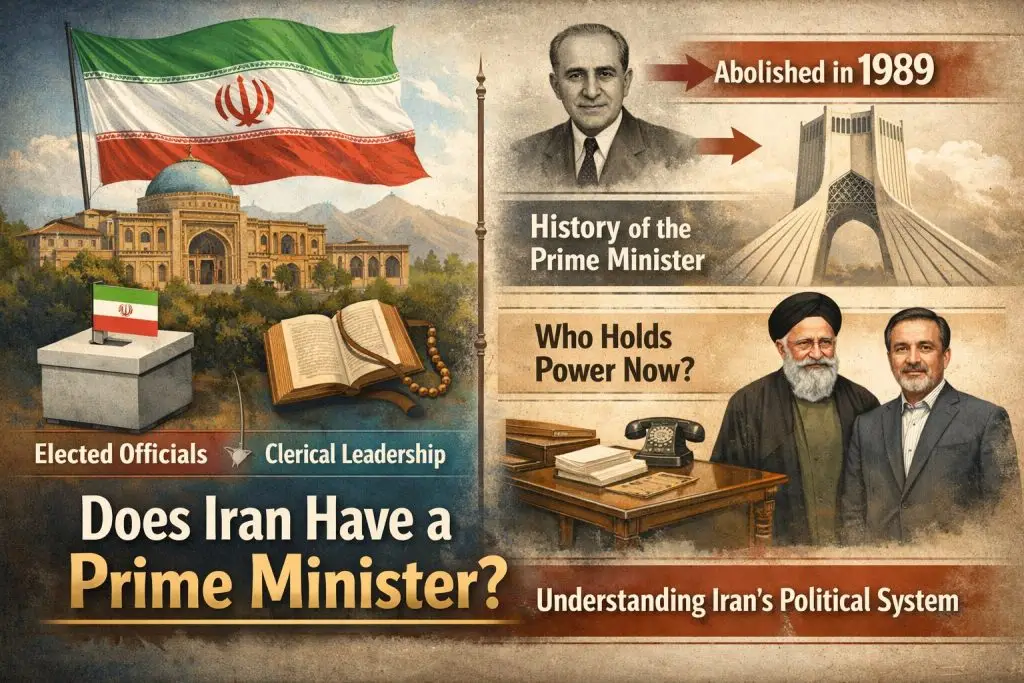
Iran’s political system stands out for its rare combination of republican institutions and religious authority. It operates under a constitutional framework where elected officials work alongside powerful clerical leadership.
Because of this hybrid structure, many international readers often misunderstand how executive power functions in the country. One of the most common areas of confusion is the position of Prime Minister. While Iran once had a prime minister, the role no longer exists in its current political structure.
This article provides a clear and detailed explanation of the subject. It examines whether Iran has a prime minister today, traces the historical importance of the office, and highlights notable figures who once held the position.
It also explains the constitutional changes that led to the abolition of the role in 1989 and clarifies who now exercises executive authority within the government. By presenting accurate, well-researched information in an original format, this article aims to eliminate confusion and offer readers a deeper understanding of Iran’s unique political system.
1. Iran’s Government Structure – A Snapshot
To understand the role of the prime minister, we must first understand Iran’s political architecture.
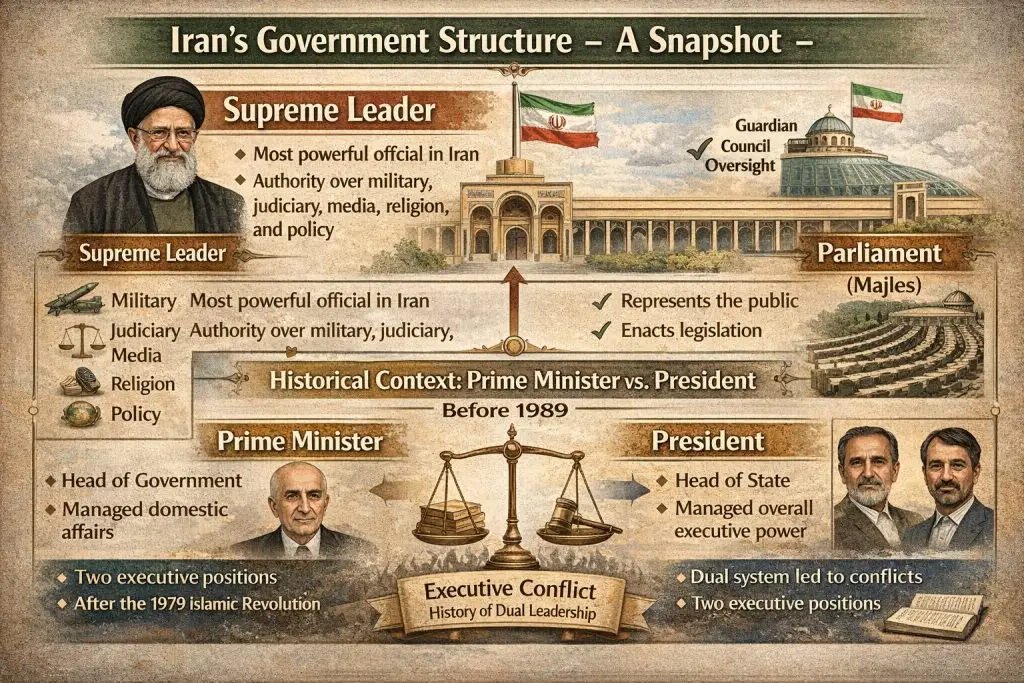
The Supreme Leader
- The most powerful official in Iran’s political hierarchy is the Supreme Leader.
- The Supreme Leader has authority over the military, judiciary, media, religion, and major policy decisions.
- Until 2026, this position was held by Ayatollah Ali Khamenei, who served from 1989 until his death in 2026.
The President
- The President is the highest elected official and handles day-to-day governance, domestic and foreign policy operations, and the executive branch.
- Unlike parliamentary systems where the Prime Minister is the head of government, Iran’s President assumes most executive duties.
Parliament (Majles)
- Iran’s Parliament (Majles) represents the public and has legislative authority, though subject to oversight by clerical bodies like the Guardian Council.
Historical Context: Prime Minister vs. President
Before 1989:
- Iran had both a President and a Prime Minister.
- The President was head of state, and the Prime Minister was head of government.
This dual system often led to executive conflict, especially in the early years following the 1979 Islamic Revolution.
2. Why the Role of Prime Minister Was Abolished (1989 Constitutional Change)
Origins of the Position
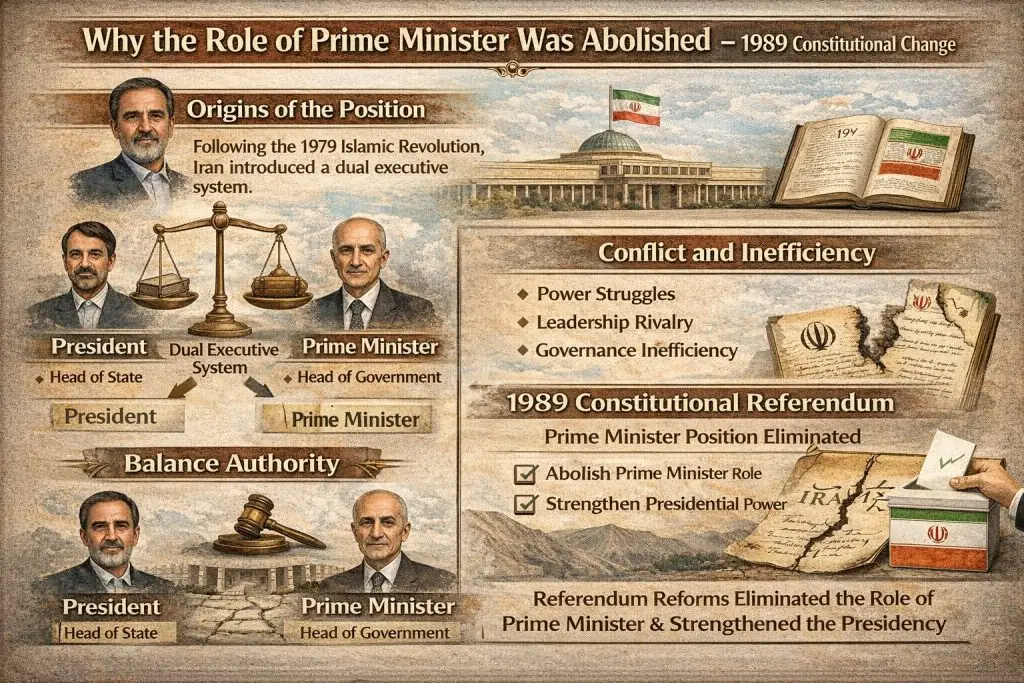
Following the 1979 Islamic Revolution, Iran introduced a new constitution that reshaped its political structure. The 1979 Constitution established a dual executive system designed to distribute authority between two key offices.
Under this arrangement, the President was directly elected by the people and served as head of state, while the Prime Minister was nominated by the President and required approval from Parliament (the Majles) to become head of government. The Prime Minister was responsible for managing daily administration, supervising ministers, and implementing domestic policies. This structure closely resembled parliamentary models used in several other countries.
Conflict and Inefficiency
Although the system was intended to balance power, it gradually produced friction at the highest levels of government. Disputes arose regarding authority, policy priorities, and executive control. Differences in political ideology and leadership style often led to rivalry between the President and the Prime Minister. As a result, decision-making slowed, coordination weakened, and governance became less efficient.
To resolve these institutional challenges, a constitutional referendum was held in 1989. The amendment eliminated the position of Prime Minister and transferred full executive authority to the President. This reform aimed to streamline leadership, reduce conflict, and strengthen administrative clarity. Since that constitutional change, Iran has operated without a Prime Minister in its modern political system.
3. Prime Ministers in Iran Before 1989
Though there’s no current prime minister, Iran has a long history of prime ministers — especially in the 20th century.
Key Historical Prime Ministers
Mirza Naser od-Dowleh (Mirza Naserullah Khan Moshir al-Dowleh)
- Regarded as the first significant prime minister during Iran’s constitutional era (early 1900s), following the Constitutional Revolution.
- His leadership helped shape early modern governance and parliamentary reform in Iran.
Mohammad Mossadegh (Prime Minister 1951–1953)
- One of the most famous prime ministers in Iranian history.
- He nationalized Iran’s oil industry, challenging British control and Western influence.
- His premiership ended in 1953 when a CIA- and MI6-backed coup removed him from power.
Mossadegh remains an iconic figure for Iranian nationalism and independence.
Mohammad-Javad Bahonar
- Briefly served as prime minister in 1981.
- A cleric and politician during the early years of the Islamic Republic.
These prime ministers were part of a lineage that ended once Iran restructured its executive branch in 1989.
4. The Prime Minister’s Role (Pre-1989)
Executive Function
Before the 1989 constitutional reform, the Prime Minister in Iran held a central role in the day-to-day management of the government. Tasked with running the executive branch, the Prime Minister oversaw the Cabinet of Ministers, coordinated policy implementation across various departments, and ensured that government initiatives were carried out efficiently.
This office acted as the administrative backbone of the nation, translating the broader goals of the President and the ruling authorities into actionable programs. The Prime Minister was accountable to both the President and the Parliament, creating a delicate balance of responsibility that required both political acumen and bureaucratic expertise.
Legislative Relations
The Prime Minister’s relationship with the Majles (Parliament) was crucial. Appointment required parliamentary approval, and the Prime Minister could be dismissed through a vote of no confidence. This system made the office highly sensitive to political shifts, as losing support in Parliament could immediately end a premiership. The position required constant negotiation and alliance-building to maintain the confidence of lawmakers while advancing the executive agenda.
Influence on Policy
Prime Ministers exerted significant influence over domestic, economic, and foreign policy. They directed economic planning, managed public administration, and often represented Iran in diplomatic matters. However, their authority was never absolute.
Before the 1979 Islamic Revolution, the Shah maintained ultimate control over policy decisions, limiting the Prime Minister’s independence. After the revolution, religious authorities and the Supreme Leader exercised strong oversight, ensuring that government policies aligned with the ideological and religious framework of the Islamic Republic. Despite these constraints, Prime Ministers played a pivotal role in shaping Iran’s governance and political trajectory during their tenure.
5. Why People Still Ask for “Iran Prime Minister”
Despite the abolition of the Prime Minister position in 1989, many people continue to inquire about Iran’s Prime Minister, reflecting widespread confusion about the country’s political structure. One major reason is international comparison. In most countries, the term “Prime Minister” refers to the head of government, making it a familiar concept for global audiences. As a result, observers often assume Iran, like other nations, still has this office, even though the President now fulfills executive responsibilities.
Historical references also contribute to the confusion. Figures such as Mohammad Mossadegh, a highly influential Prime Minister in the early 1950s, remain prominent in discussions about Iranian politics. Writers, historians, and media outlets often continue to use the title when referring to past leaders, which can mislead readers who are unfamiliar with the 1989 constitutional changes.
Additionally, misinterpretation in media and casual sources perpetuates outdated information. Some articles, social media posts, or news reports still mention a “Prime Minister” without clarifying that the office no longer exists.
These factors make it essential to provide clear, accurate explanations distinguishing Iran’s historical Prime Minister from the current governmental structure. Understanding this distinction helps readers grasp both the country’s past leadership and the modern distribution of executive power.
6. Who Holds Equivalent Power Today?
Since the prime minister role was removed, executive authority in Iran is exercised through:
The President
Currently (as of 2026):
- Masoud Pezeshkian serves as President, elected in 2024.
Pezeshkian’s responsibilities include:
- Implementing domestic policies
- Overseeing government ministries
- Representing international affairs
- Proposing the cabinet (approved by Parliament)
Pezeshkian’s reformist credentials and political background reflect broader currents in Iranian governance.
The Supreme Leader
Although the President runs government affairs, the Supreme Leader holds ultimate authority over:
- Defense and security
- Religious affairs
- Foreign policy priorities
- Key appointments in the judiciary, media, and military
This structure is unique compared with purely democratic systems.
7. Notable Presidents (Modern “Heads of Government”)
Since the prime minister was abolished, Presidents have been the chief executive officers of Iran. Some notable ones include:
- Hashemi Rafsanjani — guided Iran through post-war reconstruction
- Mohammad Khatami — promoted reform and openness
- Mahmoud Ahmadinejad — known for hardline stances
- Hassan Rouhani — engaged with the West in nuclear diplomacy
- Masoud Pezeshkian — reformist voice in a turbulent era
8. How Iran’s Unique System Compares to Other Countries
| Country | Head of Government | Head of State |
|---|---|---|
| Iran | President | Supreme Leader |
| UK | Prime Minister | Monarch |
| France | Prime Minister & President (dual) | President |
| USA | President | President |
unique because the highest authority is neither the President nor a monarch — it’s the Supreme Leader, a position grounded in theocratic doctrine.
9. The Legacy of Prime Ministers in Iranian History
Mohammad Mossadegh
- Symbol of sovereignty and anti-colonial resistance.
- His premiership is studied worldwide as a case of Cold War geopolitics.
Pre-constitutional Era Figures
Early prime ministers like Mirza Naser showcased Persia’s transition from monarchy to constitutional governance.
Islamic Republic Era (Pre-1989)
At first, Iran continued the prime minister role after the 1979 revolution before concluding it with constitutional reform.
10. Conclusion — Understanding the Prime Minister
To summarize:
- Iran does not currently have a prime minister.
- The role existed historically and was influential until 1989, when executive power was centralized in the President.
- Today, the President functions as the head of government under the authority of the Supreme Leader.
- Prime ministers such as Mohammad Mossadegh are historical figures of great importance.
- Clarifying this distinction helps avoid misunderstanding of Iran’s unique political system.