
Iran retaliation threat escalates as Gulf energy and water face risk after Trump ultimatum, raising fears of war, oil crisis, and regional instability.
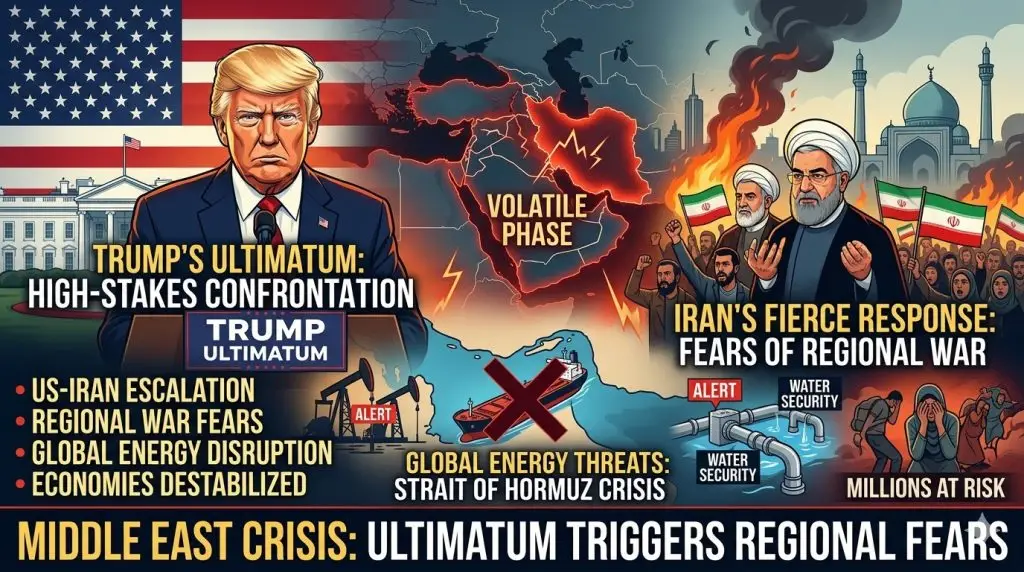
The Middle East has entered one of its most volatile phases in recent history as tensions between Iran and the United States sharply escalate. A dramatic ultimatum issued by former U.S. President Donald Trump has triggered a fierce response from Iran, raising fears of a broader regional war that could disrupt global energy supplies, destabilize economies, and threaten millions of lives.
At the center of the crisis lies a high-stakes confrontation involving energy infrastructure, water security, and control over one of the world’s most critical maritime chokepoints—the Strait of Hormuz.
Escalation Triggered by Trump’s Ultimatum
The current crisis intensified after Donald Trump issued a stark 48-hour ultimatum to Iran. The demand was clear: reopen the Strait of Hormuz to international shipping or face devastating military strikes targeting Iran’s energy infrastructure.
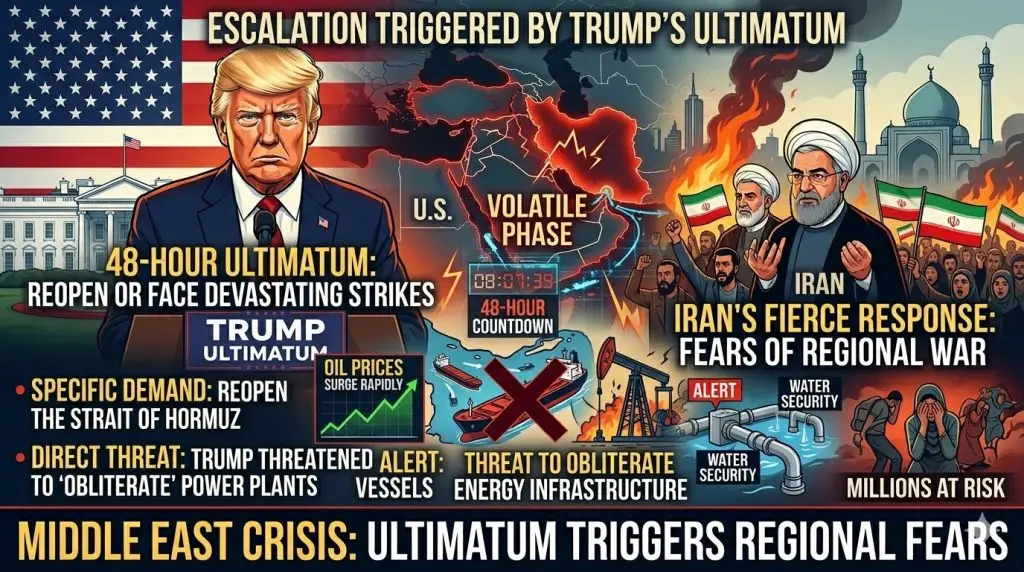
The warning was not symbolic. Trump reportedly threatened to “obliterate” Iranian power plants if Tehran failed to comply. This marked a significant escalation from earlier rhetoric and signaled a shift toward direct confrontation rather than diplomatic engagement.
The Strait of Hormuz is a narrow waterway connecting the Persian Gulf to global markets. Nearly one-fifth of the world’s oil and gas flows through this corridor. Any disruption there has immediate and severe consequences for global energy prices and economic stability.
Iran’s partial closure of the strait—whether through direct action or indirect threats—has already sent shockwaves through international markets. Oil prices surged rapidly, and shipping companies began rerouting vessels to avoid potential attacks.
Iran’s Fierce Response: “No Restraint”
Iran responded to Trump’s ultimatum with equally strong language. Officials declared that any attack on Iranian infrastructure would trigger retaliation with “zero restraint.”
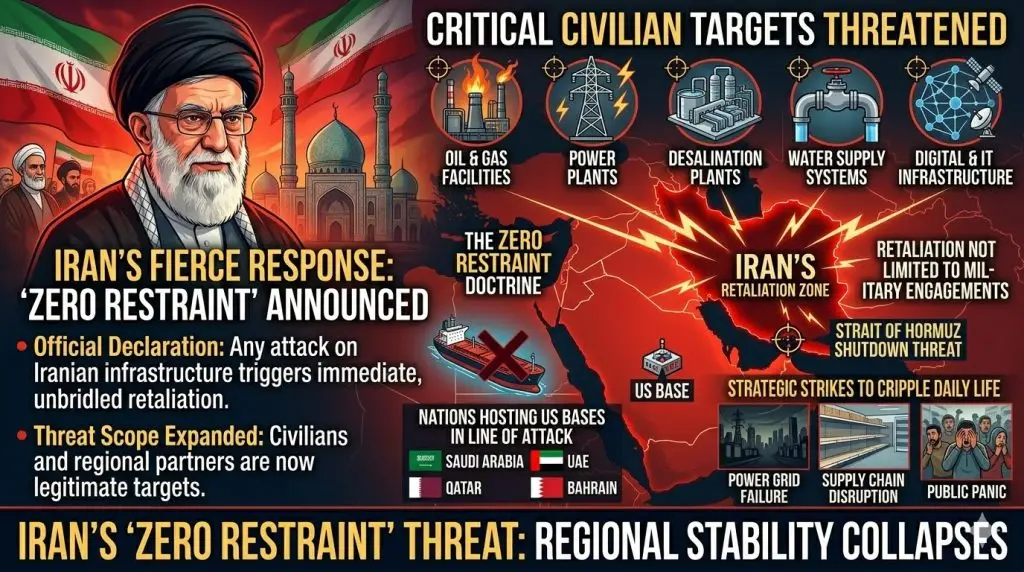
Rather than focusing solely on military targets, Iran expanded its threat to include critical civilian infrastructure across the Gulf region. This includes:
- Oil and gas facilities
- Power plants
- Desalination plants
- Water supply systems
- Digital and IT infrastructure
Iran warned that countries hosting U.S. military bases could become legitimate targets. This puts nations such as Saudi Arabia, the United Arab Emirates, Qatar, and Bahrain directly in the line of potential attacks.
According to recent reports, Iranian officials emphasized that retaliation would not be limited to traditional military engagements but could involve strategic strikes designed to cripple daily life in Gulf countries.
Water as a Weapon: A Dangerous New Dimension
One of the most alarming aspects of Iran’s threat is its focus on water infrastructure. Gulf nations rely heavily on desalination plants to produce freshwater from seawater.
Unlike countries with natural freshwater resources, many Gulf states depend almost entirely on these facilities for drinking water. A successful attack on desalination plants could create an immediate humanitarian crisis.
Iran’s warning suggests a shift in warfare strategy—from targeting purely military or energy assets to striking systems essential for civilian survival.
Experts fear that such a move would:
- Leave millions without access to clean water
- Overwhelm emergency response systems
- Trigger mass displacement in affected regions
- Create long-term environmental and public health crises
This development marks a dangerous escalation in modern conflict, where critical infrastructure becomes a primary battlefield.
The Critical Significance of the Strait of Hormuz
The Strait of Hormuz has long been considered the world’s most important oil transit chokepoint. Its strategic value cannot be overstated.
Every day, millions of barrels of crude oil and liquefied natural gas pass through this narrow passage. Countries such as Saudi Arabia, Iraq, Kuwait, and the UAE depend on it to export energy to global markets.
Iran’s threat to fully close the strait adds another layer of urgency to the crisis. Iranian military officials have stated that if U.S. attacks proceed, they are prepared to shut down the passage entirely.
Such a move would have catastrophic consequences:
- Global oil supply would shrink dramatically
- Energy prices would skyrocket
- Inflation would surge worldwide
- Developing economies would face severe hardship
Even partial disruptions have already caused significant volatility in global markets.
Expanding Conflict Zones
The conflict is no longer confined to a single region. It has expanded across multiple fronts, increasing the risk of a full-scale war.
Recent developments include:
- Iranian missile strikes targeting U.S. and allied bases
- Attacks near sensitive Israeli sites
- Rising tensions between Israel and Hezbollah
- Increased military deployments by the United States
The United States has reportedly reinforced its military presence in the region, deploying additional troops, fighter jets, and naval assets.
Meanwhile, Iran has demonstrated its capability to launch long-range missile strikes, signaling that it can project power beyond its borders.
This multi-front escalation makes the situation highly unpredictable and increases the likelihood of unintended consequences.
Energy Infrastructure Becomes the Battlefield
One of the defining features of this crisis is the transformation of energy infrastructure into a central battlefield.
Both sides have made it clear that energy systems are now legitimate targets:
- The U.S. threatens Iran’s power plants
- Iran threatens Gulf oil facilities and refineries
- Both sides are targeting economic lifelines rather than just military assets
This shift reflects the growing importance of economic warfare in modern conflicts.
Energy infrastructure is particularly vulnerable because:
- It is often centralized and difficult to defend
- Damage can have immediate global consequences
- Repairs can take months or even years
The result is a conflict where economic disruption becomes as significant as military victory.
Global Economic Impact
The implications of this crisis extend far beyond the Middle East.
Oil Prices Surge
Global oil prices have already risen sharply due to fears of supply disruptions. Some estimates suggest prices have exceeded $110 per barrel amid escalating tensions.
Higher oil prices lead to:
- Increased transportation costs
- Rising food prices
- Inflation across multiple sectors
Supply Chain Disruptions
Shipping companies are avoiding the Strait of Hormuz due to safety concerns. This has caused delays and increased costs for global trade.
Market Uncertainty
Financial markets have reacted nervously to the escalating situation. Investors are concerned about:
- Prolonged conflict
- Economic instability
- Potential recession
Human Cost of the Conflict
Beyond the geopolitical and economic implications, the human cost of the conflict continues to rise.
Reports indicate that thousands of people have already been killed, with many more injured or displaced.
Civilians in affected regions face:
- Airstrikes and missile attacks
- Disrupted access to essential services
- Growing uncertainty about safety and security
Humanitarian organizations warn that the situation could worsen rapidly if the conflict escalates further.
Regional Tensions and Alliances
The crisis has placed Gulf countries in a difficult position.
Many of these nations host U.S. military bases, making them potential targets for Iranian retaliation. At the same time, they rely on stability to maintain their economic prosperity.
Countries in the region are now:
- Strengthening defense systems
- Coordinating with allies
- Preparing for potential attacks
However, there is also a growing reluctance to become directly involved in the conflict, as the risks are extremely high.
International Reactions
The international community has responded with concern and calls for de-escalation.
Global leaders and organizations have urged both sides to avoid further escalation and return to diplomatic negotiations.
There are growing fears that:
- The situation could intensify into a full-scale regional war
- Key global shipping routes could be permanently disrupted
- The global economy could face long-term damage
Religious and humanitarian leaders have also appealed for peace, emphasizing the human suffering caused by the conflict.
Political Implications in the United States
The crisis is not only an international issue but also a domestic political challenge in the United States.
Reports suggest that a significant portion of the American public disapproves of the military escalation.
This could have implications for:
- Upcoming elections
- U.S. foreign policy
- Military strategy
The administration faces pressure to balance strong action with the need to avoid a prolonged and costly conflict.
The Risk of Full-Scale War
The current situation remains highly volatile, with multiple scenarios possible.
Scenario 1: Limited Conflict
Both sides engage in controlled strikes without escalating into full-scale war.
Scenario 2: Regional War
The conflict expands to include multiple countries in the Middle East.
Scenario 3: Global Economic Crisis
Disruptions to energy supplies trigger a worldwide economic downturn.
Each scenario carries significant risks, making diplomatic solutions increasingly urgent.
Conclusion: A Critical Moment for Global Stability (Iran retaliation threat)
The confrontation between Iran and the United States has reached a critical juncture. What began as a dispute over maritime access and military strategy has evolved into a complex and dangerous conflict involving energy security, water resources, and regional stability.
Iran’s threat to target Gulf energy and water infrastructure marks a significant escalation, introducing new risks that could affect millions of people.
At the same time, Trump’s ultimatum has raised the stakes, pushing both sides closer to direct confrontation.
The coming days will be crucial in determining whether the situation de-escalates or spirals into a larger conflict.
For now, the world watches closely as one of the most important regions on the planet stands on the brink of a potentially devastating war.