
Iran war crisis intensifies as Europe refuses Trump’s demands. Explore 7 explosive reasons behind the rejection and its impact on global politics.
By International Desk | March 19, 2026
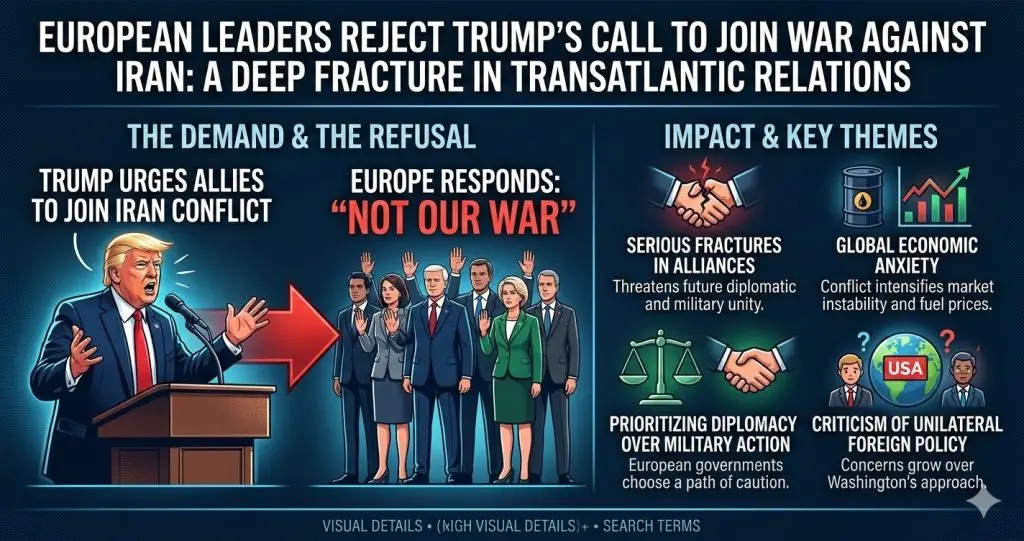
In a dramatic escalation of tensions between Western allies, European leaders have firmly rejected calls by Donald Trump to join the ongoing war against Iran, declaring the conflict “not our war.” The blunt response marks one of the most serious fractures in transatlantic relations in recent history, raising concerns about the future of global alliances, military cooperation, and diplomatic unity.
The refusal comes amid intensifying fighting in the Middle East, mounting global economic anxiety, and growing criticism of Washington’s unilateral approach to foreign policy. European governments, while acknowledging the seriousness of the conflict, have chosen a path of caution—prioritizing diplomacy over direct military involvement.
A Unified European Rejection
Leaders across Europe, including Emmanuel Macron, Keir Starmer, and Friedrich Merz, have signaled strong resistance to U.S. demands for military participation.
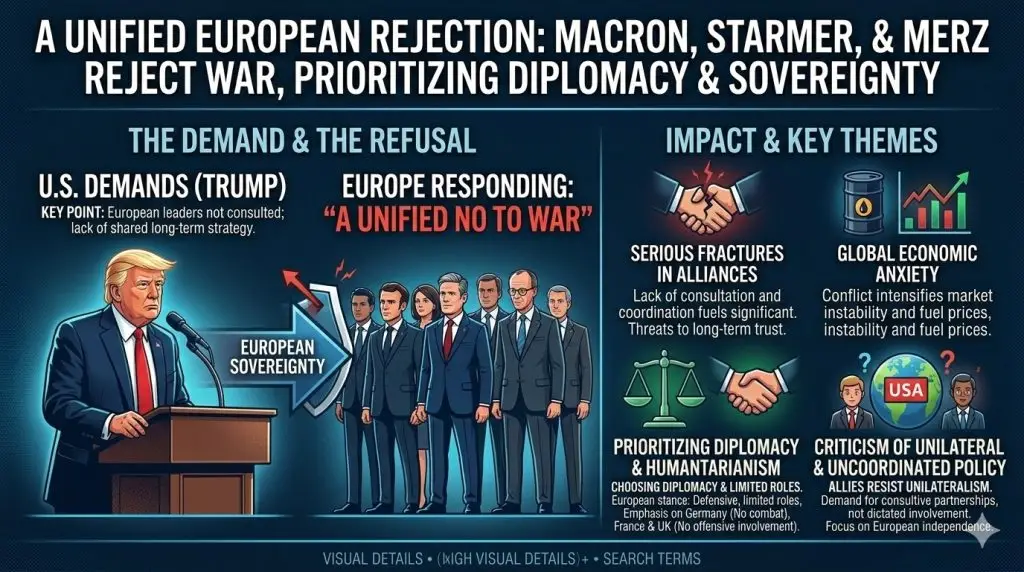
According to multiple reports, European officials were neither consulted before the war began nor given a clear outline of Washington’s long-term strategy. This lack of coordination has fueled frustration among allies who traditionally align closely with the United States on security matters.
Germany’s leadership has been particularly outspoken, with senior officials emphasizing that their country will not participate in combat operations in the Gulf region. France and the United Kingdom have taken similar positions, stressing that their involvement—if any—would be limited to defensive or humanitarian roles.
The message from Europe is clear: while they remain partners of the United States, they are unwilling to be drawn into a conflict they did not initiate and do not control.
Trump’s Push for Allied Support
President Donald Trump has been actively pressuring NATO allies to support U.S. military operations, particularly efforts to secure the strategically vital Strait of Hormuz.
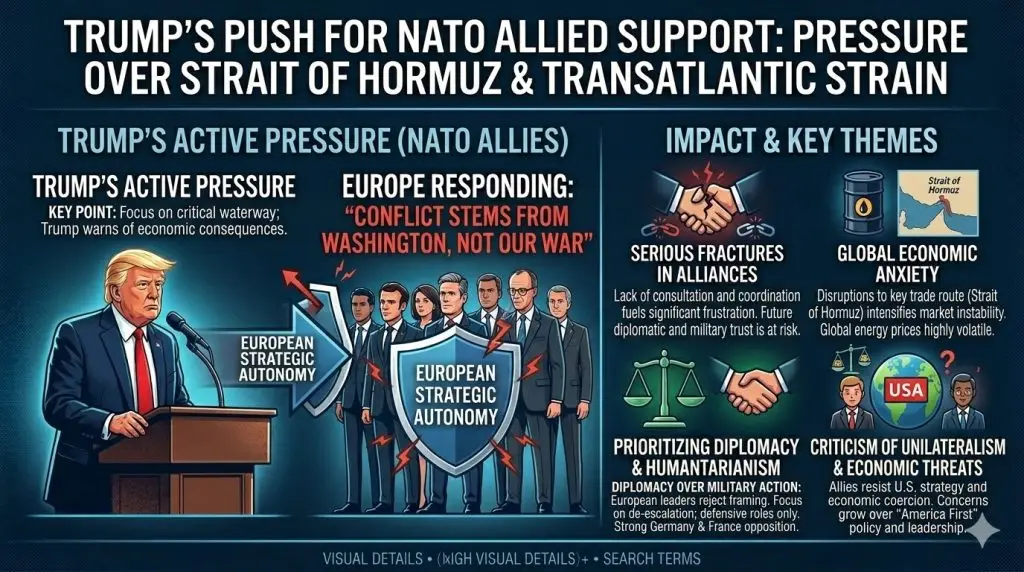
The waterway is one of the world’s most important oil transit routes, and disruptions there have already sent shockwaves through global energy markets. The U.S. administration argues that ensuring safe passage for oil shipments is a shared international responsibility.
However, European leaders have rejected this framing, arguing that the conflict—and its consequences—stem from decisions made in Washington and should not automatically require European military involvement.
Trump has reportedly warned of economic consequences, including trade pressure, for countries that refuse to cooperate. These threats have further strained relations, reinforcing European skepticism about U.S. leadership.
A War Without Consensus
The current conflict traces back to renewed hostilities following the collapse of a fragile ceasefire earlier in 2026. The United States, alongside Israel, launched a series of strikes targeting Iranian military infrastructure.
One of the most significant operations was the bombing of Kharg Island, a critical energy hub responsible for a large share of Iran’s oil exports. The strikes targeted dozens of military sites, signaling a major escalation in the conflict.
Washington has described the campaign as a strategic success, claiming it has significantly degraded Iran’s military capabilities. However, intelligence assessments suggest that while Iran has been weakened, its government and broader strategic posture remain intact.
This ambiguity has raised questions in Europe about the ultimate objectives of the war and whether it risks spiraling into a prolonged regional conflict.
Europe’s Strategic Calculations
European leaders face a complex balancing act. On one hand, they seek to maintain strong ties with the United States, a cornerstone of European security since World War II. On the other, they must respond to domestic political pressures and public opinion, which overwhelmingly oppose military involvement in the Iran conflict.
Across countries such as Germany, Spain, and the United Kingdom, public sentiment has been shaped by memories of past conflicts, particularly the Iraq War. Leaders are wary of repeating what many consider strategic mistakes driven by incomplete intelligence and unclear objectives.
Spain, for example, has taken a particularly firm stance, refusing to provide military support and even denying access to U.S. forces for operations. The Spanish government has framed its position as a principled stand against escalation and in favor of international law.
NATO Under Pressure
The disagreement over Iran has exposed underlying tensions within NATO, the military alliance that has long served as the backbone of Western defense cooperation.
Trump’s insistence that NATO members contribute to operations in the Middle East has been met with resistance, with several countries arguing that the alliance’s mandate is defensive—not to support unilateral offensive campaigns.
This divergence raises critical questions about NATO’s future role. If member states cannot agree on how to respond to major global crises, the alliance’s cohesion could be at risk.
Economic Fallout and Global Impact
The conflict has already begun to affect global markets. Oil prices have surged amid fears of supply disruptions, while shipping routes through the Persian Gulf remain under threat.
For Europe, which relies heavily on imported energy, the stakes are particularly high. Yet despite these risks, European leaders have chosen to prioritize stability over immediate military action.
Analysts warn that prolonged instability in the region could lead to inflation, slower economic growth, and increased geopolitical uncertainty worldwide.
Diplomatic Efforts and Alternatives
Rather than joining the conflict, European nations are focusing on diplomatic solutions. Efforts are underway to reopen channels of communication with Iran and to reduce tensions through multilateral negotiations.
France has proposed initiatives aimed at de-escalation, while Germany has emphasized the importance of dialogue over military force. The European Union as a whole has reiterated its commitment to a rules-based international order.
At the same time, some countries are exploring limited defensive measures, such as protecting commercial shipping without directly engaging in combat operations.
A Shift in Global Power Dynamics
The current standoff reflects broader changes in global politics. The traditional model of U.S.-led coalitions is increasingly being challenged, as allies assert greater independence in foreign policy decisions.
Trump’s approach—characterized by direct demands and economic pressure—has been criticized for alienating partners and weakening long-standing alliances.
For Europe, the situation presents both a challenge and an opportunity: a chance to redefine its role on the global stage while maintaining strategic autonomy.
Domestic Pressure in the United States
Within the United States, the war has sparked its own controversies. Lawmakers have questioned the administration’s justification for the conflict and its handling of intelligence assessments.
Testimony from intelligence officials has highlighted both the successes and limitations of the military campaign, adding to the complexity of the situation.
The debate underscores the broader uncertainty surrounding the war’s trajectory and its long-term consequences.
Public Opinion and Political Risk
Public opinion plays a crucial role in shaping government decisions on both sides of the Atlantic.
In Europe, widespread opposition to the war has reinforced leaders’ reluctance to engage militarily. In the United States, support for the conflict appears more divided, reflecting broader political polarization.
For European leaders, joining the war without clear justification could carry significant political risks, potentially undermining public trust and electoral support.
The Future of Transatlantic Relations
The dispute over Iran may have lasting implications for relations between Europe and the United States.
While both sides have expressed a desire to maintain strong ties, the current crisis highlights deep differences in approach, priorities, and strategic vision.
Some analysts warn that if these differences are not resolved, they could lead to a gradual weakening of the transatlantic alliance.
Conclusion: Iran war crisis
Europe’s refusal to join the Iran war marks a defining moment in international relations. By declaring the conflict “not our war,” European leaders have signaled a willingness to chart an independent course—even in the face of pressure from their closest ally.
The decision reflects a broader shift toward strategic autonomy, as well as a recognition of the risks associated with military intervention in a volatile region.
As the conflict continues, the world will be watching closely to see whether diplomacy can prevail—or whether divisions among allies will deepen further.
One thing is certain: the era of automatic alignment between the United States and Europe is no longer guaranteed.