
One killed and 11 injured after Iran strikes Dubai and Abu Dhabi airports. Explore the attack details, Middle East tensions, global reactions, and security impact.
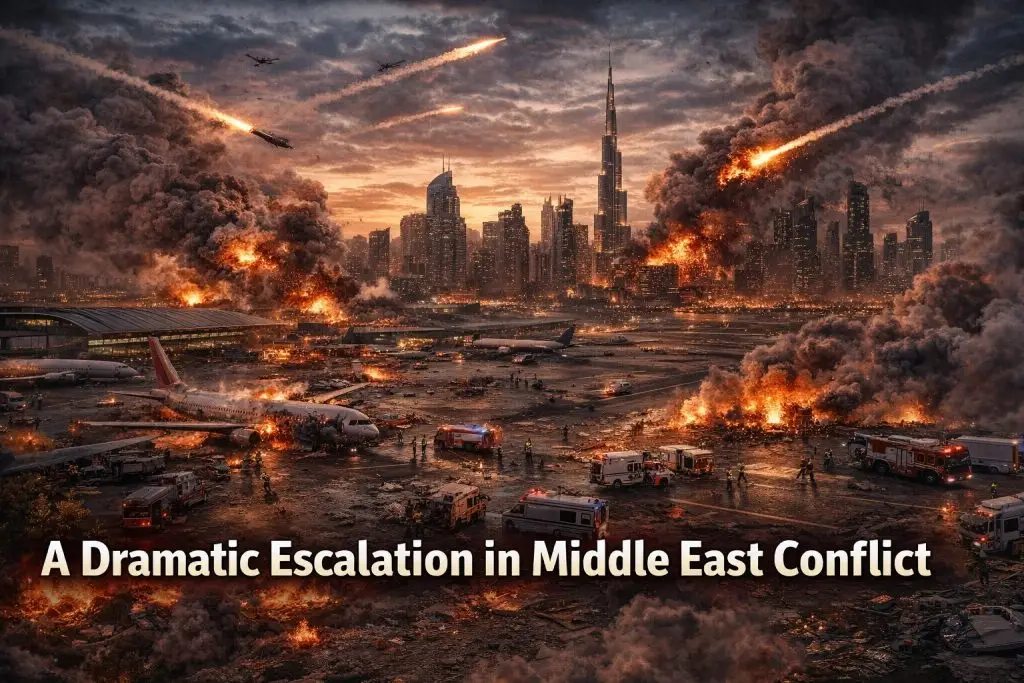
Introduction: A Dramatic Escalation in Middle East Conflict
In one of the most serious regional security disruptions in years, Iran’s retaliatory strikes across the Gulf region have triggered direct impacts on civilian infrastructure, including some of the world’s busiest airports. On February 28–29, 2026, a wave of Iranian ballistic missile and drone attacks hit several Gulf states — particularly the United Arab Emirates, including Dubai and Abu Dhabi — resulting in the death of one person and injuries to at least 11 others at major airports, as well as grounded flights and travel chaos worldwide.
These attacks occurred amid the most intense escalation yet in the conflict following a massive U.S.–Israel military offensive against Iran, which included the reported killing of Iran’s Supreme Leader. Iran’s response has reverberated far beyond military targets, spilling into civilian hubs like international airports and iconic urban landmarks, leaving global travel disrupted and raising fears of a wider regional war.
This article provides a comprehensive look at what happened, why it matters, and what the implications are for aviation, security, regional stability, and global travel.
Section 1 — What Happened: The Attacks on UAE Airports
Casualties and Airport Incidents
Over the weekend, authorities in the United Arab Emirates confirmed that significant incidents unfolded at two major aviation hubs:
- Zayed International Airport in Abu Dhabi reported that a drone targeting the facility was intercepted by UAE air defenses, but falling debris killed one person — identified as an Asian national — and injured seven others during the chaotic event. The authorities linked the incident to Iran’s regional aggression.
- Dubai International Airport (DXB) — the world’s busiest international aviation hub — experienced an “incident” in which debris from an intercepted aerial threat caused minor damage to a concourse and four personnel were injured, according to the Dubai media office.
Combined, these airport attacks resulted in one confirmed fatality and 11 total injuries across both airports.
How the Attacks Unfolded
The strikes were part of a wider series of Iranian missile and drone launches targeting U.S. allies and strategic locations across the Gulf — a response to massive U.S.–Israel air operations against Iran earlier that week. Gulf state defense systems, particularly those of the UAE, reportedly intercepted hundreds of incoming threats:
- UAE officials said they detected and neutralized dozens of ballistic missiles and drones, though falling fragments still caused damage and casualties.
- Local media reported sirens and alerts blaring throughout the night, with debris scattering into both urban and aviation zones.
While government statements emphasized interception success, the physical impact — including fires at the Burj Al Arab hotel and at the Jebel Ali Port — underscored the sheer scale of the assault and the risk civilian infrastructure now faces amid the ongoing conflict.
Section 2 — Immediate Impact on Aviation: Flights Grounded and Chaos Ensues
Airspace Closure and Flight Cancellations
In response to the escalating security situation, regional and international aviation authorities took unprecedented steps:
- Airspace over the entire Gulf region — including the UAE, Qatar, Bahrain, and Kuwait — was closed, halting arrivals and departures at all major hubs.
- Major airlines such as Emirates, Etihad Airways, and Qatar Airways temporarily suspended operations, leaving tens of thousands of travellers stranded.
- According to aviation analytics firms, more than 3,400 flights were canceled, affecting travel routes linking Europe, Asia, Africa, and the Americas.
Passengers across the globe found themselves suddenly unable to reach destinations, get home, or continue planned travel. Airports that typically handle over 90,000 passengers per day turned into crowded waiting zones marked by uncertainty.
Disruptions to Global Travel and Economy
The closure of these transit hubs — among the busiest in the world — has far-reaching implications:
- Travel delays and cancellations will likely continue for days, if not longer, as military assessments determine safe airspace corridors.
- Airlines face financial losses from stranded flights and passengers, while airports lose revenue from suspended operations.
- Tourism, business travel, and cargo transit are deeply affected, especially in markets that rely heavily on the UAE as a connection point between regions.
This abrupt aviation standstill marks one of the largest travel disruptions since the global COVID-19 pandemic, underlining just how dramatically regional conflicts can ripple into global mobility.
Section 3 — Regional Security Context: Why the Strikes Happened
Background — Conflict Escalation After the Iran Attacks
The airport incidents did not happen in isolation. They are part of a rapidly escalating conflict sparked by a U.S.–Israel air offensive against Iran, including the reported death of Iran’s Supreme Leader, Ayatollah Ali Khamenei, earlier in the week. Iran’s retaliation has targeted U.S. bases, allied military sites, and now civilian infrastructure across the Gulf.
Iran’s strategic calculus appears to involve:
- Demonstrating military reach beyond its borders by targeting high-profile allies in the region.
- Signalling to domestic audiences that it can respond with force after suffering major blows.
- Raising the stakes for U.S. and Israeli forces through wider engagement that tests regional air defenses.
This sequence of events has drastically changed the risk environment across the Middle East, drawing states that were previously neutral or less directly involved into the crossfire.
Section 4 — Civilian Toll and Human Impact
Life and Loss Amid Conflict
For everyday people, the impact has been deeply personal:
- The fatality at Abu Dhabi’s Zayed International Airport, identified in official reports as a worker killed in the aftermath of intercepted threats, underscores the fact that even robust defense systems cannot fully protect civilians.
- Airport staff and travellers suffered injuries during the Dubai incident, and emergency services rushed to respond amid sirens and alerts.
- Thousands of passengers remain stuck in airport terminals or neighbouring cities, unsure when flights can resume.
Beyond physical injuries, the psychological toll of living in a conflict zone where airports and major infrastructure are struck — even indirectly — cannot be overstated. Communities throughout the Gulf now face prolonged periods of heightened anxiety and safety concerns.
Section 5 — Government and International Responses
UAE Government Statements
Officials in the UAE have consistently emphasized that:
- Their defense systems successfully intercepted the majority of Iranian projectiles, mitigating more extensive damage and loss of life.
- Immediate response teams were deployed to contain fires and provide medical care after the airport incidents.
- Authorities urged the public to stay calm, rely on official information channels, and prioritize safety.
The UAE has also denounced the attacks as violations of sovereignty and international law, reaffirming its right to defend its territory and citizens.
Global Diplomatic Reactions
Internationally, responses have varied:
- Western nations have condemned the escalation but also stressed the need for de-escalation and safeguarding civilian infrastructure.
- Many countries with citizens stranded in the UAE — including India, the UK, and Australia — issued travel advisories and urged nationals to avoid the region until flights resume.
- International organizations, including aviation bodies, are coordinating with Gulf states to assess when it might be safe to reopen airspace.
The complex web of alliances and diplomatic pressures has made finding a peaceful resolution increasingly urgent yet more difficult.
Section 6 — Broader Implications: What This Means for the Future
Impact on Global Travel and Economy
The strikes on civilian airports reverberate well beyond the Middle East:
- Airlines may permanently reroute flights to avoid the region, raising operational costs and increasing travel times.
- Cargo and freight disruptions could affect global supply chains, particularly between Europe, Asia, and Africa.
- Rising insurance premiums for flights crossing conflict zones may further elevate costs for passengers and businesses.
Security and Military Dynamics
Strategically, these attacks illustrate how modern conflicts can quickly expand beyond military targets into essential civilian infrastructure, forcing nations to rethink defense postures, airport security protocols, and crisis response systems.
There is also a growing fear that continued tit-for-tat strikes could trigger a broader region-wide war involving multiple states — a scenario that would have far-reaching geopolitical consequences.
Conclusion: A Region Transformed by Conflict
The deadly attacks on major UAE aviation hubs have marked a defining moment in Gulf security history. What happened at the international airports serving Dubai and Abu Dhabi was more than a tragic incident resulting in one civilian death and 11 injuries — it signaled a dangerous escalation in the broader confrontation involving Iran, the United States, and Israel. These strikes exposed vulnerabilities in even the most advanced aviation and defense systems, raising urgent questions about regional preparedness and deterrence strategies.
Beyond the immediate human toll, the economic ripple effects are significant. The UAE, a global aviation and tourism powerhouse, now faces renewed concerns over airport security, airline safety, and investor confidence. Temporary flight suspensions, airspace restrictions, and insurance risk adjustments could alter travel patterns across the Gulf. International carriers and logistics firms are reassessing contingency plans, while governments review missile defense coordination and intelligence sharing mechanisms.
Politically, the attacks represent a turning point in Middle Eastern geopolitics. Regional alliances may shift as Gulf states weigh stronger defense partnerships against diplomatic efforts to prevent further escalation. Calls for de-escalation coexist with hardline rhetoric, creating an atmosphere of uncertainty that could persist for months or even years.
Ultimately, the crisis underscores a stark reality: the Gulf region has entered a new security era where infrastructure, civilians, and global commerce are increasingly intertwined with geopolitical conflict. The long-term consequences — political, economic, and strategic — will reshape not only regional stability but also the global balance of power.