
Israeli strikes near Beirut raise tensions with Hezbollah. A US envoy says disarming Hezbollah could end the war, sparking fears of wider conflict.
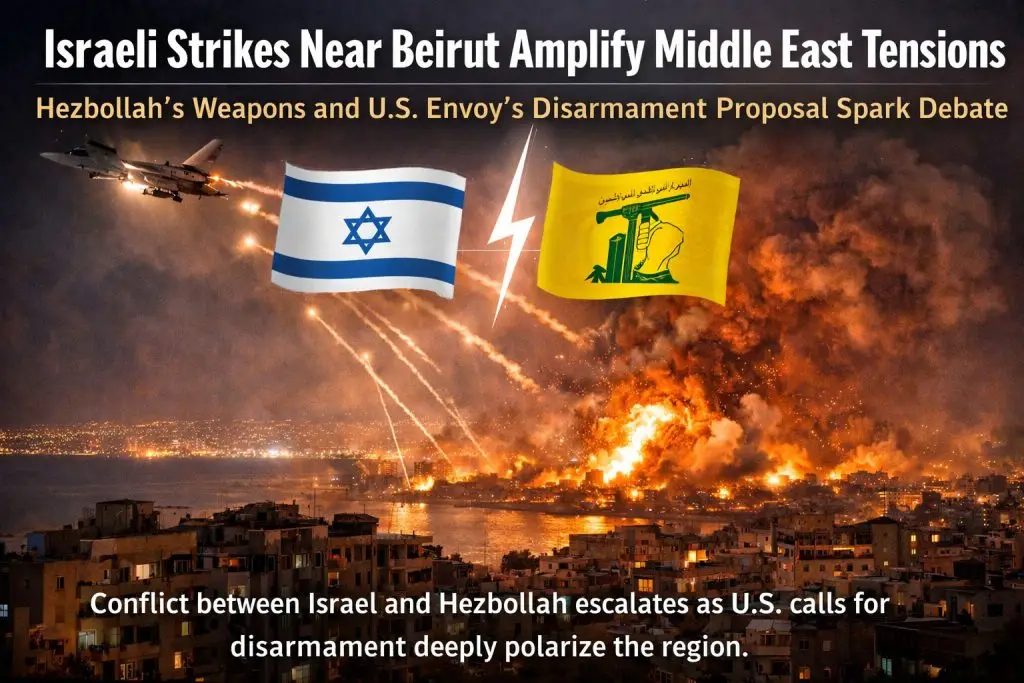
Tensions in the Middle East have escalated dramatically once again after a series of Israeli airstrikes struck areas close to the Lebanese capital of Beirut. The attacks came amid intensifying clashes between Israel and the powerful Lebanese armed group Hezbollah.
At the same time, a senior envoy from the United States suggested that the conflict might end if Hezbollah agreed to disarm and withdraw its military presence from sensitive areas near the border. The comment has sparked debate across the region, with supporters arguing that disarmament could bring stability, while critics say such a move is unrealistic given the group’s deep influence in Lebanon.
The latest strikes highlight the fragile and dangerous situation along the Israel–Lebanon frontier. What began as limited cross-border exchanges months ago has gradually grown into one of the most serious regional crises in recent years.
Escalation Near Beirut
According to regional security officials and local media reports, Israeli aircraft launched several strikes on targets believed to be connected to Hezbollah infrastructure on the outskirts of Beirut. Explosions were heard across multiple districts, sending residents rushing into shelters and causing widespread panic.
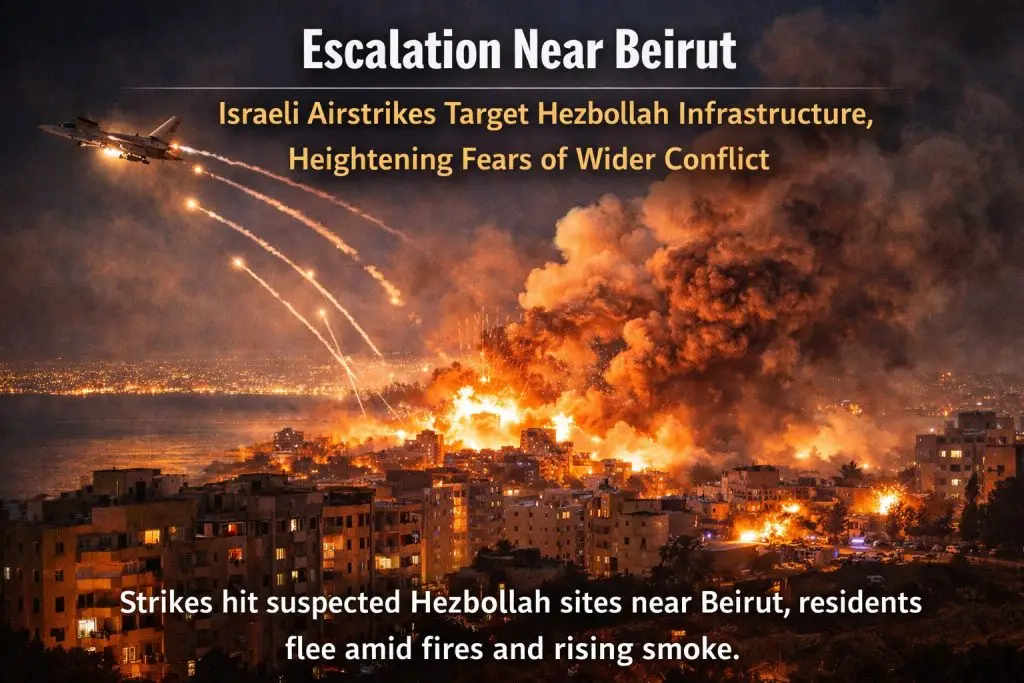
The targeted locations were reportedly areas suspected of storing weapons or housing command facilities used by Hezbollah. While the strikes were not directly in the central urban area of Beirut, their proximity to the capital was enough to raise fears that the conflict is expanding deeper into Lebanon.
Witnesses described loud blasts and thick plumes of smoke rising into the night sky. Emergency services rushed to the scene, and hospitals were placed on high alert as medical teams prepared for possible casualties.
Lebanese authorities confirmed that several buildings were damaged in the strikes, although the full extent of casualties remained unclear in the immediate aftermath.
For many residents of Beirut, the attacks revived painful memories of previous wars that devastated the country. Lebanon’s capital has experienced numerous conflicts over the decades, and the fear of another prolonged war is growing among civilians.
Israel’s Military Strategy
Officials in Israel said the strikes were part of an ongoing effort to weaken Hezbollah’s military capabilities. The Israeli government has repeatedly accused Hezbollah of launching rockets and drones across the border into northern Israeli towns.
Israel maintains that it is acting in self-defense and targeting sites linked to militant operations. According to Israeli military statements, the strikes near Beirut focused on facilities believed to be used for storing missiles and coordinating attacks.
The Israeli leadership has emphasized that Hezbollah’s growing arsenal poses a significant threat to national security. Israeli defense officials estimate that Hezbollah possesses tens of thousands of rockets and missiles capable of striking major cities across Israel.
Prime Minister Benjamin Netanyahu has repeatedly warned that Israel will continue military operations until threats from Hezbollah are neutralized.
“We cannot allow heavily armed militias to operate freely along our borders,” Israeli officials said in statements following the strikes.
Hezbollah’s Response
Hezbollah has condemned the Israeli attacks, calling them acts of aggression against Lebanon’s sovereignty. The group vowed that it would respond to what it described as “unprovoked military aggression.”

In recent months, Hezbollah fighters have launched rockets and drones toward Israeli positions along the border. The group says its actions are part of a broader resistance against Israeli military operations in the region.
Hezbollah has also warned that if Israeli strikes expand deeper into Lebanon, the group could escalate its own military responses.
Analysts believe Hezbollah is carefully balancing its actions. On one hand, the organization wants to demonstrate strength and support for regional allies. On the other hand, it is aware that a full-scale war with Israel could cause massive destruction in Lebanon.
The Role of Iran
Many experts say the conflict cannot be fully understood without considering the role of Iran. Hezbollah is widely viewed as Iran’s most powerful regional ally.
Iran has provided financial support, weapons, and training to Hezbollah for decades. This partnership has turned Hezbollah into one of the most formidable non-state military forces in the Middle East.
Israel often accuses Iran of using Hezbollah as a proxy force to pressure Israeli security interests. Iranian officials, however, argue that Hezbollah operates independently and represents Lebanese resistance against Israeli influence.
The rivalry between Israel and Iran has therefore added another layer of complexity to the conflict.
U.S. Envoy’s Proposal
Amid rising tensions, a U.S. envoy involved in regional diplomacy suggested that disarming Hezbollah could be the key to ending the current conflict.
The envoy argued that if Hezbollah withdrew its fighters and dismantled its heavy weapons near the Israel–Lebanon border, it could remove one of the main triggers of the ongoing clashes.
Washington has long supported efforts to enforce international agreements that call for armed groups in Lebanon to disarm. One such framework includes United Nations resolutions that aim to prevent non-state militias from operating near the Israeli border.
The U.S. diplomat stressed that diplomatic solutions remain possible if all parties commit to reducing military threats.
However, the suggestion that Hezbollah should disarm has been met with skepticism from many analysts and political leaders in Lebanon.
Political Divisions Inside Lebanon
Lebanon’s political landscape is deeply divided over the issue of Hezbollah’s weapons.
Some Lebanese political factions argue that Hezbollah’s military power undermines the authority of the national government and increases the risk of war with Israel. These groups support international efforts to limit Hezbollah’s armed activities.
Others, however, view Hezbollah as an essential defense force against potential Israeli attacks. They argue that Lebanon’s national army lacks the capacity to deter Israel without Hezbollah’s support.
This division reflects broader tensions within Lebanon’s fragile political system. The country has struggled with economic collapse, political paralysis, and security challenges in recent years.
The latest escalation has only intensified concerns that Lebanon could once again become a battlefield for regional conflicts.
Fear Among Civilians
For ordinary people living in Beirut and other parts of Lebanon, the strikes have created a climate of anxiety and uncertainty.
Residents say they fear that the situation could quickly spiral into a full-scale war similar to past conflicts between Israel and Hezbollah.
Lebanon’s economy is already in a severe crisis, with high unemployment, inflation, and shortages of basic services. A major war would likely worsen the humanitarian situation dramatically.
Families in Beirut described hearing explosions late at night and rushing to check on relatives. Many parents kept children home from school the following day as a precaution.
Local aid organizations are preparing emergency plans in case the violence expands.
International Reactions
Governments across the globe are carefully watching the developing situation. Diplomatic officials warn that further escalation could destabilize the entire Middle East.
Several governments have called for restraint from both Israel and Hezbollah, urging them to avoid actions that could trigger a broader war.
The United Nations has also expressed concern about the rising tensions near Beirut and along the Israel–Lebanon border.
Peacekeeping forces stationed in southern Lebanon are reportedly increasing patrols and monitoring military movements in the region.
Despite these diplomatic efforts, analysts say the situation remains extremely fragile.
Military Balance in the Region
Hezbollah is widely considered one of the most powerful armed groups in the world outside of national armies.
Over the years, it has built a sophisticated military network that includes:
- Long-range missiles
- Precision-guided rockets
- Drone systems
- Underground tunnels
- Highly trained fighters
Israel, meanwhile, possesses one of the most technologically advanced militaries in the region. Its air force, missile defense systems, and intelligence capabilities provide significant advantages.
However, Hezbollah’s decentralized structure and large rocket arsenal could still pose serious challenges in any extended conflict.
Experts say a full-scale war would likely result in heavy casualties and destruction on both sides.
The Risk of Regional War
One of the biggest concerns among international observers is the possibility that the conflict could spread beyond Israel and Lebanon.
Because Hezbollah is closely linked to Iran, any major escalation could draw other regional actors into the conflict.
Some analysts warn that attacks on Iranian assets or involvement by other allied groups could turn the situation into a wider regional war.
Such a scenario could disrupt global energy markets, international trade routes, and political stability across the Middle East.
For this reason, many governments are urging all parties to pursue diplomatic solutions rather than military escalation.
The Human Cost of Conflict
Beyond the geopolitical implications, the human toll of the conflict continues to grow.
Civilians living near the border areas have been forced to evacuate their homes as fighting intensifies. Entire communities have been displaced on both sides of the frontier.
Schools, hospitals, and infrastructure remain vulnerable to damage from airstrikes and rocket attacks.
Human rights organizations warn that prolonged fighting could create a humanitarian crisis if large numbers of people are forced to flee their homes.
Lebanon, already struggling with economic hardship, would face enormous challenges in caring for displaced populations.
Historical Context
The conflict between Israel and Hezbollah is not new. Their rivalry has shaped regional politics for decades.
One of the most significant confrontations occurred during the 2006 war between Israel and Hezbollah. That conflict lasted more than a month and caused widespread destruction across Lebanon.
Since then, tensions have periodically flared along the border. However, the current escalation appears to be one of the most serious since that war.
The proximity of Israeli strikes to Beirut suggests that the conflict could be entering a more dangerous phase.
Diplomatic Efforts Continue
Despite the violence, diplomats continue working behind the scenes to prevent a wider war.
International mediators are exploring possible frameworks for reducing tensions along the Israel–Lebanon border.
These discussions often focus on:
- Withdrawal of armed groups from border areas
- Strengthening international monitoring forces
- Negotiating security guarantees for both sides
However, reaching such agreements remains extremely difficult due to deep political mistrust.
Uncertain Future
As Israeli strikes hit near Beirut and Hezbollah signals potential retaliation, the region stands at a crossroads.
The proposal that Hezbollah should disarm may appeal to some international observers, but the reality on the ground is far more complex.
Hezbollah remains a powerful political and military actor within Lebanon. Any effort to dismantle its weapons would require broad political consensus and strong international support.
At the same time, Israel continues to view Hezbollah’s military capabilities as a major security threat.
Without meaningful diplomatic progress, the risk of further escalation remains high.
Conclusion : Israeli strikes near Beirut
The latest Israeli strikes near Beirut have underscored the growing dangers of the conflict between Israel and Hezbollah. While international diplomats argue that disarming Hezbollah could help end the war, achieving such a goal appears extremely challenging given the political and strategic realities in Lebanon.
For civilians living in the region, the priority is simple: peace and stability. Yet the path toward that outcome remains uncertain as military actions continue and political tensions deepen.
The coming weeks may prove critical in determining whether the crisis moves toward diplomacy—or slides further into a devastating regional conflict.