
Flights Cancelled Middle East crisis: airspace shutdown, airline rerouting, passenger impact & safety updates. Complete guide here.
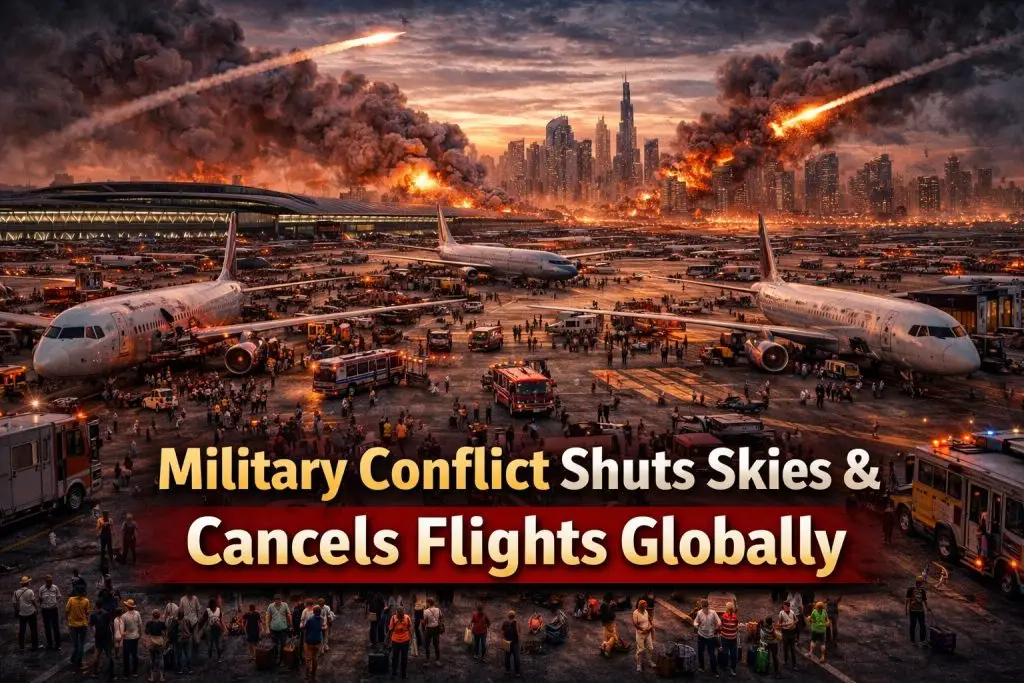
In late February – early March 2026, global civil aviation faced one of its most severe disruptions in years as escalating military conflict in the Middle East led to unprecedented airspace closures and widespread flight cancellations. The region — long known as a strategic hub for international travel — suddenly became a no-fly zone over large swathes of territory as nations shut their skies amid fears of spill-over from military actions. The closures affected not just regional connectivity, but also international routes across Asia, Europe, Africa, and the Americas.
1. Background: What Triggered the Airspace Closures?
In late February 2026, military actions by the United States and Israel against Iran triggered significant escalation in the Middle East conflict. In response, Iran launched a series of missile and drone strikes across the Gulf region. These attacks hit areas in the United Arab Emirates (UAE) — including major airports — as well as military bases, causing casualties and damage that later led to closures of critical civil aviation facilities.
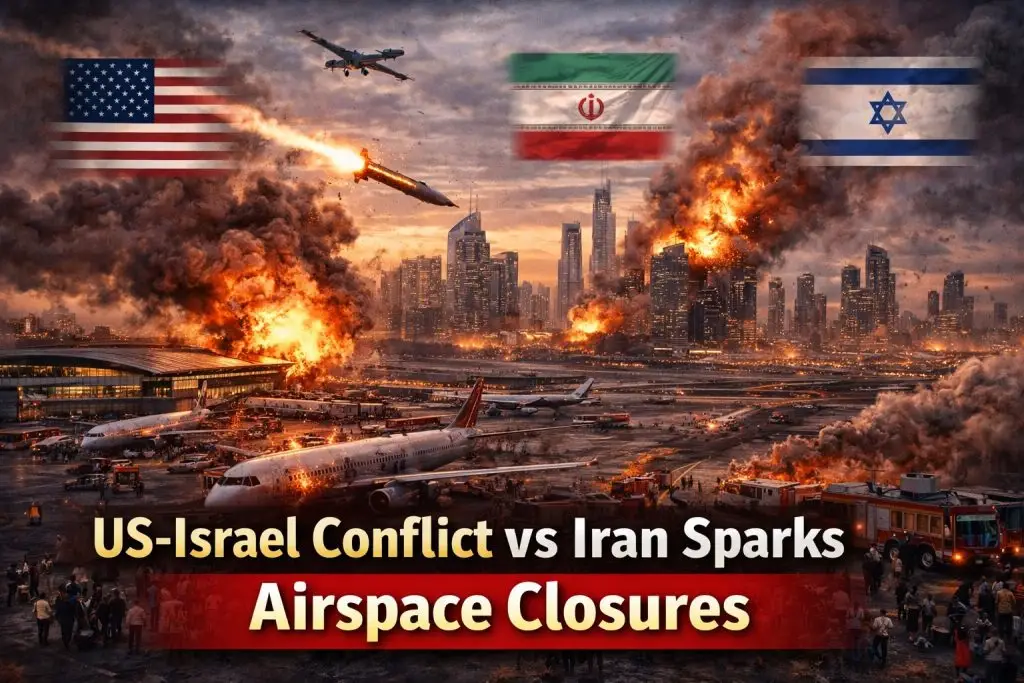
While the primary trigger was the escalation between these nation states, civil aviation regulators around the region took the unusually precautionary step of closing their airspace — either fully or partially — to ensure safety and avoid exposing civilian aircraft to potential conflict zones. Countries including Iran, Iraq, Israel, Syria, Kuwait, Bahrain, Qatar, the UAE, and others joined in opening — then swiftly closing — some parts of their skies.
2. What Does It Mean to Close Airspace? How Does It Affect Flights?
Airspace closure means that civil aviation authorities temporarily prohibit aircraft from operating in designated sky regions due to safety concerns. Civil airspace might be fully shut or limited to specific altitudes or corridors, and airlines are usually prohibited from entering those spaces without special permissions.
In this particular crisis:
- Airspaces of entire countries were closed, meaning no departures, arrivals or overflights were allowed through multiple regions.
- Major Gulf States airspaces — including Qatar, UAE (Dubai and Abu Dhabi), Bahrain, and Kuwait — were restricted.
- The closures were not limited to one country; almost the entire Middle East region faced wide-scale restrictions, affecting not only flights operating within the region but also those using these airstrips as international transit hubs.
- Flights already en-route were rerouted, turned back to origin, or placed in holding patterns until safe corridors could be arranged.
3. Major Flight Cancellations and Global Disruptions
3.1 Regional Impact: Gulf Hubs and Their Shut Downs
The Middle East hosts some of the busiest aviation hubs in the world — including Dubai International Airport (DXB), Doha’s Hamad International Airport, Abu Dhabi International Airport, and Kuwait International Airport. These are not just regional transfer points, but are also critical transit nodes connecting Europe and the Americas with Asia and Africa.
- Dubai and Abu Dhabi suspended all operations amid airspace restrictions, forcing airlines like Emirates, Etihad Airways, and flydubai to halt services.
- Qatar Airways temporarily suspended flights to and from Doha when Qatar’s airspace was closed.
- Other carriers were forced to cancel or reschedule flights to Saudi Arabia, Kuwait, Jordan, and Israel.
Collectively, this created one of the largest regional flight disruptions in years, displacing thousands of flights and passengers.
3.2 Data on Cancellations and Delays
According to aviation analytics firms and trackers:
- More than 3,400 flights were cancelled across the Middle East on and around March 1, 2026.
- Other reports noted that of over 4,200 scheduled flights, nearly 966 flights (over 20%) were cancelled on one day alone — and that total rose above 1,800 when outbound and return segments were included.
- Data from flight trackers also showed tens of thousands of flights globally delayed or rerouted, not just within the Middle East.
These figures highlight how widespread the impact became — beyond simple local closures to a global aviation bottleneck.
3.3 Impact on Major International Airports
While direct closures hit Middle Eastern hubs hardest, international airports globally also reported:
- Delays and cancellations due to downstream connections being blocked.
- Rerouted flights taking longer paths around the region.
- Luggage transfers and crew scheduling issues worsening the situation.
Large carriers such as British Airways, Air France, Lufthansa, Turkish Airlines, and Air India responded by cancelling or rerouting hundreds of flights as airspace restrictions remained in place.
4. Country-by-Country Breakdown of Flight Disruptions
4.1 Bangladesh and South Asia
Bangladesh saw a direct effect on flights to the Middle East:
- All flights from Dhaka to Middle Eastern destinations were suspended as airspace closures took effect.
- Reports indicated that more than 54 Dhaka–Middle East flights were cancelled over a two-day period, disrupting travel plans for thousands.
- The Civil Aviation Authority of Bangladesh (CAAB) issued directives for airlines to keep passengers informed about changes, cancellations, delays, and rescheduling.
4.2 India and South-Central Asia Links
At major Indian airports:
- More than 350 flights were cancelled due to airspace restrictions affecting Gulf connections.
- At Indira Gandhi International Airport (Delhi) alone, nearly 100 flights were reported cancelled due to the regional crisis, spanning departures and arrivals.
These disruptions also affected onward travel — flights booked via Gulf transit points became unusable, forcing passengers to find alternative routes or postpone travel.
4.3 Europe and the Americas
Even distant airports felt the impact:
- Airports such as Dublin issued warnings as flights to the Gulf region were cancelled.
- Brisbane and Melbourne airports saw flights cancelled mid-flight or diverted as carriers like Qatar Airways and partner services turned back after airspace closures.
This demonstrates how interconnected modern global aviation is — a closure in one region quickly cascades into operations worldwide.
5. Airline and Government Responses
5.1 Airlines’ Actions
Airlines largely adopted safety-first strategies:
- Waivers and refunds were offered to passengers whose flights were cancelled, allowing rebooking without extra fees.
- Some carriers are operating alternative routing via airspace that remains open — for example, routing via Afghanistan airspace for flights avoiding the Gulf region.
- Airline staff were deployed to assist passengers directly at airports, helping with rebooking, accommodation, and information dissemination.
5.2 Government and Civil Aviation Authority Responses
Civil aviation authorities from affected nations have:
- Issued urgent directives for airlines to communicate flight changes proactively.
- Coordinated with foreign ministries and international aviation bodies to monitor safety and reopen airspace when possible.
- Advised travelers to avoid unnecessary travel to conflict zones and to keep close contact with airlines for updates.
6. Passenger Impact: What Travelers Experienced
The disruptions left countless travelers stranded:
- Thousands of passengers were stuck at airports with flights cancelled or indefinitely delayed.
- Travelers faced uncertain schedules and rapid changes to boarding gates, departure times, and flight paths.
- Many airlines provided hotel accommodations or rebooking options, while some passengers chose to return home rather than wait.
Those who were planning to travel through major transit hubs faced the hardest impact, especially when retries and alternate routing added hours to travel time — and sometimes extra layovers.
7. Economic and Long-Term Aviation Impacts
7.1 Short-Term Economic Effects
The closures caused tangible financial effects:
- Airlines faced fuel and operational cost increases due to rerouting and longer flight times.
- Airports lost landing fees and passenger traffic revenue during the closures.
- Ticket prices on alternative routes showed signs of increasing due to demand and limited availability.
Aviation analysts also warned that the crisis could affect airline profitability and scheduling efficiency for weeks to come, especially in markets depending on Middle East transit hubs.
7.2 Long-Term Implications
In the longer run, this event may lead to:
- Re-evaluation of flight routing dependencies on the Middle East for global east-west travel.
- Greater emphasis on alternative corridors that bypass volatile regions.
- Enhanced safety protocols for flights crossing conflict zones.
Experts suggest that carriers might invest more in route optimization and conflict-zone aviation risk management to prevent similar mass disruptions in the future.
Conclusion: Airspace Closures and Flight Cancellations in the Middle East
The sudden closure of Middle Eastern airspace and mass flight cancellations in early 2026 was a dramatic reminder of how geopolitical tensions can rapidly disrupt global aviation systems. The cascading effects — from cancelled flights and stranded passengers to economic pressures on airlines and shifts in routing strategies — indicate the depth of impact when conflict intersects with civil airspace. These events not only tested the resilience of airlines and airports, but also highlighted the need for stronger coordination among international aviation authorities.
While recovery efforts are ongoing and some routes have begun to resume, the effects of the disruption will continue to influence how global airlines plan flight paths, manage risk, and respond to geopolitical uncertainty in the years ahead.