
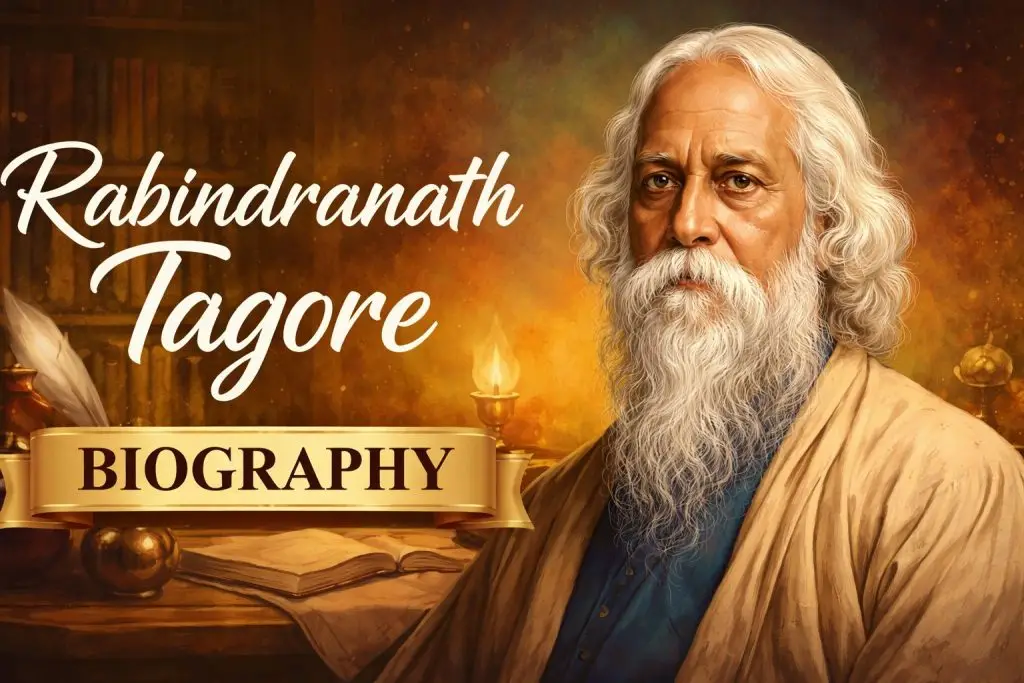
Discover Rabindranath Tagore biography, life’s 7 facts, and Nobel Prize journey. Learn about Rabindranath Tagore’s works, legacy, and achievements.
Introduction: Rabindranath Tagore Biography
Rabindranath Tagore stands as one of the most influential literary figures in world history, celebrated for his remarkable contributions to literature, music, and philosophy. A poet, philosopher, musician, and artist, Rabindranath Tagore reshaped Bengali literature and introduced the richness of Indian culture to a global audience. His writing reflects deep human emotions, spirituality, and a universal vision that continues to inspire readers across generations.
Born in 1861 in Kolkata, he grew up in a culturally vibrant environment that nurtured his creativity from an early age. Over the course of his life, Rabindranath Tagore produced a vast body of work, including poetry, novels, short stories, songs, and essays. His most famous work, Gitanjali, brought him international recognition and critical acclaim.
In 1913, Rabindranath Tagore was awarded the Nobel Prize in Literature, making him the first non-European laureate to receive this prestigious honor. This achievement not only marked a personal milestone but also highlighted the global importance of Indian literature.
In this detailed biography, you will explore Rabindranath Tagore’s life, achievements, major works, and seven fascinating facts that define his lasting legacy and worldwide influence.
Early Life of Rabindranath Tagore
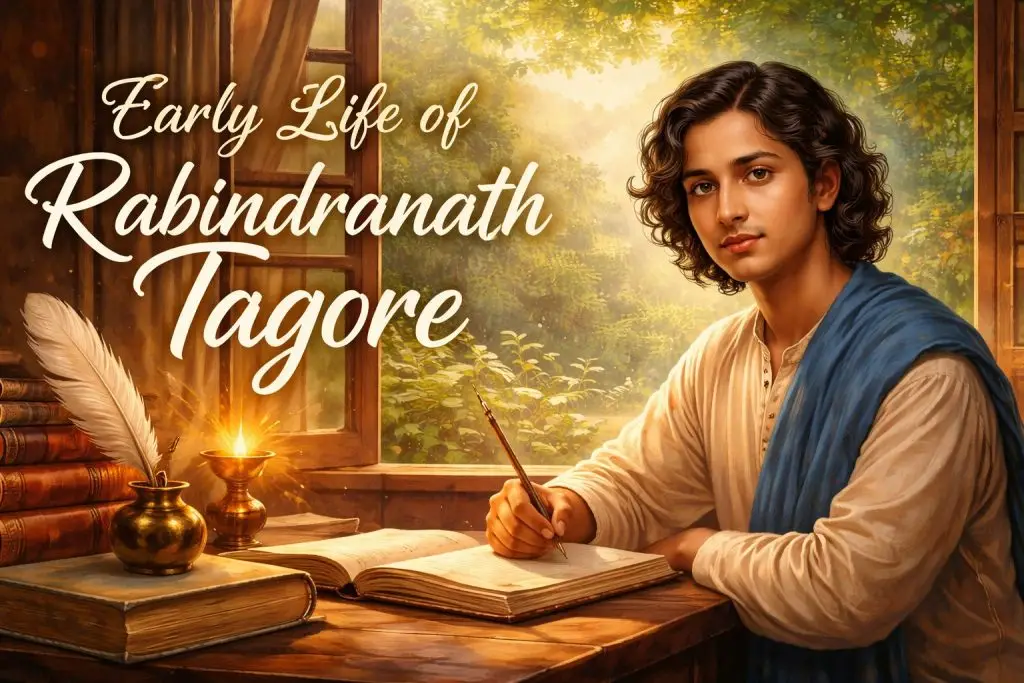
Rabindranath Tagore was born on May 7, 1861, in Kolkata (then known as Calcutta), India, into a wealthy and culturally influential Bengali family. His father, Debendranath Tagore, was a respected philosopher and religious reformer, while his mother, Sarada Devi, managed the household. Growing up in such an intellectually vibrant environment, Rabindranath Tagore was surrounded by literature, music, art, and spiritual discussions from an early age.
As a child, Rabindranath Tagore showed remarkable talent and curiosity. He was not fond of traditional classroom education and often found the rigid schooling system restrictive. Instead, he preferred learning at home through self-study, observation, and creative exploration. This freedom allowed him to develop his imagination and unique style of thinking.
From a very young age, Rabindranath Tagore demonstrated a deep passion for writing. He began composing poetry when he was just eight years old, showing maturity beyond his years. By the time he reached sixteen, he had already published several poems and literary works under a pseudonym, gaining early recognition.
This strong foundation in creativity and independent learning played a crucial role in shaping Rabindranath Tagore’s future as one of the greatest literary figures in history.
Education and Influences
Rabindranath Tagore’s educational journey was unconventional and deeply shaped by his independent spirit. He briefly attended several schools in Kolkata, including traditional institutions where strict discipline and rote learning were common. However, he found the rigid structure of formal education limiting and uninspiring. As a result, much of his early learning took place at home under private tutors, where he explored a wide range of subjects, including literature, philosophy, music, and art. This flexible approach allowed him to develop a creative and inquisitive mindset from a young age.
In 1878, Rabindranath Tagore traveled to England with the intention of studying law at University College London. Although he enrolled and attended classes for a short period, he soon realized that a legal career did not align with his true interests. His passion for writing, poetry, and artistic expression ultimately led him to leave his studies unfinished and return to India.
During his stay in England, Rabindranath Tagore encountered Western literature, music, and cultural ideas that broadened his perspective. These experiences, combined with his strong roots in Indian traditions, helped him develop a distinctive literary voice. This fusion of Eastern and Western influences became a defining feature of his works, earning him global recognition.
Literary Career and Major Works
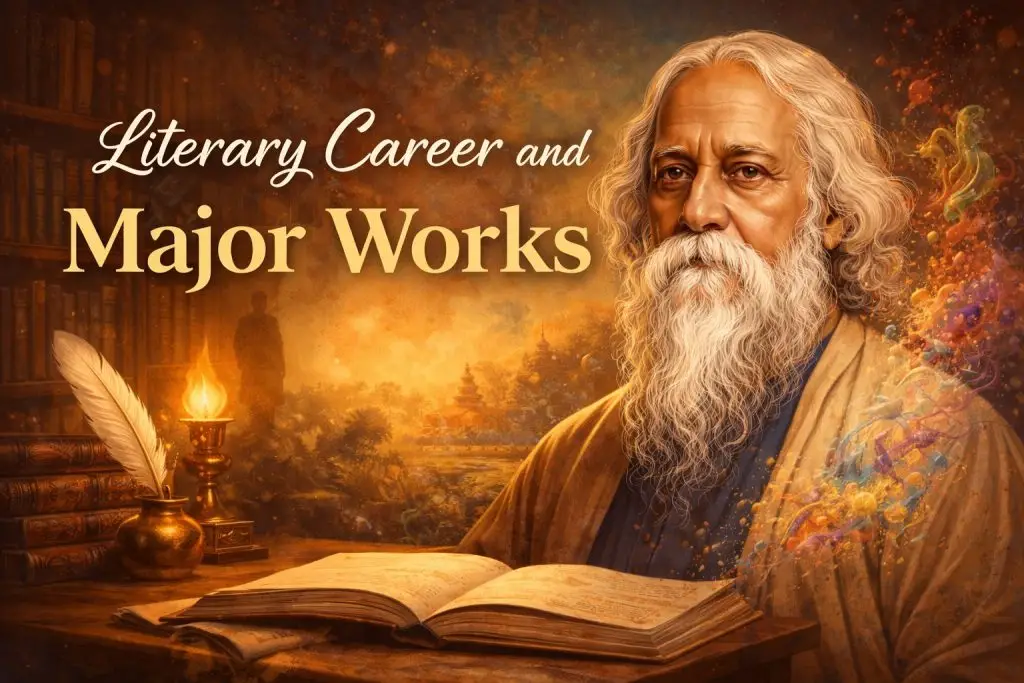
Rabindranath Tagore’s literary career, spanning over six decades, was a monumental force that redefined Bengali literature and brought Indian thought to the global stage. A true polymath, he produced an staggering body of work—including thousands of poems, eight novels, dozens of short stories, and over 2,000 songs known as Rabindra Sangeet.
His career was characterized by a transition from classical Sanskrit-influenced styles to a more relatable, “lingua franca” approach. In his masterpiece Gitanjali, he explored the spiritual connection between man and the divine, while his novels like Gora and The Home and the World tackled complex themes of nationalism, identity, and social reform.
Beyond long-form fiction, Tagore is credited with pioneering the modern short story in India. Works like Kabuliwala showcased his ability to find profound human connection in everyday encounters. His writing was never static; even in his later years, he continued to experiment, eventually turning to painting and prose-poetry. This tireless creativity ensured that his work remained fresh, authoritative, and deeply influential across generations of writers worldwide.
Famous Works of Rabindranath Tagore
- Gitanjali (Song Offerings): This world-renowned collection of spiritual lyrics explores the intimate relationship between the human soul and the divine. It earned Tagore the Nobel Prize and remains a landmark of universal emotional appeal.
- Gora: A complex, philosophical novel that dives deep into the themes of traditional Hinduism versus modern reform and national identity. It challenges the rigid boundaries of religion and race through its intense character development.
- The Home and the World: Set against the backdrop of the Swadeshi movement, this narrative explores the tension between global ideals and radical nationalism. It masterfully weaves a love triangle with conflicting political ideologies and moral dilemmas.
- Kabuliwala: One of his most beloved short stories, it depicts the tender, unlikely friendship between a fruit seller from Kabul and a little girl in Kolkata. It is a timeless exploration of paternal love and the human connections that transcend borders.
- Chokher Bali: A groundbreaking work that explores female desire, widowhood, and the intricate complexities of human relationships within a patriarchal society. It is often cited as the first truly modern Indian novel due to its psychological depth.
Rabindranath Tagore also composed over 2,000 songs, now known as Rabindra Sangeet, which remain an integral part of Bengali culture.

Rabindranath Tagore and the Nobel Prize
In 1913, Rabindranath Tagore etched his name into history by becoming the first Asian and first non-European to win the Nobel Prize in Literature. The Swedish Academy honored him for his collection Gitanjali (Song Offerings), praising his “profoundly sensitive, fresh and beautiful verse.”
Tagore’s success was a watershed moment for global literature. Before this, the Nobel Prize had been largely Eurocentric; his win forced the Western literary establishment to recognize the intellectual depth and lyrical sophistication of the East. His poetry, while deeply rooted in Indian philosophy and Bengali landscapes, touched on universal themes of love, nature, and the divine.
The impact of his Nobel win extended beyond the arts. He used his global platform to advocate for education and humanism, even using the prize money to fund his experimental school at Santiniketan. This achievement didn’t just celebrate a book; it validated a culture. By bridging the gap between Eastern mysticism and Western realism, Tagore’s work transformed the way the world engaged with Indian literature, leaving an immortal legacy that continues to inspire poets and seekers across the globe today.
Contribution to Education
Beyond his literary genius, Rabindranath Tagore was a visionary educational reformer who sought to dismantle the “factory-like” schooling system of his era. In 1901, he established an experimental school in Santiniketan, West Bengal, which eventually evolved into the world-renowned Visva-Bharati University.
Tagore’s pedagogical philosophy was rooted in the concept of Amlananda (pure joy). He believed that education should occur in harmony with nature, moving classrooms from cramped buildings to the shade of mango groves. For Tagore, the “walls” of a traditional school were both physical and intellectual barriers that stifled a child’s natural curiosity. He emphasized creativity through music, dance, and art, arguing that education must nurture the soul and the imagination rather than focusing strictly on rote memorization and academic achievement.
His vision was truly global; he wanted Santiniketan to be a place “where the world makes its home in a single nest.” By integrating Indian traditional wisdom with Western scientific inquiry, Tagore created a blueprint for holistic learning. Today, his legacy lives on through Visva-Bharati, which continues to produce thinkers who value freedom of thought and a deep, spiritual connection to the environment.
Philosophy and Ideology
Rabindranath Tagore’s philosophical core was built upon the pillars of humanism, universalism, and a profound sense of harmony. He viewed the world not as a collection of fragmented nations, but as a single “nest” where humanity could coexist without the barriers of religion, race, or geography. This ideology was radical for its time, as he dared to critique narrow nationalism, which he believed led to conflict and spiritual decay.
Tagore advocated for a “Great Federation of Mankind,” where the best of Eastern spiritualism and Western scientific progress could merge. His belief in the unity of the human spirit influenced every facet of his life, from his educational reforms at Santiniketan to his political interactions with leaders like Gandhi. By prioritizing empathy over borders and peace over power, Tagore’s ideology remains a vital blueprint for global understanding. He taught that true freedom is not merely political, but a state of mind where “the world has not been broken up into fragments by narrow domestic walls.”
7 Interesting Facts About Rabindranath Tagore
Here are seven fascinating facts about Rabindranath Tagore:
- Young Prodigy – He wrote his first poem at the age of eight.
- First Asian Nobel Laureate – He won the Nobel Prize in Literature in 1913.
- National Anthems – He wrote the national anthems of both India and Bangladesh.
- Global Traveler – He visited over 30 countries promoting cultural exchange.
- Artist in Later Life – He began painting at the age of 60.
- Education Pioneer – He founded Visva-Bharati University.
- Knighthood Renounced – He gave up his British knighthood in protest of injustice.
Personal Life
The personal life of Rabindranath Tagore was a poignant tapestry of deep love and profound sorrow, which heavily influenced the emotional depth of his writing. In 1883, he married Mrinalini Devi, and together they had five children. While his family life provided a sense of grounding, it was also marked by a series of devastating losses. Between 1902 and 1907, Tagore faced an overwhelming period of grief, losing his wife, two of his daughters, and his youngest son to illness.
These personal tragedies did not silence his creative voice; instead, they transformed it. His mourning and philosophical struggle with mortality found their way into his literature, most notably in the hauntingly beautiful verses of Gitanjali. Rather than falling into despair, Tagore channeled his pain into a universal search for spiritual meaning and human connection. His ability to produce such luminous, hopeful work despite his private heartbreaks remains a testament to his resilience. For Tagore, personal suffering was the forge in which his most enduring and empathetic insights into the human condition were shaped.
Rabindranath Tagore’s Role in Society
Rabindranath Tagore was a cornerstone of India’s cultural and social evolution, acting as a moral compass during the tumultuous years of the early 20th century. He used his immense literary influence to advocate for a society rooted in reason rather than blind tradition, challenging social injustices and promoting the dignity of every individual through his essays and poetry.
His relationship with the Indian independence movement was deeply nuanced. While he passionately supported the quest for self-rule and justice, he was a vocal critic of “extreme nationalism,” which he feared could lead to narrow-mindedness and violence. This stance occasionally put him at odds with political activists, yet he remained a respected intellectual figure who prioritized global humanism over territorial pride.
Ultimately, Tagore’s role was that of a bridge-builder between a colonially oppressed India and the wider world. By emphasizing themes of justice, humanity, and universal brotherhood, he provided a spiritual framework for a nation seeking its identity. His legacy is that of a “Great Sentinel,” guarding the values of intellectual freedom and international peace against the rising tides of intolerance.
Legacy of Rabindranath Tagore
The legacy of Rabindranath Tagore is a multifaceted jewel that continues to illuminate music, education, and global philosophy. He was a rare pioneer who refused to be categorized by a single discipline, ensuring that his influence would permeate every layer of modern culture. Today, he is remembered not just as the “Bard of Bengal,” but as a global architect of humanism whose ideas on internationalism predated the modern era of globalization.
Nowhere is his legacy more tangible than in the world of Rabindra Sangeet. His thousands of compositions provide a rhythmic heartbeat to Bengali life, offering a musical language for every human emotion, from the agony of loss to the ecstasy of spring. Similarly, his artistic legacy—the thousands of paintings he began in his sixties—continues to be studied for its raw, modernistic power.
In the realm of education, Visva-Bharati University stands as a living monument to his vision of a “world university.” It remains a global destination for those seeking an education that balances scientific inquiry with spiritual and artistic freedom. By translating his works into dozens of languages, the world has claimed Tagore as its own, ensuring his legacy as a guiding light for any generation seeking truth, beauty, and a deeper connection to the human spirit.
Why Rabindranath Tagore Still Matters Today
In a 21st-century landscape often divided by borders and digital noise, the philosophy of Rabindranath Tagore remains a vital compass for humanity. His advocacy for a “world without walls” is more than just poetic sentiment; it is a practical blueprint for global citizenship. In an era where cultural polarization is common, Tagore’s emphasis on universalism and empathy offers a necessary path toward peace and mutual understanding.
Today’s shift toward holistic, child-centric learning—prioritizing mental well-being and environmental awareness—directly mirrors Tagore’s experiments at Santiniketan. He understood, long before modern psychology confirmed it, that true education isn’t about filling a vessel, but about lighting a fire of creativity and independent thought.
Furthermore, in a rapidly changing world dominated by AI and automation, Tagore’s works serve as a profound reminder of the irreplaceable beauty of human expression. His songs and stories celebrate the nuances of the human heart, urging us to maintain a deep connection with nature and one another. Tagore still matters today because he provides the spiritual and intellectual vocabulary needed to navigate the complexities of the modern age with grace, compassion, and artistic integrity.
Conclusion
The legacy of Rabindranath Tagore is not confined to the pages of history; it is a living, breathing influence that continues to shape modern cultural and intellectual thought. He was a rare visionary who successfully bridged the gap between traditional Eastern spiritualism and the progressive demands of the modern world. From his revolutionary “forest school” at Santiniketan to his historic Nobel Prize, Tagore’s journey was a testament to the power of a single mind to transform a nation’s identity.
This biography of Rabindranath Tagore has explored the multifaceted nature of the “Bard of Bengal”—a man who was a poet, a painter, a philosopher, and a patriot. His life proves that true greatness lies in the ability to see the universal in the particular and to advocate for a world that is not “broken up into fragments by narrow domestic walls.”
As we reflect on his ten defining facts and his vast literary contributions, it becomes clear that his work remains a guiding light. Tagore’s message of humanism, freedom, and harmony with nature is perhaps more relevant today than ever before. He remains an immortal symbol of creativity, reminding us that art and education are the ultimate tools for human liberation.