
Russian air attack on Ukraine in 2026 kills four civilians after drones and missiles strike the Kyiv region, damaging homes and raising global concern.
Introduction

The war between Russia and Ukraine continues to produce devastating consequences for civilians and infrastructure. In one of the latest escalations of the ongoing conflict, a large-scale Russian air attack struck multiple regions of Ukraine, leaving at least four people dead and many others injured. The assault involved hundreds of drones and dozens of missiles, highlighting the intensifying use of aerial warfare in the conflict.
The overnight strike targeted several cities and regions, including areas surrounding the Ukrainian capital Kyiv. According to Ukrainian authorities, residential buildings, schools, and energy infrastructure were damaged in the attack, causing widespread disruption and fear among local residents. Emergency teams rushed to rescue survivors and extinguish fires while the government condemned the attack as part of a broader strategy to weaken Ukraine’s defenses and morale.
This incident reflects the continuing volatility of the Russia–Ukraine war, which has entered another intense phase marked by drone swarms, missile strikes, and attacks on critical infrastructure.
Background of the Russia–Ukraine War
The conflict between Russia and Ukraine began escalating in 2014 following Russia’s annexation of Crimea. Tensions intensified dramatically in February 2022 when Russia launched a full-scale invasion of Ukraine. Since then, the war has evolved into one of the largest military confrontations in Europe since World War II.

Throughout the conflict, both countries have relied heavily on advanced weapons systems, including missiles, drones, artillery, and air-defense technology. Russia has frequently targeted Ukrainian cities with long-range missile strikes and drone attacks, while Ukraine has responded with defensive systems and counterattacks on Russian infrastructure.
Air strikes have become a central tactic in the war. These attacks are often aimed at disrupting Ukraine’s power supply, destroying transportation routes, and weakening the country’s military capabilities. However, many of the strikes have also caused civilian casualties and extensive damage to homes and public facilities.
The recent attack that killed four people fits into a broader pattern of aerial bombardment used by Russian forces throughout the war.
Details of the Latest Russian Air Attack
According to Ukrainian officials, the overnight assault involved an enormous barrage of aerial weapons. Russia launched approximately 430 drones and 68 missiles targeting several regions of Ukraine.
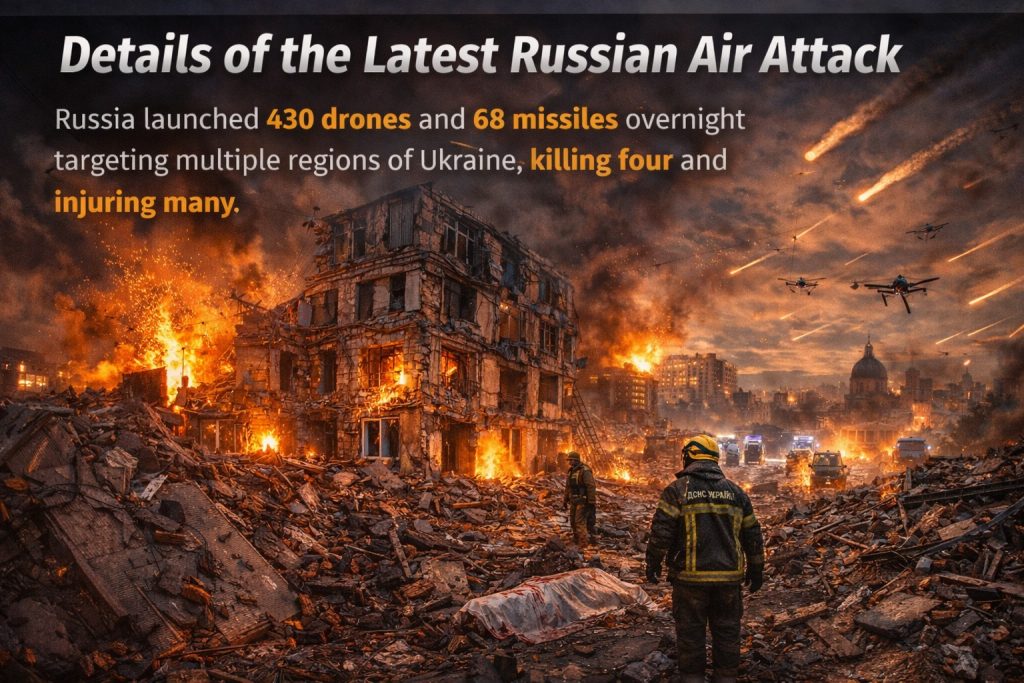
Most of the drones and missiles were intercepted by Ukrainian air-defense systems, but several managed to strike their intended targets. The attacks affected multiple regions including Kyiv, Sumy, Kharkiv, Dnipro, Mykolaiv, and Zaporizhzhia.
The Kyiv region was among the hardest hit. Officials reported that at least four people were killed and around fifteen others were injured during the strikes. Some of the injured were reported to be in serious condition and were taken to nearby hospitals for treatment.
Residential buildings were damaged, and several homes caught fire due to falling debris from intercepted missiles and drones. Emergency crews worked overnight to control the fires and search for survivors trapped in damaged structures.
Authorities also reported damage to schools, businesses, and critical infrastructure. The strikes caused power outages in multiple regions as energy facilities were targeted.
Impact on Civilians and Infrastructure
One of the most troubling aspects of the attack was the impact on civilian areas. Residential neighborhoods in the Kyiv region suffered heavy damage as missile fragments and drone debris fell onto homes and streets.
Local residents described scenes of chaos and fear as explosions were heard throughout the night. Many people rushed to underground shelters or basements while air raid sirens echoed across cities.
Emergency workers, firefighters, and medical teams were quickly deployed to affected areas. Rescue crews searched through rubble for survivors and assisted injured residents.
The Ukrainian Energy Ministry reported that electricity supply was disrupted in several regions after the strikes hit energy infrastructure. As a result, thousands of households experienced temporary power outages.
Damage to infrastructure also affected transportation networks and communication systems. Repair teams began working immediately to restore electricity and essential services.
Ukraine’s Air Defense Response
Ukraine’s air defense systems played a crucial role in limiting the damage caused by the attack. According to military officials, many of the incoming drones and missiles were successfully intercepted before they reached their targets.
Air defense units across the country were placed on high alert as the barrage approached. Systems such as missile interceptors and anti-aircraft guns were used to shoot down the incoming threats.
Despite these efforts, the sheer number of weapons launched during the attack made it impossible to intercept every missile and drone.
Ukrainian officials emphasized that the country urgently needs additional air-defense systems from international allies. As the war continues, the demand for defensive equipment has increased significantly.
President Volodymyr Zelenskyy has repeatedly urged Western partners to accelerate the production and delivery of advanced air-defense technology.
Regional and International Reactions
The attack triggered concern among neighboring countries and international organizations.
During the strikes, Poland scrambled fighter jets to protect its airspace as missiles and drones approached near its borders. However, no violations of Polish territory were reported.
In addition, Moldova reported that a Russian drone briefly entered its airspace during the attacks. Moldovan authorities condemned the incident and called it a threat to regional security.
International leaders expressed concern about the escalation and urged both sides to avoid actions that could further intensify the conflict.
Several Western governments reiterated their support for Ukraine and condemned attacks on civilian infrastructure.
Russia’s Strategy in the War
Military analysts believe that Russia’s recent strikes are part of a broader strategy aimed at weakening Ukraine’s energy infrastructure and military capabilities.
During winter months in particular, Russia has frequently targeted power plants, energy grids, and heating facilities. The objective is believed to be to disrupt daily life and place pressure on Ukraine’s government.
The use of large numbers of drones has become increasingly common in Russian operations. These drones are often deployed in waves to overwhelm air-defense systems.
Missiles are typically launched alongside drones to increase the chances that some weapons will penetrate defenses and reach their targets.
This combination of drones and missiles has become one of the defining features of the air war between Russia and Ukraine.
Ukraine’s Counterattacks
While Ukraine focuses heavily on defense, it has also carried out its own strikes on Russian infrastructure.
Ukrainian forces have launched drone attacks targeting Russian oil refineries, ports, and military facilities. These operations aim to disrupt Russia’s supply chains and reduce its ability to conduct military operations.
In some cases, Ukrainian drones have reached deep inside Russian territory, demonstrating the expanding capabilities of Ukraine’s military technology.
However, the conflict remains highly asymmetric in terms of resources and military capacity.
The Human Cost of the War
The Russia–Ukraine war has already resulted in tens of thousands of casualties and massive displacement of civilians.
Millions of Ukrainians have been forced to leave their homes, either relocating within the country or seeking refuge abroad.
Cities and towns across Ukraine have experienced repeated attacks since the beginning of the invasion.
For many civilians, life has become a constant cycle of air raid sirens, sheltering from attacks, and rebuilding damaged homes and communities.
The latest strike that killed four people is just one of many incidents that highlight the ongoing humanitarian crisis.
Previous Major Airstrikes in the War
The latest strike is not a single or isolated event. Since the war began, numerous large-scale airstrikes have caused significant casualties and destruction.
For example, in April 2025 a missile strike on the Ukrainian city of Sumy killed at least 35 people and injured more than 100 others.
Similarly, a Russian missile strike in Poltava in February 2025 destroyed part of a residential building and killed 15 civilians.
Another major attack occurred in November 2025 in the city of Ternopil, where missile strikes on apartment buildings killed dozens of people.
These incidents illustrate the devastating impact of aerial warfare on civilian populations during the conflict.
Global Political Implications
The ongoing war between Russia and Ukraine has significant global implications.
The conflict has affected energy markets, food supply chains, and international diplomacy. Ukraine is a major exporter of grain, and disruptions to its agricultural production have influenced food prices worldwide.
Additionally, Western sanctions imposed on Russia have reshaped global economic relations.
The war has also strengthened military cooperation among NATO members and prompted increased defense spending across Europe.
International diplomacy continues to seek a path toward peace, but negotiations have repeatedly stalled due to disagreements between the two sides.
Challenges to Peace Negotiations
Efforts to negotiate a ceasefire or peace agreement have faced numerous obstacles.
Both Russia and Ukraine maintain strong positions regarding territory and security guarantees.
Ukraine insists on restoring its territorial integrity, while Russia continues to hold occupied regions in eastern and southern Ukraine.
The complexity of the conflict, combined with geopolitical tensions between Russia and Western countries, makes a diplomatic resolution difficult.
Despite occasional talks and proposals, no comprehensive peace agreement has been reached so far.
Future Outlook
The recent air attack suggests that the war is likely to continue with high intensity in the near future.
Both sides are investing heavily in military technology, particularly drones, missile systems, and air defenses.
Experts believe that aerial warfare will remain a central feature of the conflict.
Ukraine continues to seek additional military support from its allies, while Russia maintains its strategy of targeting infrastructure and military positions.
Until a diplomatic solution emerges, civilians in Ukraine remain vulnerable to further attacks and humanitarian challenges.
Conclusion: Russian air attack on Ukraine
The Russian air attack that killed four people in Ukraine is another tragic reminder of the ongoing devastation caused by the war. The massive barrage of drones and missiles demonstrates the scale and intensity of modern warfare and the challenges faced by Ukraine’s air defenses.
While many of the weapons were intercepted, the attack still caused casualties, damaged homes, and disrupted essential infrastructure.
As the conflict continues, the humanitarian impact remains severe, with civilians bearing the brunt of the violence. International attention and diplomatic efforts remain crucial in seeking a path toward peace.
For now, however, the war between Russia and Ukraine shows little sign of ending, and the threat of further air attacks continues to loom over Ukrainian cities and communities.