
Unemployment problems in Bangladesh continue to rise in 2026. Read causes, economic effects, and smart solutions to reduce joblessness.
Introduction: Unemployment Problems In Bangladesh 2026
The unemployment problems in Bangladesh have become one of the most alarming socio-economic challenges in 2026. Despite steady GDP growth, rising infrastructure development, and digital expansion, millions of Bangladeshis—especially young people—continue to struggle to secure stable employment. This growing gap between economic growth and job creation is raising serious concerns about the country’s long-term stability and development.
With more than two million new job seekers entering the labor market every year, Bangladesh is facing a critical employment crisis. If not addressed urgently, unemployment could fuel poverty, social unrest, brain drain, and economic inequality.
Moreover, the mismatch between skills and job opportunities is widening, leaving graduates underemployed or in low-paying informal sectors. Rural-urban migration is intensifying competition in cities, further aggravating job scarcity. Without targeted policies, the unemployment crisis may hinder Bangladesh’s ambition to become a middle-income, knowledge-driven economy by 2030. This article explores the causes, economic effects, and smart solutions to reduce joblessness in Bangladesh in 2026 and beyond.

Current Unemployment Situation in Bangladesh (2026)
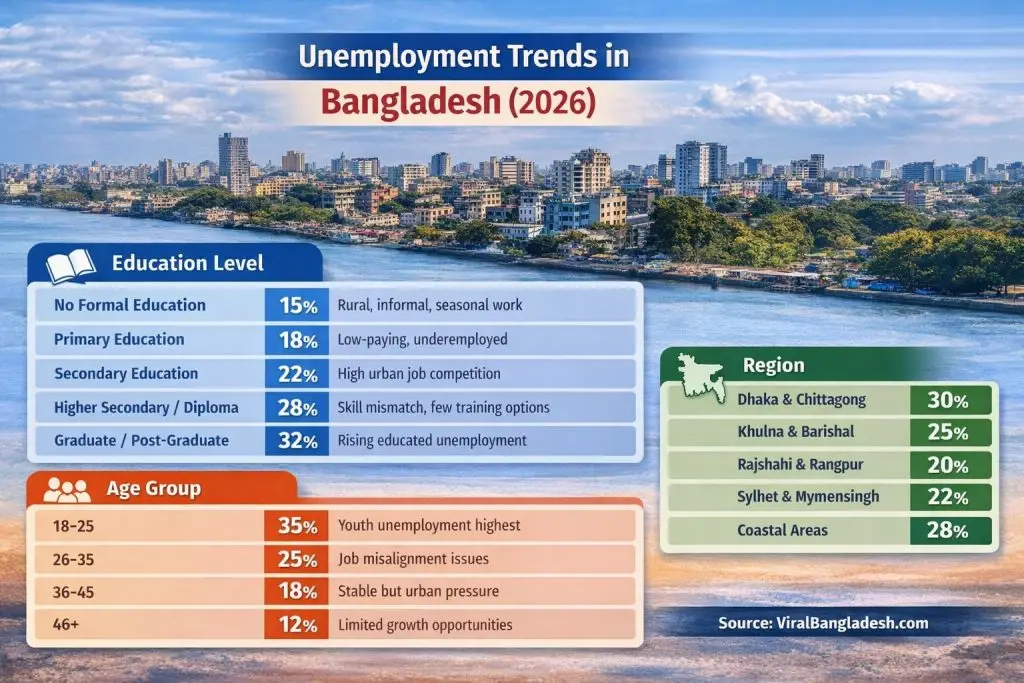
In 2026, unemployment problems in Bangladesh are intensifying across all education levels. Graduates, diploma holders, and even post-graduates are increasingly unemployed or underemployed. Many young professionals settle for low-paying or informal jobs that fail to match their skills, increasing frustration and social tension.
Urban areas like Dhaka, Chittagong, and Khulna face severe job pressure due to rural-to-urban migration, while rural districts struggle with seasonal unemployment and limited opportunities. Youth unemployment remains the highest among all age groups, highlighting structural gaps in the labor market.
Key causes include outdated education systems, insufficient vocational training, slow industrial growth, and a mismatch between skills and market demands. Informal work dominates, creating job insecurity and low wages.
Addressing these issues requires smart, long-term solutions. Skill development programs, entrepreneurship support, digital economy opportunities, and rural employment initiatives can reduce unemployment. Aligning higher education with labor market needs and promoting industrial expansion will help absorb educated youth.
By implementing these strategies, Bangladesh can mitigate the unemployment problems in Bangladesh, empower its youth, and drive sustainable economic growth in 2026 and beyond.
Key Highlights:
- Educated unemployment is rising faster than unskilled unemployment
- Informal and low-paying jobs dominate the labor market
- Rural-urban migration continues to increase job pressure in cities
- The unemployment problems in Bangladesh now reflect structural weaknesses in education, policy planning, and labor market alignment
- Lack of vocational and technical training limits employability in emerging sectors like IT, manufacturing, and services
- Gender disparity in employment remains high, with women facing limited opportunities
- Automation and technological shifts are replacing traditional jobs, creating new skill gaps
- Regional imbalances mean some districts experience severe unemployment while others remain underdeveloped
- Economic shocks, inflation, and limited industrial expansion exacerbate the job crisis, making long-term employment planning critical
The unemployment problems in Bangladesh now reflect structural weaknesses in education, policy planning, and labor market alignment.
Major Causes of Unemployment Problems in Bangladesh
Unemployment problems in Bangladesh are rising sharply in 2026 due to multiple economic and structural factors. Key causes include a mismatch between education and job market needs, limited vocational training, rapid population growth, and rural-urban migration increasing competition for jobs. Industrial and private sector expansion has not kept pace with the growing workforce, while technological disruption is replacing traditional roles. Seasonal and informal employment dominate rural areas, leaving many underemployed. Addressing these root causes through skill development, education reform, entrepreneurship promotion, and targeted government policies is essential to reduce unemployment and boost economic stability.
Moreover, fostering innovation and digital literacy can prepare the workforce for emerging industries like IT, fintech, and renewable energy. Encouraging small and medium enterprises (SMEs) and providing access to microfinance will generate local job opportunities. Collaborative efforts between government, private sector, and NGOs are crucial to create a resilient labor market and ensure sustainable employment for the nation’s growing youth population.
1. Rapid Population Growth
Bangladesh’s population growth continues to put enormous pressure on the job market. Each year, millions of young people reach working age, but job creation does not keep pace with demand.
- High population density limits employment expansion
- Competition for limited jobs increases
- Wage levels remain low due to labor oversupply
2. Education–Employment Mismatch
One of the most critical causes of unemployment problems in Bangladesh is the mismatch between education and job market needs.
- The education system focuses more on theory than skills
- Graduates lack practical and technical competencies
- Employers struggle to find job-ready candidates
As a result, many educated youths remain unemployed despite years of academic qualifications.
3. Limited Industrial Diversification
Bangladesh’s economy heavily depends on:
- Ready-Made Garments (RMG)
- Agriculture
- Informal services
This lack of diversification restricts job opportunities in emerging sectors such as technology, renewable energy, and advanced manufacturing.
4. Weak Private Sector Job Creation
Private sector growth has not translated into sufficient employment due to:
- High operational costs
- Policy uncertainty
- Limited access to finance for small businesses
Small and medium enterprises (SMEs), which are key job creators, face regulatory and financial barriers.
5. Automation and Technological Disruption
While technology boosts productivity, it also reduces demand for low-skilled labor.
- Automation replaces manual jobs
- Digital transformation leaves unskilled workers behind
- Lack of reskilling programs worsens unemployment
6. Rural Employment Decline
Agricultural mechanization and climate change have reduced rural employment.
- Seasonal jobs are disappearing
- Climate disasters disrupt livelihoods
- Migration to cities increases urban unemployment

Economic Effects of Unemployment Problems In Bangladesh
The unemployment problems in Bangladesh have far-reaching economic consequences that affect individuals, families, and the national economy. Rising joblessness leads to reduced household incomes, limiting access to healthcare, education, and basic necessities. It also hampers consumer spending, slowing domestic economic growth. For the nation, high unemployment increases dependency on social welfare programs, strains government budgets, and discourages foreign and domestic investment. Without urgent interventions, these economic challenges can exacerbate poverty, inequality, and social instability, making long-term development goals harder to achieve.
Additionally, persistent unemployment reduces workforce productivity and discourages innovation, weakening Bangladesh’s competitiveness in the global market. Youth frustration over limited job opportunities may lead to social unrest and increased migration, draining the country of valuable talent. Addressing unemployment through skill development, entrepreneurship, and strategic economic planning is therefore critical to ensuring inclusive growth, sustainable development, and long-term national stability.
1. Increased Poverty and Inequality
Unemployment directly reduces household income, pushing families into poverty and widening income inequality.
- Rising cost of living worsens hardship
- Middle-class households face downward mobility
- Informal debt increases
2. Reduced Economic Productivity
A large unemployed workforce means:
- Wasted human capital
- Lower national productivity
- Slower economic growth
Educated but unemployed youth represent lost economic potential.
3. Pressure on Government Resources
Unemployment increases demand for:
- Social safety net programs
- Subsidies and welfare assistance
- Public sector jobs
This strains government budgets and limits development spending.
4. Youth Frustration and Social Instability
Long-term unemployment among youth can lead to:
- Mental health issues
- Social unrest
- Increased crime and substance abuse
The job crisis poses risks to social harmony and national security.
5. Brain Drain and Migration
Skilled workers increasingly seek opportunities abroad due to:
- Limited local jobs
- Low wages
- Lack of career growth
This brain drain weakens Bangladesh’s future workforce.
Smart Solutions to Reduce Joblessness in Bangladesh
Addressing the unemployment problems in Bangladesh requires coordinated, long-term, and smart strategies. Investing in skill development programs tailored to industry needs can equip the youth with employable skills. Promoting entrepreneurship and small business startups will create new job opportunities across urban and rural areas. Strengthening public-private partnerships can help match workforce supply with demand, while digital platforms can facilitate remote work and gig economy growth. Additionally, reforming labor policies and improving vocational training infrastructure will ensure sustainable employment for future generations.
Furthermore, encouraging innovation hubs, technology-driven industries, and green jobs can open new sectors for employment. Focused government incentives, mentorship programs, and access to microfinance will empower youth to create and sustain their own ventures. By integrating education, policy, and industry collaboration, Bangladesh can transform its employment landscape, reduce joblessness, and harness the full potential of its young workforce for national growth.
1. Skill-Based Education Reform
- Introduce industry-aligned curricula
- Expand vocational and technical training
- Strengthen university–industry partnerships
Skill-focused education can transform graduates into employable professionals.
2. Promoting SMEs and Entrepreneurship
- Provide low-interest loans for startups
- Simplify business registration processes
- Offer tax incentives to job-creating businesses
Entrepreneurship can absorb large numbers of unemployed youth.
3. Expanding Digital and Freelance Economy
Bangladesh has strong potential in:
- Freelancing
- Outsourcing
- IT services
- Remote work
Government-supported digital training programs can create global job access.
4. Industrial Diversification and Innovation
- Invest in renewable energy, agro-processing, and ICT
- Develop economic zones beyond RMG
- Encourage foreign direct investment (FDI)
Diversification reduces dependency on limited sectors.
5. Strengthening Rural Employment
- Promote agro-based industries
- Support climate-resilient farming
- Develop rural infrastructure and services
This can reduce urban migration pressure.
6. Active Labor Market Policies
- Job placement services
- Internship and apprenticeship programs
- Public-private employment initiatives
Such policies help bridge job seekers and employers.
7. Women’s Workforce Participation
Increasing female employment can:
- Boost household income
- Reduce poverty
- Strengthen economic growth
Flexible work policies and safe workplaces are essential.
Role of Government and Policy Makers in Bangladesh 2026
The role of government and policy makers in Bangladesh is more critical than ever in 2026. With rapid economic growth, a young population, and emerging challenges such as unemployment, climate change, and technological disruption, effective governance is essential for sustainable national development. The decisions made today will shape Bangladesh’s future across social, economic, and political spheres.
Government authorities and policy makers are responsible for creating an environment that ensures stability, promotes innovation, and safeguards citizens’ welfare. From legislation to infrastructure development and social programs, their influence directly impacts the lives of millions. Strong policies and proactive implementation can accelerate economic growth, reduce inequality, and empower marginalized communities, especially youth and women.
Key Roles of Government and Policy Makers
- Policy Formulation and Implementation
- Designing laws and regulations that support economic growth, education, employment, and healthcare.
- Ensuring transparent and timely execution of government programs.
- Economic Planning and Job Creation
- Promoting investment, entrepreneurship, and small and medium-sized enterprises (SMEs).
- Encouraging skill development and vocational training programs to reduce unemployment.
- Social Welfare and Inclusivity
- Implementing programs for vulnerable communities, rural development, and gender equality.
- Strengthening disaster preparedness and climate adaptation policies.
- Digital Governance and Innovation
- Promoting e-governance and digital infrastructure for transparent, efficient public services.
- Encouraging youth participation in decision-making through technology-driven platforms.
- Regulation and Oversight
- Monitoring compliance with laws and policies.
- Ensuring anti-corruption measures and accountability in public institutions.
- Global Collaboration
- Engaging with international organizations and governments to adopt global best practices.
- Leveraging foreign investment and sustainable development frameworks.
In 2026, the government and policy makers in Bangladesh play a pivotal role in shaping a prosperous and resilient nation. Their vision, strategies, and execution determine whether challenges like unemployment, climate vulnerability, and social inequality are mitigated or exacerbated. Active, innovative, and inclusive policy-making ensures long-term national growth, social equity, and a brighter future for all citizens.
Future Outlook: Bangladesh Beyond 2026
If smart reforms are implemented, Bangladesh can transform its large population into a powerful demographic dividend, driving economic growth, innovation, and global competitiveness. Strategic investments in education, vocational training, and digital skills will be critical to prepare youth and professionals for the jobs of the future.
However, failure to tackle the rising unemployment problems in Bangladesh may result in prolonged economic stagnation, social unrest, and widened inequality. Urban centers may experience higher competition for jobs, while rural regions could face increased migration pressures.
The next decade will determine whether Bangladesh evolves into a high-employment, knowledge-driven economy or struggles with persistent job instability. Policies supporting entrepreneurship, small business development, and public-private collaboration will be vital. Additionally, leveraging technology, green industries, and sustainable development sectors can create thousands of new jobs for youth and women, promoting inclusive growth.
Summary Table: Future Outlook of Unemployment in Bangladesh (2026 and Beyond)
| Focus Area | Expected Outcome | Key Strategies | Potential Risks |
|---|---|---|---|
| Demographic Dividend | High productivity, youth-led growth | Skill development, vocational training, education reform | If ignored, youth unemployment increases |
| Urban Employment | More job opportunities, innovation hubs | Smart city projects, startups, digital economy | High competition, migration pressure |
| Rural Employment | Balanced regional development | Agriculture modernization, local industry, infrastructure | Seasonal unemployment, migration to cities |
| Entrepreneurship & SMEs | Economic diversification, innovation | Incentives, startup funding, mentorship | Limited access to finance, regulatory barriers |
| Technology & Green Jobs | Sustainable economic growth | Digital economy, renewable energy, AI & IT sectors | Skills mismatch, slow adoption |
| Social Stability | Inclusive growth, reduced inequality | Gender equality, youth empowerment programs | Social unrest if jobs are scarce |
FAQs: Unemployment Problems in Bangladesh (2026)
Q1: What are the main unemployment problems in Bangladesh in 2026?
The main unemployment problems in Bangladesh include rising youth unemployment, lack of job-ready skills, education–employment mismatch, limited industrial diversification, and slow private-sector job creation. Automation and population growth have further intensified the crisis.
Q2: Why is youth unemployment so high in Bangladesh?
Youth unemployment is high because many graduates lack practical skills, internships, and industry exposure. The job market cannot absorb the growing number of educated job seekers, leading to frustration and underemployment.
Q3: How does unemployment affect Bangladesh’s economy?
Unemployment reduces household income, increases poverty, slows economic growth, and puts pressure on government welfare programs. It also contributes to brain drain, social instability, and reduced productivity.
Q4: Which sectors can create jobs in Bangladesh?
High-potential job-creating sectors include:
- Information technology and freelancing
- Small and medium enterprises (SMEs)
- Agro-processing industries
- Renewable energy
- Healthcare and skill-based services
Q5: What role can education reform play in reducing unemployment?
Skill-based education, vocational training, and industry-aligned curricula can significantly reduce unemployment by preparing students for real-world job demands instead of theoretical learning alone.
Q6: Can freelancing and digital jobs reduce unemployment in Bangladesh?
Yes. Freelancing, outsourcing, and remote work offer global income opportunities for Bangladeshi youth. With proper digital skills training and internet access, this sector can absorb thousands of job seekers.
Q7: What steps should the government take to reduce unemployment?
The government should focus on:
- Job-focused economic policies
- SME and startup support
- Skill development programs
- Industrial diversification
- Strong public–private partnerships
Q8: Is unemployment a long-term threat for Bangladesh?
If left unresolved, unemployment could become a long-term threat by increasing poverty, social unrest, and migration. However, with smart reforms, Bangladesh can turn its population into a strong economic asset.
Conclusion
The unemployment problems in Bangladesh in 2026 represent a serious national challenge with economic, social, and political implications. Rising joblessness—especially among youth and educated citizens—threatens sustainable development and social stability.
By reforming education, expanding skill development, supporting entrepreneurship, and diversifying the economy, Bangladesh can reduce joblessness and unlock its full potential. Immediate, coordinated, and people-focused action is essential to ensure a productive workforce and a resilient economy.
Investing in digital skills, vocational training, and technology-driven industries can create new employment opportunities and address the evolving labor market demands. Strengthening public-private partnerships and encouraging youth-led startups will also play a crucial role in reducing unemployment.
Solving unemployment is not just an economic necessity—it is the foundation of Bangladesh’s future progress, social well-being, and global competitiveness. Ensuring equitable access to jobs and empowering all segments of society will help Bangladesh achieve inclusive growth and long-term prosperity.