
Visa validity extended for Bangladeshi migrant workers amid the Iran-Israel war. Discover 5 relief steps, government support, and travel updates for expats.
Introduction
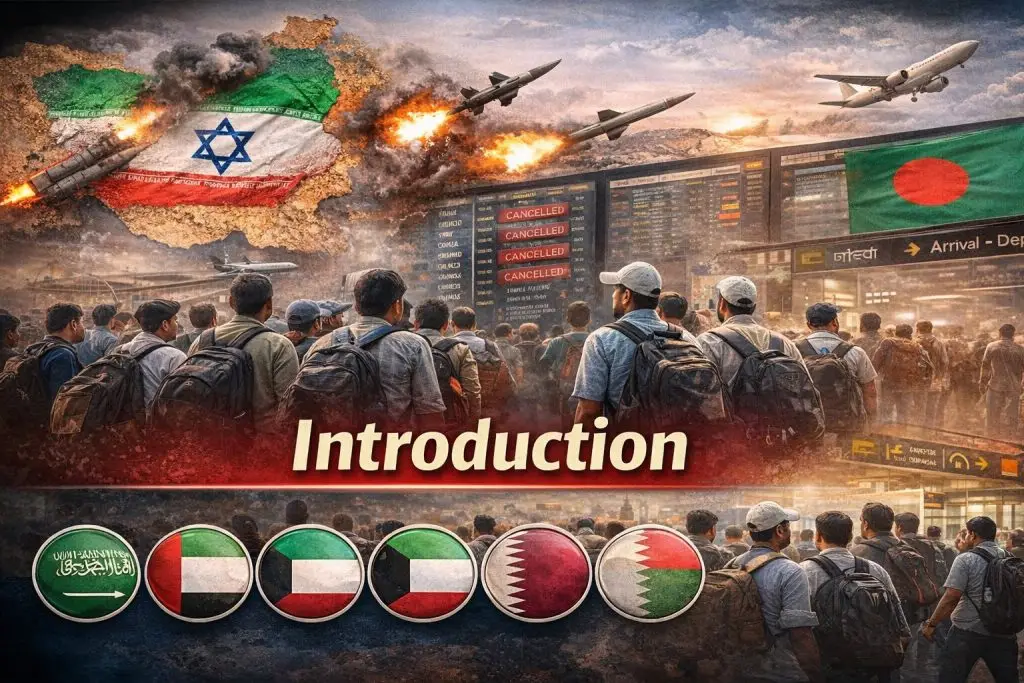
The ongoing military confrontation between Iran and Israel has created widespread geopolitical and economic uncertainty across the Middle East. One of the immediate consequences of this crisis has been the disruption of international flights, regional labour markets, and migration systems that millions of expatriate workers depend on. Among those significantly affected are Bangladeshi migrant workers who work in Gulf countries such as Saudi Arabia, the United Arab Emirates (UAE), Kuwait, Qatar, Oman, and Bahrain.
Bangladesh is one of the world’s largest labour-sending countries, with millions of citizens working overseas, particularly in the Middle East. These workers are crucial not only to their families but also to the national economy through remittances. However, the escalation of the Iran–Israel conflict has temporarily disrupted travel routes, suspended flights, and created administrative challenges related to visa renewals.
In response to the crisis, the government of Bangladesh and several Middle Eastern countries have taken emergency steps to extend the validity of visas for Bangladeshi migrant workers who are currently stranded in Bangladesh or unable to travel due to the war situation. This move aims to protect the employment status of thousands of workers whose visas were nearing expiration during the conflict.
This article provides a detailed overview of the visa extension decision, the circumstances that led to it, and the broader implications for migrant workers and the Bangladeshi economy.
Background: Iran–Israel War and Regional Instability
The conflict between Iran and Israel escalated dramatically after large-scale military strikes and retaliatory attacks across the Middle East. The war disrupted several strategic areas, including airspace and shipping routes in the Persian Gulf.
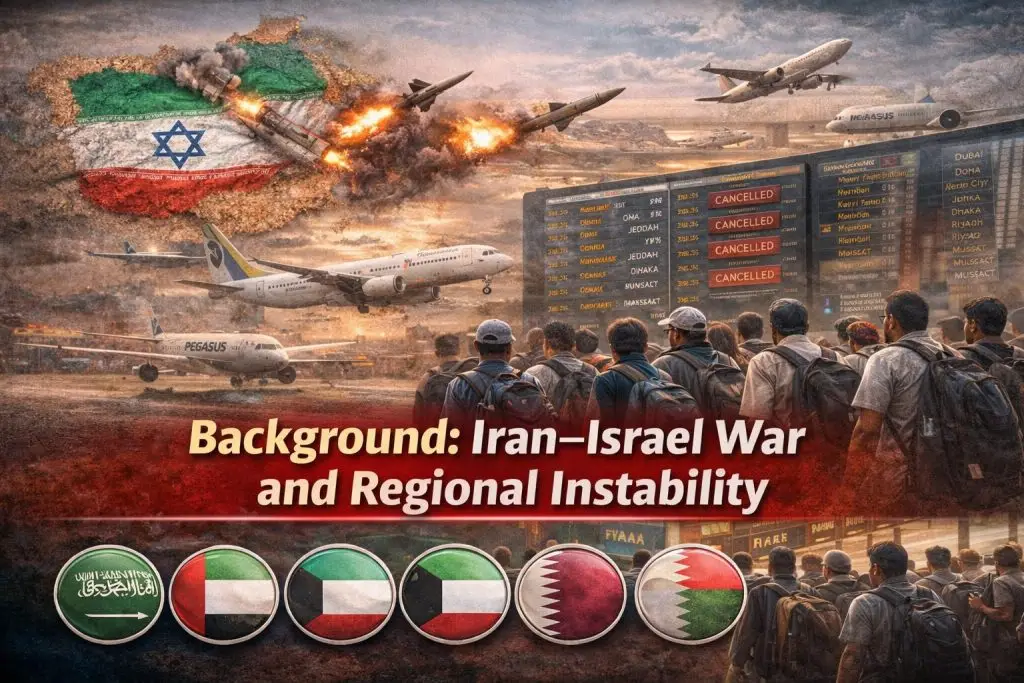
As tensions intensified, several countries temporarily closed parts of their airspace, leading to the cancellation or delay of many international flights. This directly affected migrant workers traveling between Bangladesh and Middle Eastern countries.
Flight cancellations and travel restrictions created a situation where thousands of Bangladeshi workers who had returned home on leave could not travel back to their workplaces. According to reports, hundreds of flights between Bangladesh and Gulf countries were cancelled within a few days after the escalation began.
The disruption left many workers worried that their visas might expire before they could return to their jobs.
Bangladesh’s Dependence on Overseas Employment
Overseas employment plays a critical role in Bangladesh’s economy and labour market. According to migration statistics, Bangladesh has more than 11 million migrants working around the world, making it one of the largest migrant-sending nations globally.
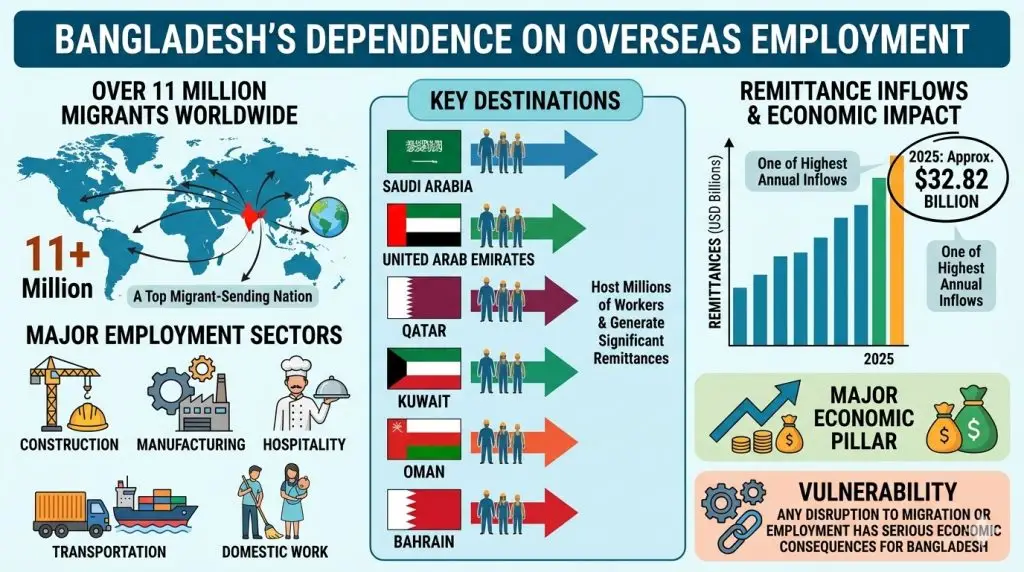
The majority of these migrants work in Middle Eastern countries, where they are employed in construction, manufacturing, hospitality, transportation, and domestic work.
Key destinations for Bangladeshi migrant workers include:
- Saudi Arabia
- United Arab Emirates
- Qatar
- Kuwait
- Oman
- Bahrain
These countries collectively host millions of Bangladeshi workers and generate a significant share of the country’s remittance income.
Remittances from migrant workers are a major pillar of Bangladesh’s economy. In 2025 alone, Bangladesh received approximately $32.82 billion in remittances, marking one of the highest annual inflows in the country’s history.
Therefore, any disruption to labour migration or migrant employment can have serious economic consequences for Bangladesh.
Migrant Workers Stranded Due to Travel Disruptions
The Iran–Israel war caused significant disruptions to regional travel networks. Many airlines suspended or cancelled flights due to security concerns, airspace closures, and rising geopolitical risks.

As a result, thousands of Bangladeshi migrant workers who had traveled home for vacation or family visits were unable to return to their workplaces.
According to reports, more than 16,000 migrant workers became stranded in Bangladesh after flights to Middle Eastern countries were suspended or delayed.
For these workers, the situation quickly became alarming.
Most migrant workers operate under fixed employment contracts and visa arrangements tied to their employers. If a worker fails to return before their visa expires, they risk losing their job or facing complications when trying to re-enter the host country.
The sudden travel disruption therefore created a risk that thousands of workers might lose their employment simply because they could not travel in time.
Government Response: Visa Validity Extension
Recognizing the seriousness of the situation, the Ministry of Expatriates’ Welfare and Overseas Employment in Bangladesh issued a notice addressing the visa problem faced by migrant workers.
The ministry stated that many workers currently in Bangladesh have visas that have either expired or are about to expire but cannot travel back due to the ongoing war and flight disruptions.
To resolve this issue, the ministry asked workers to communicate with their employers or sponsors abroad so that visa renewal applications could be submitted online.
At the same time, Bangladesh’s foreign missions and labour wings in Gulf countries began coordinating with local authorities to facilitate visa extensions.
Gulf Countries Extend Visa Validity
Several Middle Eastern governments responded positively to the situation by granting temporary visa extensions for migrant workers affected by the conflict.
Countries such as:
- Kuwait
- Qatar
- United Arab Emirates
have already announced one-month extensions for entry visas that were about to expire.
These extensions were designed to ensure that workers would not lose their jobs or face immigration penalties due to circumstances beyond their control.
In many cases, the extension process was carried out automatically through electronic systems, reducing the need for workers to visit immigration offices or pay additional fees.
Role of Employers and Sponsors
Many migrant workers in Gulf countries operate under the Kafala sponsorship system, where their legal residency status is linked to their employer.
Under this system:
- Employers act as sponsors for workers’ visas.
- Workers typically require employer approval for visa renewals or transfers.
- The sponsor manages the worker’s immigration status in the host country.
Because of this system, workers affected by visa expiration must usually coordinate with their employer or sponsor to process renewal or extension requests.
The Bangladesh government therefore advised workers to stay in contact with their employers to ensure that visa extension applications are submitted promptly.
Diplomatic Efforts by Bangladesh
The Bangladesh government has also taken diplomatic initiatives to protect migrant workers during the conflict.
Authorities from the Ministry of Expatriates’ Welfare and Overseas Employment requested the Ministry of Foreign Affairs to coordinate with Gulf countries to extend visas for affected workers.
Bangladesh embassies in the Middle East have been instructed to:
- Maintain communication with host governments
- Assist migrant workers with documentation issues
- Ensure workers do not lose their jobs due to visa expiration
The government has emphasized that protecting migrant workers abroad remains a national priority.
Safety Concerns for Bangladeshi Migrants
Beyond visa issues, the Iran–Israel conflict has raised serious concerns about the safety of Bangladeshi migrants living in the Middle East.
Reports indicate that several Bangladeshis have been injured or killed in the conflict-affected areas, highlighting the risks faced by migrant communities.
Bangladesh’s leadership has instructed officials to closely monitor the situation and ensure the safety of expatriates living in the region.
The government is also maintaining communication with embassies and international partners to respond quickly if the situation deteriorates.
Economic Risks for Bangladesh
The conflict has broader economic implications for Bangladesh beyond individual workers.
An extended conflict in the Middle East could significantly impact:
1. Labour Migration
If instability continues, overseas job opportunities in Gulf countries may decline.
2. Remittance Inflows
Lower employment opportunities or wage disruptions could reduce remittance inflows to Bangladesh.
3. Oil Prices
The Middle East is a key global energy supplier. Rising oil prices could increase Bangladesh’s import costs.
Experts warn that if the conflict continues for an extended period, Bangladesh’s labour market and foreign currency reserves may face pressure.
Impact on Migrant Workers’ Families
The consequences of migration disruptions are not limited to workers alone. Millions of families in Bangladesh depend on remittances sent by relatives working abroad.
When workers cannot travel, work, or receive salaries, the financial stability of their families may be affected.
In many rural districts of Bangladesh, remittances fund:
- Household expenses
- Education
- Healthcare
- Small business investments
Therefore, the government’s decision to secure visa extensions is crucial not only for workers but also for their families back home.
Workers’ Concerns and Uncertainty
Many migrant workers remain anxious about their future despite the visa extensions.
Some of their concerns include:
- Uncertainty about when flights will resume
- Fear of losing jobs if companies close operations
- Delayed salary payments
- Safety concerns in conflict zones
Workers in sectors such as construction and small businesses are particularly vulnerable because their employment contracts are often short-term.
Possible Long-Term Policy Responses
The Iran–Israel conflict has highlighted the risks of Bangladesh’s heavy reliance on Middle Eastern labour markets.
Experts have suggested several long-term strategies:
Diversifying Overseas Job Markets
Bangladesh could expand labour migration to new destinations such as:
- Japan
- South Korea
- European countries
- Southeast Asia
Improving Worker Protection
Stronger legal protections and diplomatic agreements could help ensure the safety and rights of migrant workers.
Enhancing Skill Development
Training workers in higher-skill professions could help them access better job opportunities globally.
Conclusion: Visa validity extended
The extension of visa validity for Bangladeshi migrant workers amid the Iran–Israel war represents a crucial step in protecting the livelihoods of thousands of expatriates affected by the conflict.
The war has disrupted travel routes, created uncertainty in labour markets, and placed thousands of workers at risk of losing their employment due to expiring visas. By coordinating with Gulf countries and facilitating visa extensions, the Bangladesh government has helped ensure that migrant workers do not suffer unnecessary economic losses during this crisis.
However, the situation also highlights the broader vulnerabilities of Bangladesh’s migration-dependent economy. A prolonged conflict in the Middle East could disrupt labour markets, reduce remittances, and create economic uncertainty for millions of families.
For now, the visa extension offers temporary relief to migrant workers stranded by the conflict. But the evolving geopolitical situation will continue to require careful diplomatic engagement, proactive policy planning, and long-term strategies to protect the interests of Bangladesh’s migrant workforce.