
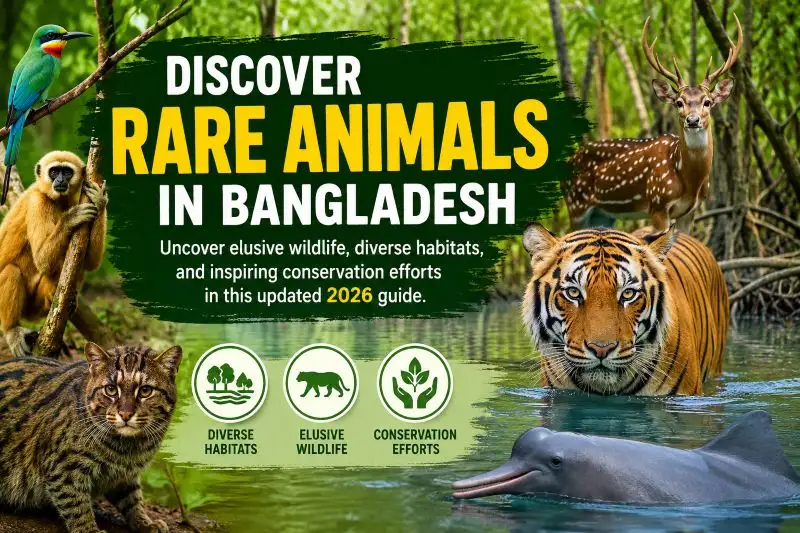
Discover Rare Animals in Bangladesh, uncover elusive wildlife, diverse habitats, and inspiring conservation efforts in this updated 2026 guide.
Introduction
Bangladesh is celebrated for its lush forests, winding rivers, vast wetlands, and the world-famous Sundarbans mangrove ecosystem. While many travelers know the country for its scenic beauty and rich cultural heritage, it is also home to an extraordinary collection of wildlife. Among its greatest natural treasures are the Rare Animals in Bangladesh, many of which are found only in specific habitats and face growing threats from habitat loss, climate change, and illegal hunting.

From the majestic Royal Bengal Tiger roaming the Sundarbans to the playful Ganges River Dolphin gliding through freshwater rivers, Bangladesh supports an impressive variety of mammals, birds, reptiles, and aquatic species. These remarkable animals are not only symbols of the country’s biodiversity but also essential to maintaining healthy ecosystems.
As forests shrink and wetlands disappear, protecting these unique creatures has become more important than ever. Government agencies, conservation organizations, and local communities are working together to safeguard endangered wildlife for future generations. Their efforts are helping preserve Bangladesh’s natural heritage while promoting eco-tourism and environmental awareness.
In this comprehensive guide, you’ll discover the history of wildlife conservation in Bangladesh, learn why the country is rich in biodiversity, and explore ten of the most fascinating rare animals that make Bangladesh one of South Asia’s most important wildlife destinations.
History of Rare Animals in Bangladesh
The story of wildlife in Bangladesh stretches back thousands of years. Long before modern cities and farmland expanded across the landscape, dense tropical forests, freshwater rivers, floodplains, and coastal mangroves provided ideal habitats for countless animal species.
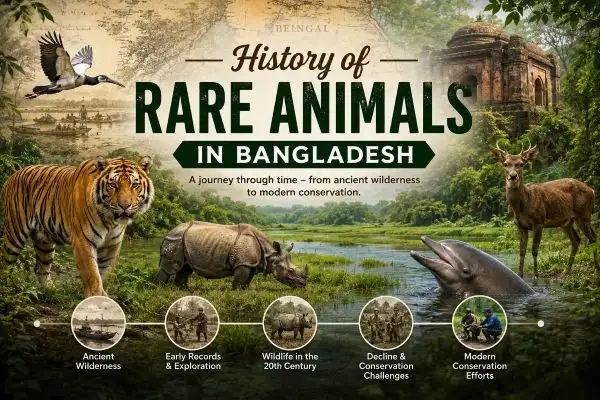
Historical records and local folklore describe elephants wandering through hill forests, tigers ruling dense jungles, rhinoceroses grazing wetlands, and dolphins thriving in mighty rivers. These animals played an important role in local traditions and the ecological balance of the region.
During the nineteenth and early twentieth centuries, rapid population growth, commercial logging, agricultural expansion, and excessive hunting dramatically reduced wildlife populations. Several species disappeared from Bangladesh, while many others became endangered.
Recognizing the importance of protecting its biodiversity, Bangladesh began strengthening wildlife conservation after independence. Protected areas such as national parks, wildlife sanctuaries, and ecological reserves were established to conserve natural habitats. Today, the country has dozens of protected areas that shelter many of its rarest species.
Modern conservation programs also focus on restoring habitats, reducing human-wildlife conflict, preventing wildlife trafficking, and educating communities about the value of biodiversity. These initiatives are helping stabilize populations of several threatened species, although many continue to require long-term protection.
Why Bangladesh Is Home to So Many Rare Animals
Although Bangladesh is relatively small in land area, it is one of South Asia’s richest countries in terms of biodiversity. Its diverse ecosystems—including the Sundarbans mangrove forest, tropical evergreen forests, rivers, wetlands, grasslands, and coastal regions—provide ideal habitats for many Rare Animals in Bangladesh.

The country’s warm tropical climate, abundant rainfall, and extensive river network support a wide variety of mammals, birds, reptiles, amphibians, and aquatic species. Many endangered animals depend on these unique environments for food, shelter, and breeding.
This exceptional natural diversity makes Bangladesh an important center for wildlife conservation and highlights the need to protect its valuable ecosystems for future generations.
Several natural features contribute to this rich biodiversity:
- The Sundarbans Mangrove Forest provides a unique habitat for the Royal Bengal Tiger, fishing cats, estuarine crocodiles, spotted deer, and countless bird species.
- Evergreen hill forests in Sylhet and Chattogram support rare primates, clouded leopards, hornbills, and colorful reptiles.
- Large river systems, including the Padma, Jamuna, and Meghna, offer vital habitats for freshwater dolphins, turtles, and fish.
- Wetlands and haors attract thousands of migratory birds while supporting many native species.
- Coastal islands and mudflats provide nesting grounds for endangered sea turtles and numerous shorebirds.
This remarkable combination of forests, rivers, wetlands, grasslands, and coastal ecosystems makes Bangladesh one of South Asia’s most biologically diverse countries.
However, increasing urbanization, pollution, deforestation, and climate change continue to threaten many of these fragile habitats. Protecting them is essential not only for wildlife but also for maintaining healthy ecosystems that support millions of people.
1. Royal Bengal Tiger (Panthera tigris tigris)
The Royal Bengal Tiger (Panthera tigris tigris) is the most famous of all Rare Animals in Bangladesh and proudly represents the nation’s rich wildlife heritage as its national animal. It lives primarily in the Sundarbans, the world’s largest mangrove forest, where it has uniquely adapted to tidal rivers, muddy landscapes, and dense coastal vegetation.
Unlike most tiger populations, Sundarbans tigers are exceptional swimmers, often crossing wide rivers in search of prey such as spotted deer, wild boar, and monkeys. As a top predator, the Royal Bengal Tiger plays a vital role in maintaining ecological balance by regulating prey populations and supporting a healthy ecosystem.
However, habitat degradation, climate change, rising sea levels, human-wildlife conflict, and illegal poaching continue to threaten its survival. Bangladesh has strengthened wildlife conservation through anti-poaching patrols, habitat restoration, scientific monitoring, and community-based awareness programs.
Protecting this magnificent big cat is essential for preserving the Sundarbans’ unique biodiversity and ensuring future generations can continue to admire one of the world’s most extraordinary wild animals.
Interesting Fact: Sundarbans tigers are among the few wild tigers known to swim long distances across rivers and tidal channels.
2. Asian Elephant (Elephas maximus)
The Asian Elephant (Elephas maximus) is one of the most iconic Rare Animals in Bangladesh and the largest land mammal found in the country. Small wild herds inhabit the forests of Chattogram, Cox’s Bazar, and the Chattogram Hill Tracts, where they play a vital role in maintaining healthy forest ecosystems by dispersing seeds and creating natural pathways.
These highly intelligent animals live in close family groups led by a female matriarch and communicate through low-frequency sounds and subtle ground vibrations. However, habitat loss, deforestation, and increasing human-elephant conflict threaten their survival.
Conservation initiatives focus on protecting forest corridors, restoring habitats, and promoting peaceful coexistence between local communities and these magnificent endangered animals.
Interesting Fact: An adult Asian Elephant can consume over 150 kilograms of vegetation every day, helping maintain healthy forest ecosystems by dispersing seeds.
3. Western Hoolock Gibbon (Hoolock hoolock)
The Western Hoolock Gibbon (Hoolock hoolock) is one of the most extraordinary Rare Animals in Bangladesh and the country’s only native ape. This endangered primate is mainly found in the evergreen and semi-evergreen forests of Lawachara National Park, Satchari National Park, and a few other protected areas in northeastern Bangladesh.
Unlike monkeys, gibbons do not have tails. Their exceptionally long, powerful arms enable them to move swiftly through the forest canopy using brachiation, a graceful swinging technique that allows them to travel without touching the ground. Western Hoolock Gibbons live in small family groups and communicate through loud, melodic calls that strengthen social bonds and mark their territory.
They feed primarily on fruits, leaves, flowers, and insects, making them important seed dispersers that support forest regeneration. However, deforestation, habitat fragmentation, and illegal wildlife trade continue to threaten their survival.
Ongoing conservation efforts focus on protecting forest habitats, restoring damaged ecosystems, and raising public awareness to ensure this remarkable ape remains an important part of Bangladesh’s rich biodiversity for generations to come.
Interesting Fact: Western Hoolock Gibbons can travel through the treetops at speeds of up to 50 kilometers per hour without touching the ground.
4. Fishing Cat (Prionailurus viverrinus)
The Fishing Cat (Prionailurus viverrinus) is one of the most remarkable Rare Animals in Bangladesh, thriving in wetlands, mangrove forests, rivers, and floodplains, particularly in the Sundarbans. Unlike most wild cats, it is an excellent swimmer thanks to its partially webbed feet and dense, water-resistant fur.
This agile predator hunts fish, frogs, crabs, and small aquatic animals with impressive precision, making it vital for maintaining healthy wetland ecosystems.
Sadly, habitat destruction, water pollution, illegal trapping, and shrinking wetlands threaten its survival. Conservation programs in Bangladesh are restoring wetland habitats, strengthening wildlife protection, and encouraging local communities to help safeguard this extraordinary and endangered feline for future generations.
Interesting Fact: The Fishing Cat often gently taps the water’s surface with its paws to lure fish within striking distance before making a swift catch.
5. Ganges River Dolphin (Platanista gangetica)
The Ganges River Dolphin is one of the most extraordinary freshwater mammals found in Bangladesh. It inhabits major river systems, including the Padma, Jamuna, Meghna, and Karnaphuli rivers.
Because the waters are often muddy, these dolphins rely less on eyesight and more on an advanced sonar system called echolocation. By producing sound waves and listening to returning echoes, they can locate fish and navigate even in low visibility.
The species faces increasing threats from water pollution, accidental capture in fishing nets, reduced river flow, and habitat degradation. Conservation initiatives now focus on improving river health, reducing bycatch, and promoting sustainable fishing practices.
Interesting Fact: The Ganges River Dolphin is often called the “blind dolphin,” yet it navigates expertly using echolocation instead of vision.
6. Clouded Leopard (Neofelis nebulosa)
The Clouded Leopard is one of the most mysterious and elusive wild cats among the Rare Animals in Bangladesh. It inhabits the evergreen and semi-evergreen forests of the Chattogram Hill Tracts, Sylhet, and several protected forest reserves. Because of its secretive behavior and excellent camouflage, it is rarely seen in the wild.
Its distinctive cloud-shaped markings help it blend into dense vegetation, making it an efficient predator. The Clouded Leopard is also an exceptional climber, capable of descending trees headfirst and resting on high branches.
Unfortunately, illegal hunting and continuous forest destruction have significantly reduced its population. Expanding protected forests and preventing wildlife trafficking are essential to ensuring the long-term survival of this remarkable feline.
Interesting Fact: The Clouded Leopard has one of the longest canine teeth relative to its body size of any wild cat.
7. Indian Pangolin (Manis crassicaudata)
The Indian Pangolin (Manis crassicaudata) is one of the most remarkable Rare Animals in Bangladesh, recognized for its tough, overlapping keratin scales that provide natural protection from predators. This shy, nocturnal mammal is found in scattered forest areas, where it feeds mainly on ants and termites, helping maintain ecological balance by controlling insect populations.
When threatened, it curls into a tight ball, making it difficult for predators to attack. Unfortunately, illegal wildlife trafficking, habitat destruction, and deforestation have caused its population to decline. Strengthening wildlife protection laws, conserving forests, and raising public awareness are essential to ensuring the long-term survival of this unique and endangered species in Bangladesh.
Interesting Fact: A single pangolin can consume thousands of ants and termites in just one night.
8. Saltwater Crocodile (Crocodylus porosus)
The Saltwater Crocodile (Crocodylus porosus) is one of the most powerful Rare Animals in Bangladesh and the largest living reptile in the world. In Bangladesh, it is found mainly in the Sundarbans and nearby coastal rivers, estuaries, and mangrove waterways.
This ancient predator has survived for millions of years by adapting to both freshwater and saltwater environments. With its strong jaws, excellent swimming ability, and remarkable patience, the Saltwater Crocodile hunts fish, birds, reptiles, and small mammals while helping maintain the balance of aquatic ecosystems.
However, habitat degradation, pollution, and human disturbance have reduced its population in Bangladesh. Conservation programs now focus on habitat restoration, scientific monitoring, and stronger wildlife protection laws to ensure the long-term survival of this remarkable reptile and preserve the country’s rich biodiversity.
Interesting Fact: Adult Saltwater Crocodiles can grow over 6 meters (20 feet) in length under ideal conditions.
9. Bengal Slow Loris (Nycticebus bengalensis)
The Bengal Slow Loris (Nycticebus bengalensis) is one of the most unique Rare Animals in Bangladesh, living in the evergreen forests of northeastern regions such as Lawachara and Satchari National Parks. This small nocturnal primate spends most of its life in the treetops, feeding on fruits, insects, nectar, tree sap, and flowers.
Its large, round eyes provide excellent night vision, while its slow, silent movements help it avoid predators. Sadly, habitat destruction, deforestation, and illegal wildlife trafficking have significantly reduced its population.
Conservation efforts focus on protecting forest ecosystems, preventing illegal pet trade, and increasing public awareness to ensure this gentle and fascinating primate continues to thrive in Bangladesh’s rich natural heritage.
Interesting Fact: The Bengal Slow Loris is one of the few mammals capable of producing a mild venom as a natural defense.
10. Masked Finfoot (Heliopais personatus)
The Masked Finfoot (Heliopais personatus) is one of the rarest and most elusive Rare Animalsin Bangladesh, making it a prized sight for birdwatchers and wildlife enthusiasts. It is mainly found in the quiet waterways, mangrove forests, and freshwater wetlands of the Sundarbans, where it depends on clean, undisturbed habitats.
Recognized by its distinctive facial markings and excellent swimming ability, this shy bird feeds on fish, insects, small crustaceans, and aquatic plants. However, wetland degradation, water pollution, and increasing human disturbance continue to threaten its survival.
Protecting wetlands, restoring natural habitats, and strengthening wildlife conservation programs are essential to preserving this globally threatened bird and Bangladesh’s rich biodiversity for future generations.
Interesting Fact: Birdwatchers from around the world visit Bangladesh hoping to catch a glimpse of the elusive Masked Finfoot.
Threats Facing Rare Animals in Bangladesh
Despite Bangladesh’s remarkable biodiversity, many wildlife species face serious challenges:
- Forest clearing and rapid urban development continue to reduce natural wildlife habitats.
- Illegal hunting and wildlife trafficking.
- Pollution in rivers, wetlands, and forests.
- Climate change and rising sea levels affecting coastal habitats.
- Human-wildlife conflict near villages and agricultural land.
Without effective conservation, many of these extraordinary animals could continue to decline.
Conservation Efforts in Bangladesh
Bangladesh has made significant progress in protecting its wildlife through:
- Expanding national parks and wildlife sanctuaries.
- Conserving the Sundarbans, a UNESCO World Heritage Site.
- Strengthening wildlife protection laws.
- Restoring degraded forests and wetlands.
- Promoting eco-tourism and environmental education.
- Supporting community-based conservation programs.
- Monitoring endangered species through scientific research.
These initiatives are helping preserve the country’s rich biodiversity while encouraging sustainable development.
Conclusion
The Rare Animals in Bangladesh represent one of the country’s most valuable natural treasures. From the majestic Royal Bengal Tiger and the intelligent Asian Elephant to the elusive Clouded Leopard, Indian Pangolin, and graceful Ganges River Dolphin, each species contributes to the rich biodiversity that makes Bangladesh unique.
Protecting these remarkable animals requires cooperation between governments, conservation organizations, researchers, and local communities. By safeguarding forests, rivers, wetlands, and mangrove ecosystems, Bangladesh is preserving not only its wildlife but also the ecological balance that supports millions of people.
Every effort to conserve these species brings hope for future generations. As awareness grows and conservation programs continue to expand, Bangladesh has an opportunity to remain a global example of how biodiversity and sustainable development can thrive together. Whether you are a wildlife enthusiast, student, traveler, or nature lover, learning about these incredible animals is the first step toward appreciating and protecting the nation’s remarkable natural heritage.
Frequently Asked Questions (FAQs)
What is the rarest animal in Bangladesh?
The Clouded Leopard, Indian Pangolin, and Masked Finfoot are among the rarest and most difficult animals to find in Bangladesh.
Which national animal of Bangladesh is endangered?
The Royal Bengal Tiger is Bangladesh’s national animal and remains endangered due to habitat loss, poaching, and climate-related threats.
Where can I see rare wildlife in Bangladesh?
Some of the best places include the Sundarbans, Lawachara National Park, Satchari National Park, Nijhum Dwip National Park, and the forests of the Chattogram Hill Tracts.
Why are rare animals important?
Rare animals help maintain healthy ecosystems by controlling prey populations, dispersing seeds, supporting biodiversity, and keeping natural habitats balanced.
How can people help protect wildlife?
People can support conservation organizations, avoid buying wildlife products, protect forests, reduce pollution, and promote responsible eco-tourism.