

Discover Ziaur Rahman’s life, leadership, and legacy. Explore surprising facts, historic achievements, and insights that shaped Bangladesh.
Introduction
Few leaders have left as lasting an impact on Bangladesh as Ziaur Rahman. A freedom fighter, military officer, statesman, and former president, he played a crucial role during some of the most significant moments in the nation’s history.
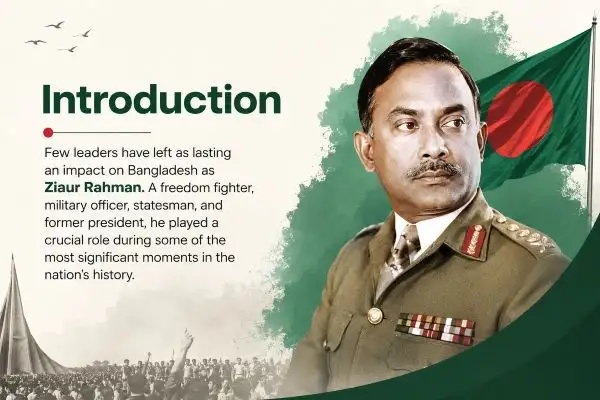
From his involvement in the Bangladesh Liberation War to his efforts to strengthen the economy and establish a new political direction for the country, his influence continues to be felt decades after his death.
Ziaur Rahman remains a prominent figure in discussions about Bangladesh’s political development, national identity, and economic progress. His supporters remember him as a visionary leader who focused on self-reliance, rural development, and national unity.
Historians continue to study his policies and leadership style, while political analysts often debate his legacy and long-term impact.
This article explores 15 historic facts about Ziaur Rahman, offering an in-depth look at his life, achievements, leadership, and lasting influence on Bangladesh.
Who Was Ziaur Rahman?
Ziaur Rahman was a prominent military officer, freedom fighter, and political leader who became one of the most influential figures in Bangladesh’s modern history. He served as the President of Bangladesh from 1977 to 1981 and played a major role in shaping the country’s political direction during a critical period after independence.
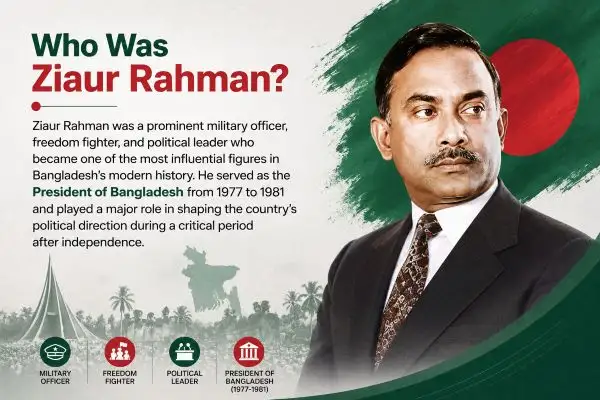
He is also the founder of the Bangladesh Nationalist Party (BNP), one of the largest and most influential political parties in the country.Known for his disciplined leadership style, strong decision-making ability, and focus on national development, Ziaur Rahman rose to prominence during a time of political uncertainty.
His journey from a young military cadet to the head of state reflects determination, strategic leadership, and a deep commitment to national progress. His legacy continues to influence Bangladesh’s political landscape and remains an important subject in discussions about the nation’s history and development.
Fact 1: Ziaur Rahman Was Born in the British Colonial Era
Ziaur Rahman was born on January 19, 1936, in Bagbari village of Bogra district, during the era when the Indian subcontinent was still under British colonial rule. Growing up in this politically charged environment exposed him early to ideas of independence, national identity, and governance.

These formative years played an important role in shaping his thinking and future leadership direction. His family placed strong emphasis on education, discipline, and moral values, which helped build his strong character.
These early influences later became the foundation of his military discipline and political leadership style, guiding him throughout his journey as a national figure in Bangladesh’s history.
Fact 2: He Chose a Military Career at a Young Age
Unlike many future political leaders who begin their journey in politics, Ziaur Rahman initially dedicated his life to military service. After completing his early education, he joined the Pakistan Military Academy, where he underwent strict and highly disciplined military training.
During this period, he demonstrated strong dedication, professionalism, and natural leadership qualities that quickly earned him respect among his peers and superiors. His time in the military helped him develop critical skills in strategic planning, crisis management, decision-making under pressure, and disciplined leadership.
This strong military foundation later played a vital role in shaping his leadership style during Bangladesh’s Liberation War and his political career.
Fact 3: He Witnessed Political Inequality Firsthand
Before the independence of Bangladesh, East Pakistan experienced significant political, economic, and administrative discrimination compared to West Pakistan.
Although East Pakistan had a larger population, many important government positions, development projects, and national resources were concentrated in the western region. As a Bengaliofficer in the Pakistan Army, Ziaur Rahman directly observed these inequalities and the growing frustration among the people of East Pakistan.
Witnessing the lack of fair representation and economic opportunities strengthened his awareness of Bengali rights and self-determination. These longstanding grievances eventually fueled the mass movement for autonomy and played a major role in the struggle that led to the birth of independent Bangladesh in 1971.
Fact 4: He Played a Key Role in the Liberation War
The 1971 Bangladesh Liberation War remains one of the most important and deeply emotional chapters in the country’s history.When the conflict began, Ziaur Rahman actively joined the struggle for independence and quickly emerged as a significant military leader.
He played an important role in organizing resistance fighters, planning operations, and coordinating guerrilla warfare against Pakistani forces. His leadership helped strengthen the morale and structure of the freedom movement during a time of intense crisis.
Through courage, discipline, and strategic thinking, he earned deep respect from fellow fighters and civilians. His contribution remains a key part of Bangladesh’s independence story.
Fact 5: His Radio Announcement Inspired the Nation
One of the most historic and widely remembered moments in Ziaur Rahman’s life occurred during the early days of the Bangladesh Liberation War.
Through a radio broadcast from the Kalurghat station in Chattogram, he announced the declaration of Bangladesh’s independence on behalf of Bangabandhu Sheikh Mujibur Rahman.
At a time when fear, confusion, and uncertainty were spreading across the nation, this powerful message brought hope and direction to millions of people.
It inspired freedom fighters and civilians alike to join the independence struggle. This broadcast remains a defining moment in Bangladesh’s history and national awakening.
Fact 6: He Served as a Sector Commander
During the Bangladesh Liberation War of 1971, Ziaur Rahman served as a sector commander, a crucial leadership position within the resistance forces. In this role, he was responsible for organizing fighters, planning military strategies, coordinating operations, and maintaining communication across liberated areas.
His leadership helped strengthen the effectiveness of guerrilla warfare against opposing forces. As a sector commander, he demonstrated discipline, strategic thinking, and courage under pressure.
This position significantly contributed to his reputation as a capable military leader and played an important role in the success of Bangladesh’s independence movement.
His responsibilities included:
- Coordinating military operations
- Organizing resistance fighters
- Planning strategic attacks
- Strengthening communication networks
- Supporting guerrilla warfare efforts
His leadership helped improve military effectiveness and contributed to the success of the liberation movement.
Fact 7: He Continued Serving After Independence
After Bangladesh achieved victory in December 1971, Ziaur Rahman continued his service in the newly independent nation through the military. The country was facing severe post-war challenges, including destroyed infrastructure, disrupted economic systems, and weakened national institutions.
During this rebuilding phase, he contributed to strengthening the armed forces and supporting national stability efforts. His direct involvement in post-independence recovery helped him gain deeper insight into governance, development priorities, and administrative needs.
These experiences later influenced his leadership vision and policy decisions aimed at rebuilding and modernizing Bangladesh.
Fact 8: He Emerged in a Time of Political Instability and Change
The period after Bangladesh’s independence was highly unstable, marked by rapid political shifts, economic challenges, and leadership crises.
The situation became even more complex following the assassination of Bangabandhu Sheikh Mujibur Rahman in 1975, which created a power vacuum and widespread uncertainty across the nation. During this turbulent phase, Ziaur Rahman gradually emerged as a strong and influential figure in national politics.
His disciplined leadership, military background, and ability to manage crisis situations helped him gain trust and authority. By carefully navigating the complex political environment, he rose to a central position in Bangladesh’s leadership structure during one of its most critical historical periods.
Fact 9: He Assumed the Presidency of Bangladesh
In 1977, Ziaur Rahman officially assumed the office of President of Bangladesh, marking a major turning point in the country’s political history. As president, he focused on restoring political stability, rebuilding public trust, and strengthening state institutions that had been weakened during years of turmoil.
His leadership emphasized national unity, disciplined governance, and economic recovery. Ziaur Rahman also worked to improve administrative efficiency and encourage development programs across rural and urban areas.
His presidency played a key role in guiding Bangladesh toward a more structured political and economic system during a critical period of nation-building.
His administration prioritized:
- Economic development
- Administrative reform
- Rural advancement
- Agricultural productivity
- National unity
These priorities reflected his belief that practical progress was essential for the country’s future.
Fact 10: He Founded the Bangladesh Nationalist Party (BNP)
One of Ziaur Rahman’s most significant political achievements was the founding of the Bangladesh Nationalist Party (BNP) in 1978. He established the party with the aim of uniting people from different social, professional, and ideological backgrounds under a common national vision.
The BNP emphasized Bangladeshi nationalism, democratic values, economic development, and social progress. It quickly became one of the most influential political forces in the country.
Through this initiative, Ziaur Rahman reshaped Bangladesh’s political landscape and introduced a new platform for national unity, governance, and long-term political participation.
The party emphasized:
- National sovereignty
- Democratic participation
- Economic growth
- Social development
- National identity
The BNP continues to play a major role in Bangladesh’s political landscape today.
Fact 11: He Focused on Rural Development
Ziaur Rahman strongly believed that the true progress of Bangladesh depended on strengthening its rural communities, where the majority of the population lived. His government introduced several development programs aimed at improving living standards outside major cities.
These initiatives focused on building rural infrastructure, expanding access to education and healthcare, creating employment opportunities, and supporting local governance systems. By prioritizing village-level development, he aimed to reduce the urban–rural gap and promote balanced national growth.
His rural development vision played an important role in shaping long-term socio-economic improvement across Bangladesh.
Key initiatives included:
- Rural infrastructure projects
- Community development programs
- Agricultural support
- Employment opportunities
- Local governance improvements
These efforts aimed to reduce poverty and improve quality of life across the country.
Fact 12: He Encouraged Agricultural Modernization
Agriculture was the backbone of Bangladesh’s economy during the late 1970s, supporting the majority of the population. Recognizing its critical importance, Ziaur Rahman introduced and supported policies aimed at improving productivity, efficiency, and sustainability in farming practices.
His administration encouraged the use of better irrigation systems, improved seed varieties, and modern farming techniques to boost crop yields. These efforts helped strengthen food security and reduce rural poverty.
By focusing on agricultural modernization, he aimed to build a more self-reliant economy and improve living standards for farmers across Bangladesh during a crucial period of national development.
His administration promoted:
- Modern farming techniques
- Improved irrigation systems
- Better seed varieties
- Agricultural financing programs
These initiatives contributed to increased food production and greater economic stability.
Fact 13: He Supported Economic Growth Through Private Enterprise
Unlike earlier state-controlled economic models, Ziaur Rahman placed strong emphasis on encouraging private sector participation in Bangladesh’s economy. His government introduced policies aimed at promoting entrepreneurship, attracting investment, and supporting small and large business development.
By reducing certain barriers to private enterprise, he helped create a more business-friendly environment that encouraged innovation and job creation. Supporters believe these reforms played an important role in stimulating economic activity during a challenging national period.
His focus on economic diversification also helped reduce overdependence on traditional sectors, laying the foundation for broader long-term economic growth and development in Bangladesh.
Fact 14: He Strengthened Bangladesh’s Global Relationships
Ziaur Rahman recognized early on that strong international cooperation was essential for Bangladesh’s development and economic growth. During his presidency, he actively worked to expand diplomatic ties with countries across Asia, the Middle East, Europe, and other regions.
His foreign policy focused on building mutual respect, increasing trade opportunities, and attracting foreign investment to support national progress.
By strengthening Bangladesh’s global presence, he helped the country gain recognition on the international stage and opened new doors for economic collaboration, diplomatic partnerships, and long-term development opportunities that benefited the nation.
His foreign policy goals included:
- Increasing trade opportunities
- Attracting foreign investment
- Enhancing diplomatic cooperation
- Expanding Bangladesh’s global presence
These efforts helped strengthen the country’s position in the international community.
Fact 15: His Legacy Continues to Influence Bangladesh
More than four decades after his death, Ziaur Rahman continues to remain a highly influential figure in Bangladesh’s political and historical landscape. His leadership style, nation-building efforts, and role in shaping modern political movements are still widely discussed and analyzed.
Supporters credit him with promoting national identity, economic development, and rural progress, while historians continue to study his policies and long-term impact.
His legacy lives on through political discourse, academic research, and public memory, making him one of the most talked-about leaders in Bangladesh’s modern history even today.
His influence can still be seen in:
- National political discussions
- Economic development strategies
- Historical research
- Public policy debates
- The continued activities of BNP
Supporters view him as a leader who promoted self-reliance and development, while scholars continue to analyze his contributions and decisions.
Regardless of political perspective, his impact on Bangladesh remains substantial.
The Assassination of Ziaur Rahman
On May 30, 1981, Ziaur Rahman was assassinated in Chattogram during a failed military uprising, an event that deeply shocked the entire nation. His sudden death created widespread grief, confusion, and political instability across Bangladesh.
At that time, the country was already facing a sensitive and transitional political environment, and his assassination marked a major turning point in its history.
In the aftermath, Bangladesh experienced significant political changes and uncertainty that influenced the direction of national governance for years to come. Despite his tragic end, Ziaur Rahman’s contributions as a freedom fighter, military leader, and president continued to shape public memory.
His legacy remains deeply embedded in Bangladesh’s political narrative, making him one of the most influential and widely discussed leaders in the nation’s modern history.
Ziaur Rahman’s Lasting Legacy
Ziaur Rahman’s lasting legacy extends beyond politics, influencing Bangladesh’s national identity, development vision, and public discourse. His leadership continues to inspire debate, research, and reflection on the country’s historical and political journey.
His contributions are remembered through:
- His role in the Liberation War
- His efforts to strengthen the economy
- His focus on rural development
- His commitment to national identity
- His influence on Bangladesh’s political system
Many of the debates surrounding his leadership continue today, demonstrating the enduring relevance of his life and work.
Conclusion
Ziaur Rahman’s remarkable journey from a dedicated military officer to the President of Bangladesh stands as one of the most significant and inspiring stories in the nation’s modern history.
His leadership during the 1971 Liberation War, his role in rebuilding the country after independence, and his efforts to shape national politics continue to be widely discussed by historians, researchers, and the general public.
Through his initiatives in economic reform, rural development, and national governance, he left a lasting impact on Bangladesh’s development path. Whether seen as a freedom fighter, a statesman, or a political reformer, Ziaur Rahman remains a central figure in the country’s history.
Studying his life provides deeper understanding of Bangladesh’s political evolution and its ongoing journey toward progress, stability, and national growth.
FAQ: Ziaur Rahman
1. Who was Ziaur Rahman?
Ziaur Rahman was a Bangladeshi military officer, freedom fighter, and politician. He served as the President of Bangladesh from 1977 to 1981 and founded the Bangladesh Nationalist Party (BNP).
2. What is Ziaur Rahman famous for?
He is famous for his role in the 1971 Bangladesh Liberation War, his presidency, and founding the BNP. He is also recognized for introducing economic reforms and advancing rural development initiatives.
3. What was Ziaur Rahman’s role in the Liberation War?
Ziaur Rahman played a key military role as a sector commander and helped organize resistance forces against Pakistani troops during the 1971 war.
4. When did Ziaur Rahman become President of Bangladesh?
He became the President of Bangladesh in 1977 and served until his assassination in 1981.
5. Who founded the Bangladesh Nationalist Party (BNP)?
Ziaur Rahman founded the Bangladesh Nationalist Party (BNP) in 1978 to promote nationalism, development, and democracy.
6. How did Ziaur Rahman die?
He was assassinated on May 30, 1981, in Chattogram during a military uprising.
7. Why is Ziaur Rahman important in Bangladesh history?
He is important for his leadership during the Liberation War, his presidency, and his efforts in shaping Bangladesh’s political and economic direction.
8. What is Ziaur Rahman’s legacy?
His legacy includes national leadership, economic reforms, rural development initiatives, and establishing one of Bangladesh’s major political parties.