
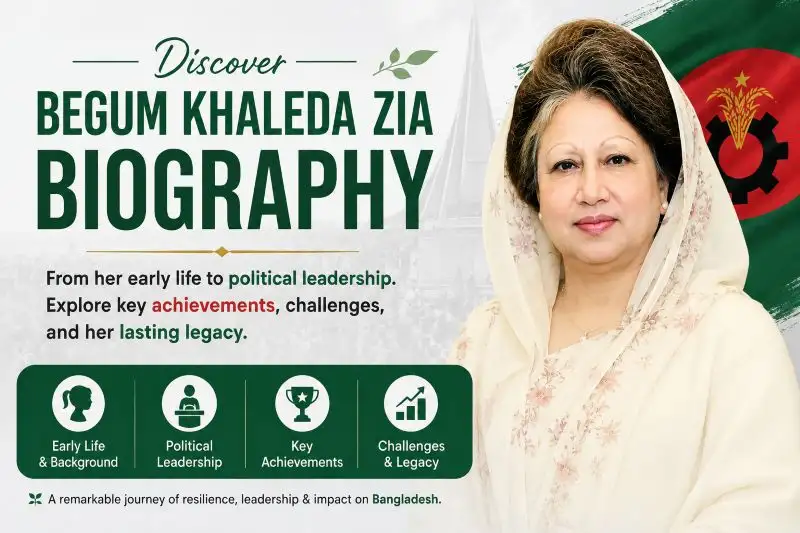
Discover Begum Khaleda Zia Biography, from her early life to political leadership. Explore key achievements, challenges, and her lasting legacy.
Introduction
The story of Begum Khaleda Zia is deeply connected to the political history of Bangladesh. As the country’s first female Prime Minister and one of the most influential political leaders in South Asia, she has played a significant role in shaping the nation’s democratic journey.
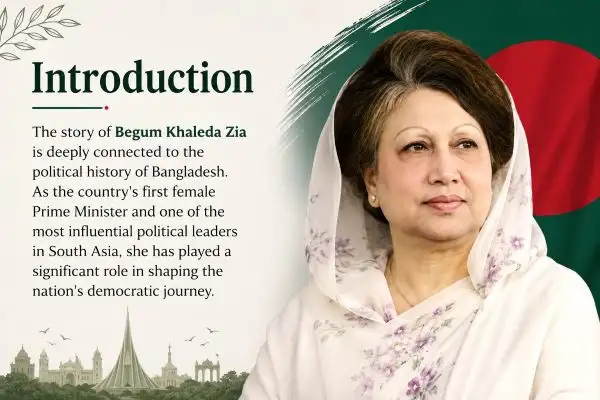
Her life is a remarkable combination of personal resilience, political determination, leadership, and public service.For decades, Khaleda Zia remained a central figure in Bangladesh’s political landscape.
Supporters admire her contributions to democracy and national development, while critics often debate her political decisions and policies. Regardless of political opinion, her impact on Bangladesh is undeniable.
This comprehensive Begum Khaleda Zia Biography explores her early life, family background, education, political rise, achievements, challenges, leadership style, and enduring legacy.
Whether you are a student, researcher, or someone interested in Bangladeshi politics, this detailed guide provides valuable insight into one of the country’s most important political figures.
Fact 1: Khaleda Zia Was Born Into a Respected Family
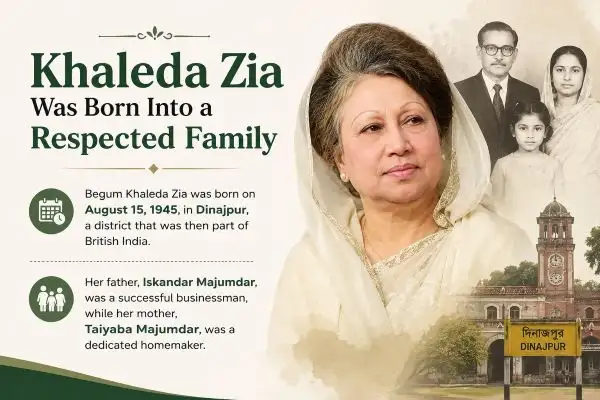
Begum Khaleda Zia was born on August 15, 1945, in Dinajpur, a district that was then part of British India. Her father, Iskandar Majumdar, was a successful businessman, while her mother, Taiyaba Majumdar, was a dedicated homemaker.
She spent her childhood in a traditional family environment where education and discipline were highly valued. Unlike many politicians who entered public life at an early age, Khaleda Zia lived a relatively private life during her youth.
Her early education took place in Dinajpur, where she attended local schools before continuing her studies at Surendranath College. During these years, there was little indication that she would eventually become one of the most powerful political leaders in Bangladesh.
The values she learned during her childhood—including perseverance, responsibility, and commitment to family—would later influence her approach to leadership and public service.
Fact 2: Her Marriage to Ziaur Rahman Changed Her Life
One of the most defining moments in Begum Khaleda Zia’s life was her marriage to Ziaur Rahman in 1959. At that time, Ziaur Rahman was serving as a military officer, who later became one of the most influential leaders in Bangladesh’s history.

After the country’s independence in 1971, he rose to national prominence and eventually became the President of Bangladesh.Despite being closely connected to a major political figure, Khaleda Zia initially remained away from active politics.
During her early life, she primarily devoted herself to family duties, caring for her children, and assisting her husband in his professional and political endeavors. Her life during this period was largely private and centered around domestic roles.
This phase of her life later became important in shaping her political identity, as her transition from a family-focused role to national leadership marked a significant transformation in the Begum Khaleda Zia Biography.
The couple had two sons:
- Tarique Rahman
- Arafat Rahman Koko
Their family life remained relatively private compared to the intense political attention that would later surround them.
Fact 3: The Assassination of Ziaur Rahman Marked Her Entry into Politics
The assassination of President Ziaur Rahman in 1981 marked a major turning point in Begum Khaleda Zia’s life and the political history of Bangladesh.
His sudden and tragic death deeply shocked the nation and created a significant leadership vacuum within the Bangladesh Nationalist Party (BNP). At that time, Khaleda Zia was largely focused on her family life and had little involvement in active politics.
However, after the incident, many BNP leaders and supporters encouraged her to step forward as a unifying figure who could continue her late husband’s political vision. Gradually, she accepted a more active role in party affairs and began engaging with political activities.
Her entry into politics was not immediate, but over time she emerged as a strong and influential leader. This transition marked the beginning of her long political journey, which eventually established her as one of the most powerful figures in Bangladesh’s modern political landscape.
Fact 4: She Became Chairperson of BNP
In 1984, Begum Khaleda Zia officially assumed leadership as the Chairperson of the Bangladesh Nationalist Party (BNP), marking a major turning point in her political journey.
At that time, Bangladesh was under the military-led government of President Hussain Muhammad Ershad, where political freedom was limited and opposition parties were actively demanding democratic reforms and fair elections.
Under Khaleda Zia’s leadership, BNP experienced significant organizational growth and became one of the strongest political parties in the country. She worked tirelessly to strengthen party structure at the grassroots level, expand its influence, and build stronger connections with people from different regions of Bangladesh.
She traveled extensively across the nation, engaging with citizens and mobilizing public support. Her leadership style focused on unity, discipline, and mass communication, which helped consolidate BNP’s position in national politics. This period established her as a powerful political leader with growing national influence.
Fact 5: She Played a Major Role in Restoring Democracy
One of the most important highlights in any Begum Khaleda Zia Biography is her significant contribution to the restoration of democracy in Bangladesh. During the 1980s, the country was under military rule, and opposition political parties launched strong nationwide movements demanding the return of democratic governance.
Khaleda Zia emerged as one of the leading political figures who actively supported these democratic struggles and called for free elections and constitutional rule.
She took part in numerous political rallies, campaigns, and public protests aimed at ending authoritarian control. Throughout this period, she faced arrests, political pressure, and restrictions, yet continued her activism with determination and resilience.
These combined efforts of the opposition movement eventually led to the fall of the Ershad regime in 1990. This historic transition opened the door for democratic elections and the restoration of parliamentary democracy in Bangladesh.
Political analysts widely regard this period as one of the most defining and influential phases of her leadership journey and political legacy.
Fact 6: Khaleda Zia Became Bangladesh’s First Female Prime Minister
The 1991 general election marked a historic turning point in Bangladesh’s political history. Following the victory of the Bangladesh Nationalist Party (BNP), Begum Khaleda Zia became the first female Prime Minister of Bangladesh.
This achievement was not only a national milestone but also a significant moment for women’s leadership in South Asia.
Her rise to the highest executive office demonstrated a major shift in political participation and representation of women in governance. It inspired many women to become involved in politics and public service.
In the Begum Khaleda Zia Biography, this moment is considered one of her most defining achievements, symbolizing leadership, progress, and breaking traditional barriers in South Asian political history.
As Prime Minister, she focused on several key areas:
Education Development
Her government prioritized education development by increasing school enrollment and supporting female education programs. These initiatives improved literacy rates and expanded access to learning opportunities across Bangladesh.
Education Development
Her government prioritized education development by increasing school enrollment and supporting female education programs. These initiatives improved literacy rates and expanded access to learning opportunities across Bangladesh.
Economic Reform
Her government introduced economic reforms supporting private-sector investment and market growth. These policies helped modernize industries, create jobs, and strengthen Bangladesh’s overall economic development and financial stability.
Infrastructure Improvements
Her government focused on improving infrastructure by expanding roads, communication networks, and public facilities across Bangladesh. These development projects supported national progress and enhanced connectivity.
Her first term as Prime Minister strengthened her reputation as an effective leader and increased her political influence in Bangladesh’s national governance and development.
Fact 7: She Served as Prime Minister Twice
Begum Khaleda Zia is one of the few leaders in Bangladesh who served as Prime Minister on two separate occasions, marking a significant achievement in her political career.
After completing her first tenure in the 1990s, she returned to power following the Bangladesh Nationalist Party (BNP) victory in the 2001 general election. This second term strengthened her position as a major national leader and highlighted her continued influence in Bangladeshi politics.
During her leadership, her government focused on economic growth, infrastructure development, education expansion, and strengthening international relations. Policies were also introduced to support industrial progress and poverty reduction.
Her two-term leadership played an important role in shaping Bangladesh’s modern political system and governance structure, making her a central figure in the country’s political history and the Begum Khaleda Zia Biography.
Her second administration focused on:
- Economic development
- Poverty reduction
- Infrastructure modernization
- Educational expansion
- International cooperation
During this period, Bangladesh experienced economic progress and increased global engagement.
However, the government also faced criticism from opponents regarding governance issues, political tensions, and security challenges.
Despite differing opinions, her second term remains one of the most discussed periods in modern Bangladeshi political history.
Fact 8: Her Political Career Faced Significant Challenges
No Begum Khaleda Zia Biography is complete without acknowledging the numerous challenges she faced throughout her long political journey. Bangladesh’s political environment has often been highly competitive, emotionally charged, and deeply polarized, with strong rivalries between major political parties.
During her career, Khaleda Zia encountered intense opposition, political controversies, electoral disputes, and periods of national instability that tested her leadership and resilience.
After completing her tenure as Prime Minister, she became involved in several legal cases and court proceedings that received widespread attention both nationally and internationally. These legal matters became a central topic in Bangladesh’s political discourse and media coverage.
Her supporters often argue that many of these cases were influenced by political motivations, while critics maintain that they reflect the importance of legal accountability and governance standards. Regardless of differing opinions, these events played a major role in shaping debates about democracy, justice, and political competition in Bangladesh’s modern history.
Fact 9: Her Legacy Continues to Influence Bangladesh
Even after decades in public life, Begum Khaleda Zia remains one of the most recognizable and influential figures in Bangladesh’s political history.
Her leadership of the Bangladesh Nationalist Party (BNP), two terms as Prime Minister, and long participation in national politics have left a lasting impact on the country’s democratic development. She is widely associated with political resilience, leadership strength, and Bangladesh’s evolving electoral system.
Her legacy continues to shape political discussions, public opinion, and historical analysis in Bangladesh. Supporters view her as a symbol of determination and democratic struggle, while analysts recognize her role in shaping modern governance.
The Begum Khaleda Zia Biography remains highly searched, reflecting her enduring relevance and lasting influence on South Asian political history.
Her influence extends beyond electoral politics. She is widely associated with:
- Democratic movements
- Women’s political leadership
- National development initiatives
- BNP’s organizational growth
- Bangladesh’s modern political history
For supporters, she symbolizes resilience and commitment to democratic values. For historians and political observers, she represents one of the key personalities who shaped Bangladesh’s post-independence political evolution.
Her legacy continues to influence political discussions, party strategies, and debates about the future direction of the country.
Leadership Style of Khaleda Zia
Throughout her long political career, Begum Khaleda Zia built a strong reputation for determination, resilience, and persistence in the face of political challenges. She is often described as a leader who remained firm on her principles and committed to her party’s ideology, even during difficult national crises and intense political competition.
Her leadership style focused on maintaining party unity, mobilizing grassroots support, and strengthening the organizational structure of the Bangladesh Nationalist Party (BNP).
Khaleda Zia is also known for her bold decision-making approach and ability to lead during periods of uncertainty. Despite facing criticism and political pressure, she consistently played a central role in Bangladesh’s political movements and democratic transitions.
Her leadership continues to be discussed as an important example of strong political influence in South Asian politics and Bangladesh’s democratic history.
Key characteristics of her leadership style included:
- Strong decision-making
- Political resilience
- Organizational discipline
- Focus on party unity
- Commitment to democratic participation
These qualities helped her maintain leadership within BNP for many years despite numerous political challenges.
Major Achievements of Begum Khaleda Zia
Begum Khaleda Zia’s major achievements include becoming the first female Prime Minister of Bangladesh and leading the country in two separate terms. She played a key role in strengthening parliamentary democracy, promoting women’s education, and supporting economic reforms.
Her leadership also contributed to infrastructure development and international diplomacy, making her one of the most influential figures in Bangladesh’s political history and a prominent leader in South Asian politics.
Some of her most notable achievements include:
First Female Prime Minister of Bangladesh
Begum Khaleda Zia created history as Bangladesh’s first woman Prime Minister, overcoming significant barriers in South Asian political leadership. She became a pioneering symbol of women’s leadership, inspiring future generations to participate in public service, governance, and national decision-making roles across the country.
Contribution to Democratic Reform
Begum Khaleda Zia played a significant role in Bangladesh’s pro-democracy movements, actively supporting the restoration of parliamentary governance.
Her leadership and political activism helped strengthen democratic institutions and contributed to the transition from military rule to a more representative political system in Bangladesh’s modern political history.
Expansion of Education
During Begum Khaleda Zia’s leadership, government initiatives focused on expanding access to education across Bangladesh. Her administration supported increased school enrollment, especially for girls, and promoted policies that improved literacy rates.
These initiatives enabled millions of students to access improved learning opportunities and supported overall national development progress.
Economic Development
Under Begum Khaleda Zia’s leadership, policies encouraging private sector investment and market-oriented reforms helped stimulate Bangladesh’s economic growth.
Her government concentrated on industrial expansion, employment creation, and trade development, which played a key role in reinforcing economic stability and national growth.
International Representation
Begum Khaleda Zia played an active role in strengthening Bangladesh’s international relations through diplomatic engagement with various countries and global organizations.
Her leadership helped improve foreign cooperation, enhance bilateral ties, and promote Bangladesh’s presence on the world stage, contributing to stronger global recognition of the nation.
Interesting Facts About Khaleda Zia
- She served as Prime Minister during two separate periods.
- She led BNP for decades.
- She became politically active after her husband’s assassination.
- She was the first woman to become Prime Minister of Bangladesh.
- She continues to hold an important place among the most recognized and influential political leaders in Bangladesh’s history.
- Her involvement in politics has extended for over four decades, making her one of Bangladesh’s longest-serving political leaders.
- She played a major role in anti-military-rule movements.
- She helped strengthen parliamentary democracy.
- Her life story continues to inspire political discussions across Bangladesh.
Conclusion
The story of Begum Khaleda Zia is one of leadership, perseverance, and political significance. From her early years in Dinajpur to becoming Bangladesh’s first female Prime Minister, her journey reflects the challenges and opportunities that shaped modern Bangladesh.
Her contributions to democracy, governance, education, and national development have secured her place in the country’s history. While opinions about her policies may differ, there is little doubt that Khaleda Zia remains one of the most important political figures Bangladesh has ever produced.
As upcoming generations explore the development of Bangladesh’s political landscape, the journey and contributions of Begum Khaleda Zia will continue to serve as a significant part of the nation’s historical narrative.
FAQ: Begum Khaleda Zia Biography
1. Who is Begum Khaleda Zia?
Begum Khaleda Zia is one of the most influential figures in Bangladesh’s political history, serving as a former Prime Minister and playing a pivotal role in the country’s democratic journey. She is also the Chairperson of the Bangladesh Nationalist Party (BNP).
2. Why is Begum Khaleda Zia famous?
She is famous for being the first female Prime Minister of Bangladesh and for her long political career in shaping the country’s democratic system.
3. When did Khaleda Zia become Prime Minister?
She first became Prime Minister in 1991 after BNP won the general election and later served a second term in 2001.
4. What is Begum Khaleda Zia’s political party?
She is the leader of the Bangladesh Nationalist Party (BNP), one of the major political parties in Bangladesh.
5. What are Khaleda Zia’s major achievements?
Her achievements include strengthening democracy, promoting education, supporting economic reforms, and improving infrastructure development in Bangladesh.
6. Who was Khaleda Zia’s husband?
She was married to Ziaur Rahman, the former President of Bangladesh and a key political figure in the country’s history.
7. What challenges did Khaleda Zia face?
She faced political opposition, legal cases, electoral challenges, and periods of imprisonment during her political career.
8. What is Khaleda Zia’s legacy?
Her legacy includes her role in Bangladesh’s democratic development and her influence as one of the most powerful political leaders in the country.
9. Why is Khaleda Zia important in Bangladesh history?
She is important because she was the first female Prime Minister and played a major role in shaping modern Bangladeshi politics and governance.
10. What is the full name of Begum Khaleda Zia?
Her full name is Begum Khaleda Zia, widely known as a leading figure in Bangladesh’s political history.